Mediterranean spearfish
Tetrapturus belone · Istiophoridae
- Saltwater
- Big pelagics
- Medium
- Regulated
- Size
200–240 cm
- Weight
75–70 kg
- Depth
0–200 m
Where to fish
- Offshore
Habitat icons: Flaticon
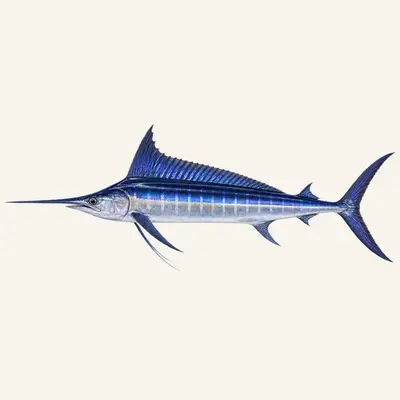
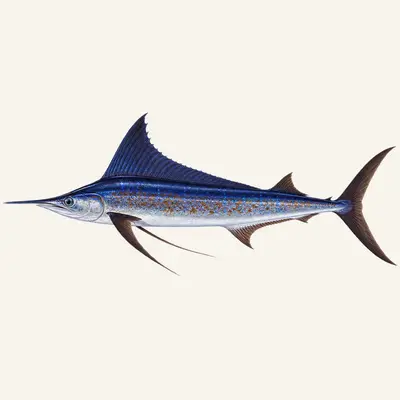
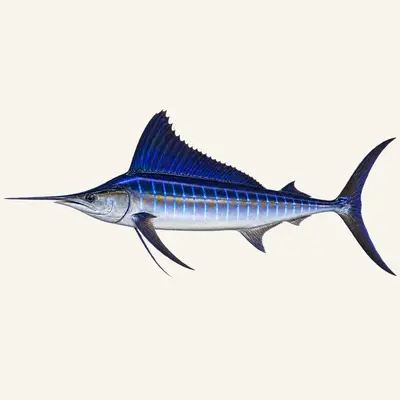
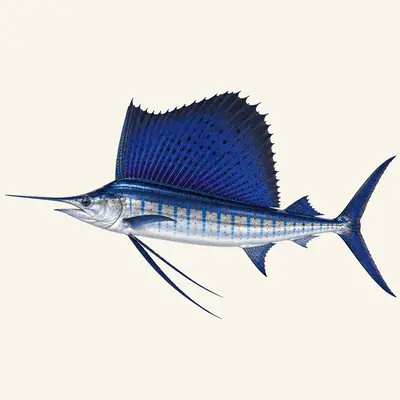
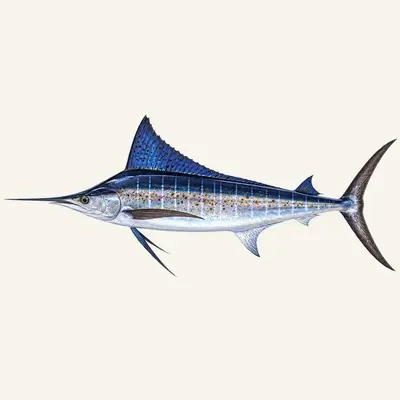
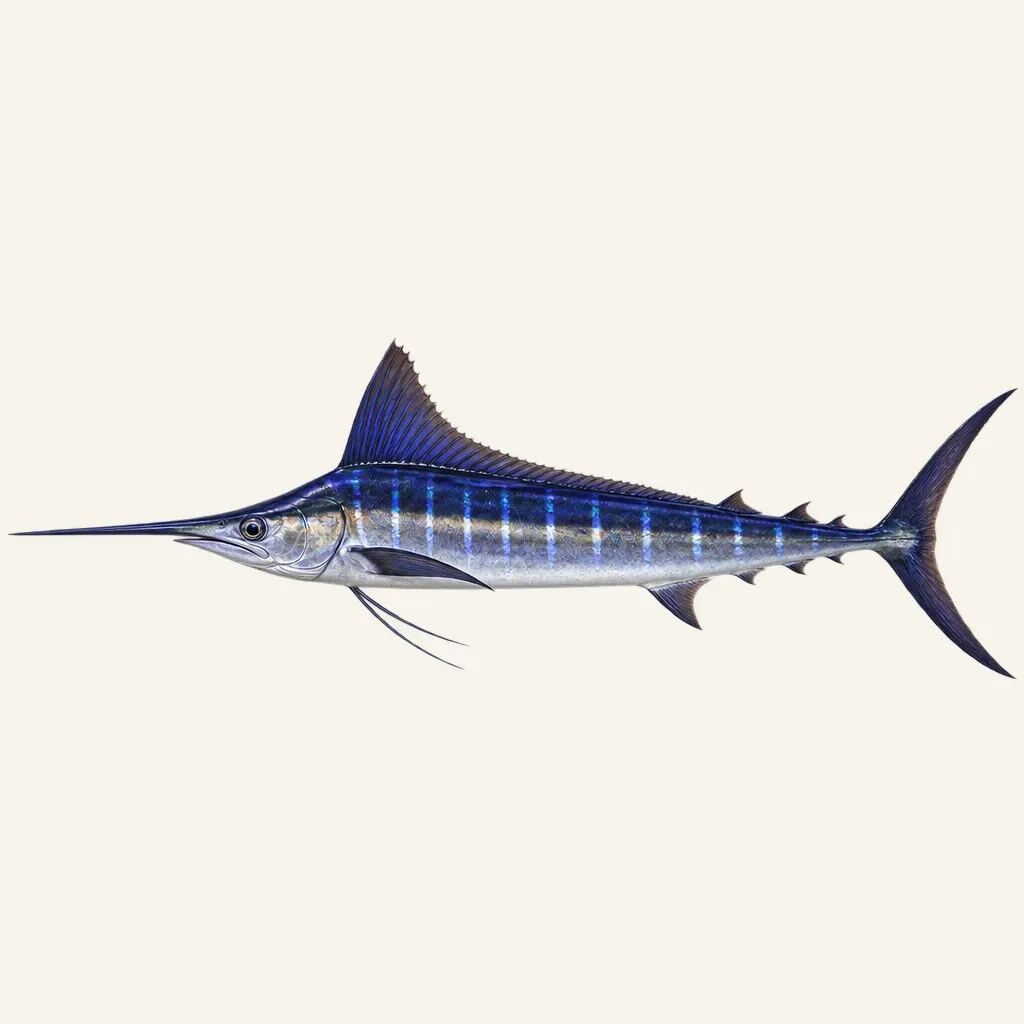
The Mediterranean spearfish is the only billfish found in the Mediterranean, a semi-enclosed sea, making it a remarkable species among billfishes. Smaller than the blue marlin, it has an elongated body and a slender bill, inhabiting the open pelagic waters of the Mediterranean basin.
Calendar
Its range
One sea contains the entire species. This spearfish completes its life cycle inside the Mediterranean as far as anyone knows today, and it is the only billfish of which that can be said. The 46 degrees north and 6 degrees west that bound its range are not the limits of an ocean but the corners of a closed basin.
Inside it, density is very uneven. The central basin concentrates the species, which is considered abundant around Italy. Eastwards the record thins out abruptly: no adult has been reported beyond the Ionian Sea, although captures have been recorded from the Aegean. The Black Sea yields no confirmed report at all.
That asymmetry is probably an asymmetry of observation. The source suggests as much itself: the fish is likely to be more widespread in the Mediterranean than the registers show, and eastern captures may have been logged under another name.
Breeding
The spawning season of this spearfish is not established. The only proposal in the literature is winter and spring, and it is offered as a hypothesis that would not be unreasonable to entertain — a formulation that states precisely how much is known.
The admission is remarkable. The fish lives in a sea ringed by countries that maintain fleets and research institutes, it carries out its whole cycle there, and the month in which it breeds remains a conjecture. No spawning ground is described, no fecundity figure exists, and no size at first maturity has been established.
The water it needs
It holds the upper part of the water column, in the first 200 metres, generally above the thermocline or within it. The conditional used by the sources is worth preserving: that bathymetry is inferred from where the fish was caught, not measured on animals that were followed.
The domain is offshore and deep water, away from the shelves.
Areas
- Central and western Mediterranean
- Deep pelagic waters
- Isolated coastal zones
Techniques
- Surface trolling
- Live bait fishing
- Soft lures
- Deep trolling
Baits
- Rigged anchovies
- Small squid
- Sardines
- Slender vinyl lures
What it eats
It eats fish, and the record says nothing further about the menu.
It does say something about method, and this is the most singular fact about the species: this spearfish travels in pairs. The behaviour is described and attributed to feeding — two animals working the same shoal do better than one. Among fish reputed to be solitary and thinly spread, that is an exception worth knowing about.
How to catch it
Travelling in pairs dictates a precise course of action at the strike. A hooked fish means a second one in the immediate vicinity, so the reflex of clearing the lines to fight works against the crew, and leaving a bait in the water through the fight is the decision that doubles the trip.
The productive sector is the central basin, with Italy as its documented centre. The fishing is done offshore, over deep water, in the first 200 metres — the band worked by trolled baits and by a live fish presented under a float.
A strictly piscivorous diet rules out invertebrate imitations and points to fish, rigged whole or copied.
One practical matter of scale: the species carries only secondary commercial interest, and no organised recreational fishery has been built on it. The technical literature is thin as a result, and the working knowledge of Sicilian and Calabrian crews is worth more than what has been published.
Regulated — Often governed by quotas, size limits, seasons, or reporting rules.
Conservation
A species whose range fits inside an enclosed sea has no external reserve. What the Mediterranean does to this spearfish, it does to the whole species: no Atlantic population will recolonise the basin, and no neighbouring stock will make good a bad decade. That is the exact inverse of the position of the oceanic billfish, whose populations are counted on the scale of a hemisphere.
On top of that sits an identification problem that distorts everything believed about it. The record states that commercial and recreational fishermen may have taken this fish for Tetrapturus albidus, the white marlin of the Atlantic, now generally placed in another genus. Catches of one have therefore been credited to the other, so the Mediterranean fish is under-declared at the same time as the few Atlantic white marlin reported from the basin are very probably individuals of this species.
The result is that nobody knows what is being taken. This is the commonest istiophorid of the central basin, and therefore the one most exposed to Mediterranean fishing effort, and its landings are not counted under its own name.
Regulations
Check the local regulations in force (legal size limits, closed seasons, bag limits).
For guidance only. Legal sizes, quotas and open seasons vary by location and season: always check the local regulations in force before fishing.
Other names
Mediterranean spearfish in English, and most languages name the sea in the same way. Italian is the exception with aguglia imperiale, the imperial needle — the country that fishes it hardest gave it the one name that is not an address.
There is a pattern in that. The other members of the genus were named for their bills, short or long or for the shape of a scale, and this is the only one named for a place, which says something about how little else was available to describe it.
The epithet belone comes from the Greek for a needle. It is also the genus name of the garfish, a slender long-beaked fish with no relation to this one whatever. Older literature places several members of this group under different combinations, and any series of Mediterranean captures has to be read in the knowledge of the white marlin confusion.
Sources: fishbase.se · api.gbif.org