Slender tuna
Allothunnus fallai · Scombridae
- Saltwater
- Big pelagics
- Hard
- Regulated
- Observation
- Size
86–105 cm
- Weight
7.8–14 kg
- Depth
0–20 m
Where to fish
- Offshore
Habitat icons: Flaticon
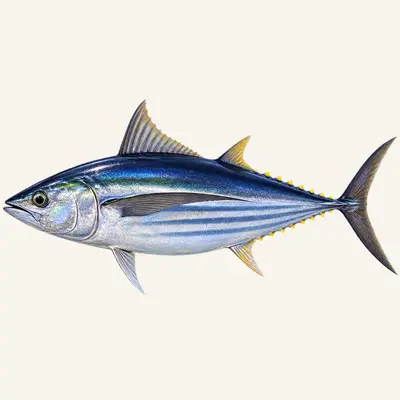
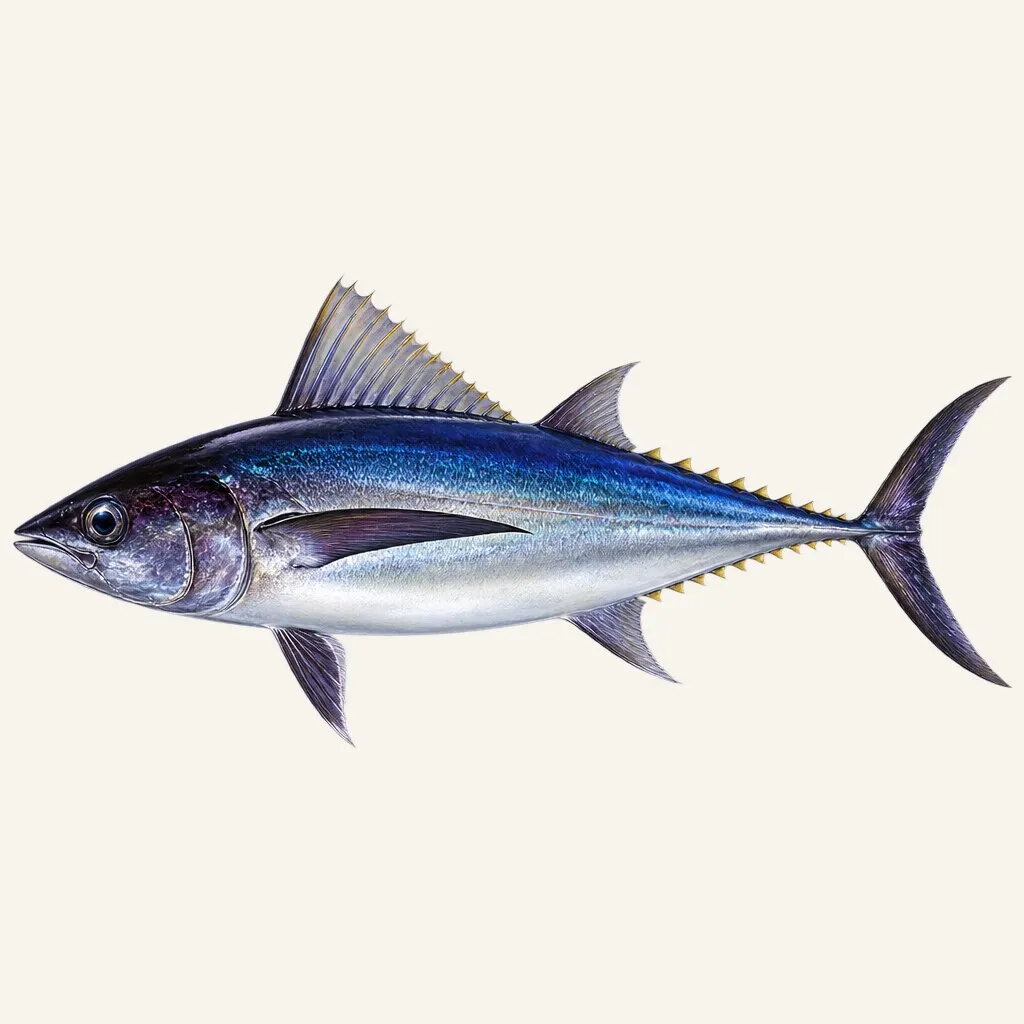
The slender tuna is a pelagic Scombridae of the cold and temperate waters of the southern hemisphere, rare and little studied. Its particularly elongated and slender body, thinner than that of other tunas, gives it its name and easily distinguishes it from its relatives.
Calendar
Recorded in 2 countries
GBIF occurrence records — native and introduced populations combined.
Its range
Circumglobal in the Southern Ocean, between 10 and 50 degrees south, across every longitude there is. The range is a belt: the fish goes all the way round the world without ever leaving a band of latitude about forty degrees wide.
One record sits outside it, and it is worth quoting exactly because of how isolated it is. A single individual was taken in Los Angeles Harbor. One fish, in one commercial port, in the wrong hemisphere — that is the whole of the northern record for the species, and it is a better measure of how tightly the animal keeps to its belt than the belt itself is.
Identifying it
The scales stop at the lateral line. The upper half of the body is covered, the belly behind a long anterior corselet is bare, and the boundary between the two runs along the flank. That arrangement is the first thing to look at on a scombrid brought aboard in this part of the world.
The counts are the second. There are 15 to 18 spines in the dorsal fin, 12 to 13 soft rays behind them, 13 to 14 in the anal, and 40 vertebrae. The interpelvic process between the pelvic fins is small and forked in two. There is no swim bladder.
Colour is plain and its plainness is worth registering. The back is bluish, darkening to deep purple or nearly black over the head. The belly is white, and the published description records it without stripes and without spots. The pectoral and pelvic fins are purple with black inner faces.
A common fish measures 86 cm. Nothing in the record gives a length at first maturity, so there is no way of telling from a measurement whether an individual has bred.
The water it needs
The recorded depth range is nought to 20 m. That is not an abbreviation of a longer list; it is the entire vertical extent of the species as the literature has it.
An animal that circles the planet inside the top twenty metres is living in a film of water rather than a volume of it. The consequences for its ecology are not documented, but the arithmetic is worth holding: whatever this fish needs, it finds in a layer thinner than the draught of the vessels that fish it.
The juveniles are the only life stage the record places precisely, and it places them between 20 and 35 degrees south, where surface temperatures run from 19 to 24 degrees. That is the warm third of the adult range. The species schools occasionally rather than habitually.
Areas
- Offshore temperate waters
- Subantarctic fronts
- Cold water upwelling zones
- Open sea southern hemisphere
Techniques
- Deep trolling
- Diving streamlined lures
- Vertical jigging
- Offshore live bait fishing
Baits
- Baitfish
- Streamlined metal lures
- Artificial squid
- Chrome jigs
What it eats
Krill — euphausiids — are the main food, with squid and small fishes alongside them.
A tuna eating krill is a tuna feeding at a level most of the family reaches only as larvae. Euphausiids are shrimps of a few centimetres, taken in quantity or not at all, and a predator that lives on them is one step nearer the bottom of the food chain than its relatives. It is also working a food that comes in swarms rather than in shoals, which is a different search problem and not a smaller one.
The flesh reflects the difference. The record describes it as paler than that of most true tunas and very oily, with fine eating qualities once cooked, and it is marketed fresh.
How to catch it
The fishery is a minor commercial one and the species counts as a gamefish.
Two facts govern any attempt at it. The first is the depth: with a recorded range ending at 20 m, everything happens at or just under the surface, and nothing about this animal rewards fishing deep. The second is the diet. A predator whose staple is a small shrimp taken in bulk is not searching for a single fleeing baitfish, and the standard scombrid presentation is an argument aimed at the wrong prey.
Occasional schooling rather than habitual schooling completes the picture. This is not a species met in numbers as a rule, so a capture predicts less here than it would for a tuna that shoals as a matter of course.
Regulated — Often governed by quotas, size limits, seasons, or reporting rules.
Observation — Listed among the species, but rare, atypical, or not usually targeted by recreational anglers.
Conservation
What is missing from the record is the finding. There is no reproductive information at all for this species — no season, no fecundity, no length at first maturity, no spawning ground. For an animal of this size in a fished ocean, that is an unusual blank, and it means the state of the population cannot be inferred from the size composition of a catch, because there is no maturity figure to compare it against.
The narrow vertical range compounds it. A species documented only in the top twenty metres has no depth to withdraw into, and every gear that works the surface of the Southern Ocean works the whole of its known habitat at once.
Regulations
Check the local regulations in force (legal size limits, closed seasons, bag limits).
For guidance only. Legal sizes, quotas and open seasons vary by location and season: always check the local regulations in force before fishing.
Other names
Slender tuna in English, and the name describes the build rather than making any claim about the animal's relations.
The genus is the more informative name. Allothunnus means the other tuna — allos, other, prefixed to the name of the genus holding the true tunas. Whoever coined it was recording a fish that belonged in the family without belonging to the group everyone already had a word for, and the flesh comparison in the record makes the same point from the other end, calling it paler than that of most true tunas.
The epithet fallai commemorates a personal name, which is common for large marine species described in the twentieth century.
Sources: fishbase.se · api.gbif.org