Pacific sierra
Scomberomorus sierra · Scombridae
- Saltwater
- Big pelagics
- Medium
- Size
60–99 cm
- Weight
1.0–7.0 kg
- Depth
10–60 m
Where to fish
- Estuary
- Reef
Habitat icons: Flaticon
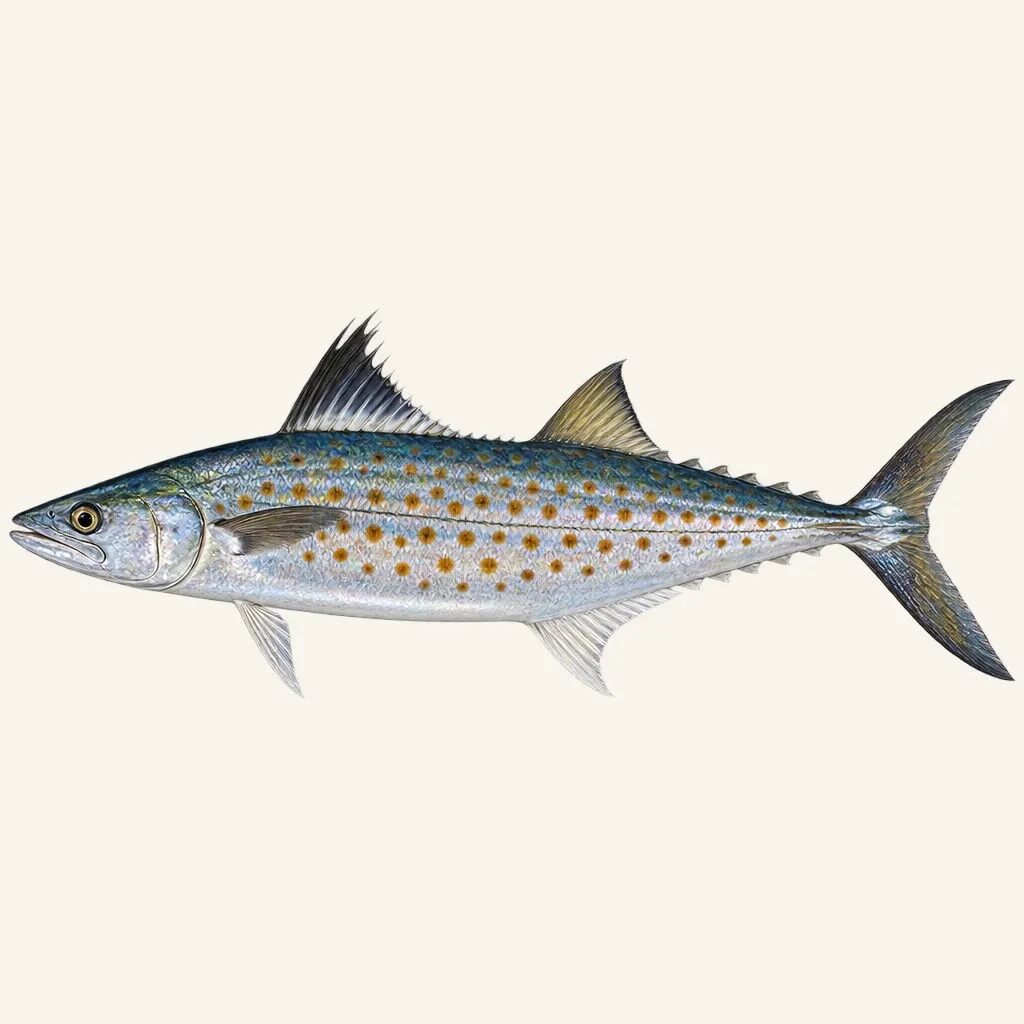
Slender king mackerel of the eastern Pacific, with a silvery body dotted with golden spots, a fast and hard-fighting coastal predator.
Calendar
Its range
Two coordinates describe the range better than any list of places: 33°N to 27°S, and 121°W to 70°W.
Sixty degrees of latitude against fifty-one of longitude sounds balanced until you look at where those meridians fall. They enclose a strip pressed against the American continent, from La Jolla in southern California down to Paita in Peru, with a recent record from Antofagasta in Chile at the far southern end. The Pacific continues west of 121°W for another hundred degrees and more, and none of it belongs to this fish.
The Galápagos mark the offshore corner of the range, and they qualify for a reason that has nothing to do with distance travelled: an island group is a platform, with shelf water around it, and shelf water is the requirement. The species is not crossing ocean to reach them.
Getting this range clear is what eventually separated the species from its Atlantic counterpart, which many authors had treated as the same fish or as its parent species. Two mackerels on two sides of a continent, described from separate literatures, spent a long time sharing one name.
Identifying it
Start with the first dorsal fin, because it is marked the wrong way round. The black is on the outer part of it and the white is at the base — an inversion of the usual arrangement in this group, and one that reads at a glance on a fish held sideways or seen breaking water.
The second dorsal is washed with yellow and edged in black; the anal is white. The pelvic fins are relatively long, which supports an identification made in the water rather than in the hand.
The spots are round and there are a great many of them, three rows of them running above the lateral line along a silver flank. They are orange while the fish is alive and brownish in the published description, which is written from preserved material.
The lateral line curves down towards the tail base gradually, with no step in it anywhere along its length.
Two internal characters and a set of counts finish the job. The intestine has two folds and three limbs, there is no swim bladder, the interpelvic process is small and forked, and small scales cover the body. Vertebrae number 46 to 49; dorsal spines 15 to 18, with 16 to 19 soft rays behind them and 16 to 21 in the anal.
That vertebral figure is the one that matters historically. The Atlantic Spanish mackerel, the species this one was repeatedly folded into, counts 51 to 53. The character that settles a question the literature argued over for decades requires opening the fish and counting bones, which is why the argument lasted.
Breeding
Spawning is believed to happen close to the coast over most of the range, and that closes the life cycle inside a very narrow strip of water. Feeding, growth and reproduction all happen in the same band, with no offshore phase to any part of it.
Maturity is reported from 26 to 32 cm, against a common capture of about 60 cm. The average estimate sits higher, near 44 cm, but on either figure the ordinary fish in a landing has bred. That is the favourable half of the arithmetic and it is worth stating plainly, because the unfavourable half is geographic rather than biological.
The water it needs
Ten to 60 m, and the whole of that depth is used. Adults are recorded both immediately below the surface in coastal water and hard on the bottom out over the shelf, which is a full vertical occupation of a fairly shallow band rather than a preference within it.
The fish shoals, and the shoals travel. They follow concentrations of prey along the shore, through bays, past river mouths and over reef ground where small pelagic fish collect.
Areas
- Mexican Pacific coast
- Gulf of California
- Central American coasts
- Peru and Ecuador
Techniques
- Spin casting
- Light trolling
- Jigging
- Live baiting
Baits
- Metal jigs
- Wobbling spoons
- Swimbaits
- Live sardines
- Anchovies
What it eats
Anchovies above all — Anchoa and Cetengraulis — and clupeids of the genera Odontognathus and Opisthonema.
What those four genera have in common matters more than what they are called. Every one of them is a small silver fish that shoals densely and moves along the coast in response to the same conditions. The predator's distribution problem is therefore identical to the prey's, and locating one solves the other. Searching means reading birds, surface disturbance and water colour, not marking structure on a sounder.
How to catch it
The absence of a swim bladder gives this fishery something almost no other coastal fishery has, and it is worth being precise about what it is.
There is no gas-filled organ to expand on the way up. A fish brought in from 60 m has nothing inside it that has changed volume, arrives at the boat in the condition it left the bottom in, and swims down again when it is put back. Sorting a catch therefore still means something after the fish is in the boat, which is exactly what is not true of most marine species taken at that depth. On a coast where undersized and unwanted fish come aboard constantly, that is a real and usable freedom.
The same anatomy has a cost in the water. With nothing to hold it up, the fish must swim continuously and never settles anywhere. There is no lie to work and no mark to sit over: the day is spent covering water and intercepting a moving mass.
The listed methods follow from that — casting, light trolling, jigging, live bait — and every one of them puts something moving into a layer of water at a speed that leaves no time for inspection. Matching an anchovy or a small sardinella points at narrow metal and slim swimming lures rather than at anything with bulk to it.
The teeth take care of the rest of the rig. An abrasion-resistant trace is the difference between landing a fish and paying for the take with a lure.
Conservation
The entire life of this species happens between 10 and 60 m, against one continental coast, and the spawning happens closer in still. There is no deep-water phase, no offshore stock and nowhere in the range that a fish can be that a small boat cannot reach.
That geography is the whole issue, because two fisheries occupy the same strip. This is the most abundant game fish along the Pacific coasts of Mexico and Central America, and it simultaneously supports a commercial fishery selling fresh and frozen. Neither of them has to go anywhere the other does not.
The biology is genuinely accommodating — early maturity, a common capture well above it, coastal spawning that produces recruits close to where the adults were removed. What that biology cannot supply is a refuge. A slow-maturing fish with an offshore adult phase keeps a portion of its population out of reach by default; this one keeps none, and its stock is only ever as large as the effort along that coast permits.
The historical footnote has a practical edge. For as long as the species was carried as a synonym or a subspecies of the Atlantic fish, catches taken here were being counted against a stock in another ocean with quite different renewal rates. Landing series from that period describe two animals at once and cannot be asked which of them moved.
Regulations
Check the local regulations in force (legal size limits, closed seasons, bag limits).
For guidance only. Legal sizes, quotas and open seasons vary by location and season: always check the local regulations in force before fishing.
Other names
Sierra is the Spanish word for a saw, given for the teeth, and it is the name the fish carries from California to Peru — in the markets, on the boats and, unusually, in the scientific name as well. The word was already the fish's name before anyone formalised it.
English never settled on anything of its own. It borrows the Spanish word, or it reaches for the group label that the whole genus carries, which is how the same animal ends up recorded under two names in the same document.
On that coast the fish has a third identity, which is culinary and quite specific. The flesh is firm and it is the standard fish for ceviche, cut into cubes and cooked in acid rather than heat. A species sold fresh and frozen for a preparation that requires it fresh is a species whose value is highest close to where it was landed, which is one reason the fishery stays coastal and diffuse rather than industrial.
Sources: fishbase.se · api.gbif.org