Narrow-barred Spanish mackerel
Scomberomorus commerson · Scombridae
- Saltwater
- Big pelagics
- Medium
- Size
120–240 cm
- Weight
12–70 kg
- Lifespan
22 years
- Depth
10–70 m
Where to fish
- Estuary
- Reef
- Offshore
Habitat icons: Flaticon
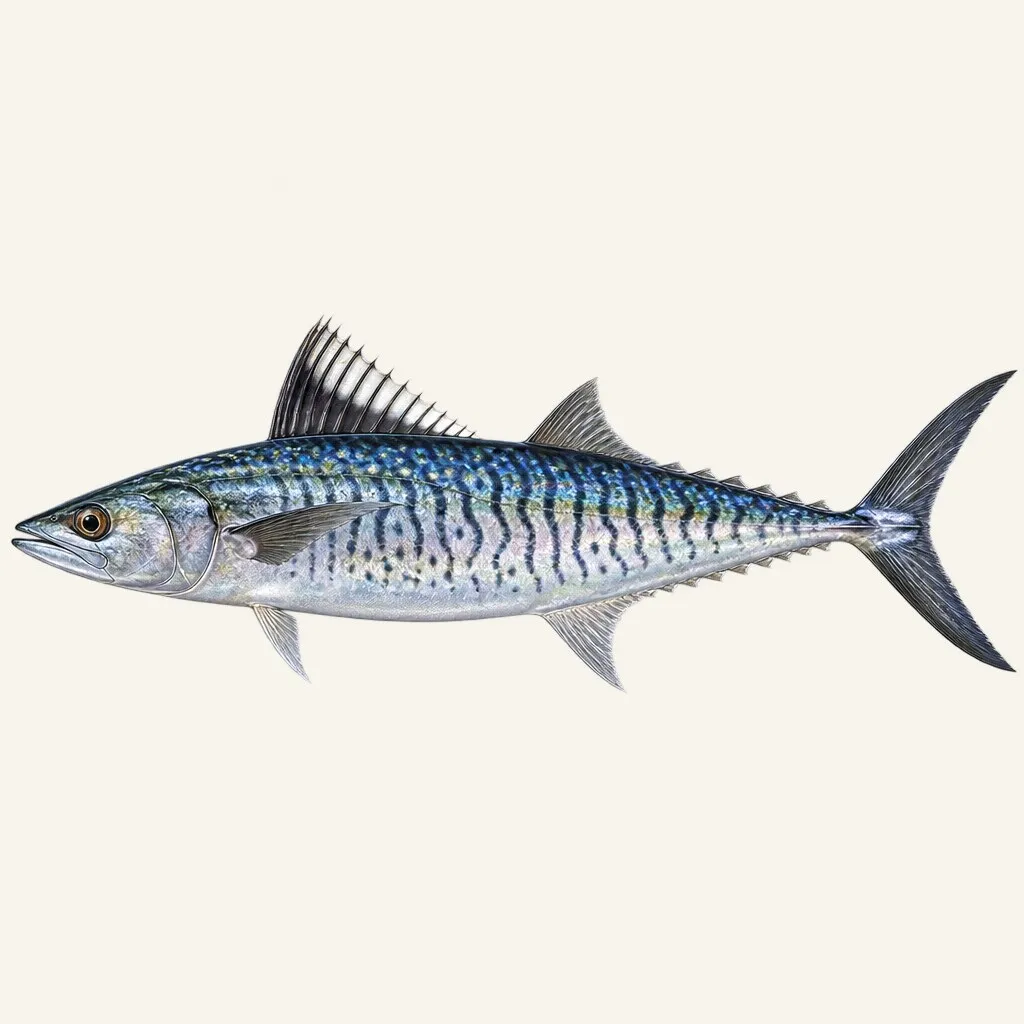
The narrow-barred Spanish mackerel is a large coastal scombrid of Indo-Pacific tropical waters, with a very elongated silver body crossed by numerous dark vertical bars. A fast and aggressive predator, it hunts near the surface and in mid-water along reefs and estuaries.
Calendar
Recorded in 26 countries
Australia · China · Egypt · Fiji · Greece · India · Indonesia · Iran · Israel · Japan · Madagascar · Malaysia · Mozambique · New Caledonia · Pakistan · Palau · Papua New Guinea · Philippines · Saudi Arabia · Singapore · South Africa · Sri Lanka · Taiwan · Thailand · Türkiye · Vietnam
GBIF occurrence records — native and introduced populations combined.
Its range
The range covers the Indo-West Pacific, from the Red Sea and South Africa across to South-East Asia, north to China and Japan and south to south-eastern Australia and Fiji. There is a separate population in the south-east Atlantic, at St Helena.
It also occupies the eastern Mediterranean, and it did not get there by swimming around Africa. This is a Lessepsian migrant: it came through the Suez Canal, the artificial connection opened in 1869 that has since delivered hundreds of Red Sea species into a sea they had no route to before. A fisherman in the Levant is therefore dealing with a fish that was not part of that fauna a century and a half ago, and whose presence there is an engineering consequence rather than a natural range extension.
Long alongshore migrations are documented, but resident populations appear to exist as well. The distinction is not academic: part of the stock moves through and part of it stays, and a fishery that assumes one is dealing with the other.
Identifying it
Gill rakers decide it. On the first arch there are none to two on the upper limb and one to eight on the lower, for a total that never exceeds eight. That is a very low count, and it is what separates this fish from the Spanish mackerels carrying many more. Everything else on the list is supporting evidence.
Size supports it heavily. This is much the largest of the Spanish mackerels, against under a metre for several of its relatives, so a large one is identified before anybody counts anything.
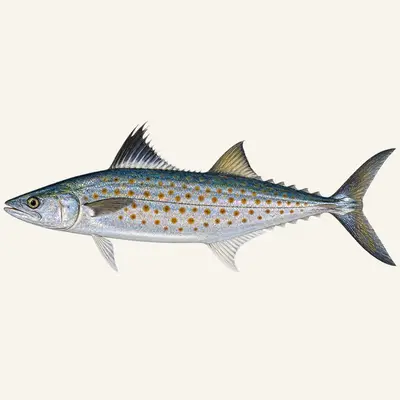
The bars are the trap. Flanks are silver over an iridescent blue-grey back, marked with numerous thin wavy vertical bands — but their number is a function of length, not of identity. A 40 cm fish carries about 20 of them and a 150 cm fish as many as 65. Juveniles are frequently spotted rather than barred, which is where the confusion with the spotted species comes from and why small fish are the hard ones.
The rest is measurement. Body depth goes 4.8 to 5.6 times into standard length, and the upper jaw reaches the rear margin of the eye or a little past it. The first dorsal carries 15 to 18 spines, the second 15 to 20 rays followed by eight to 11 finlets; the anal starts below the midpoint of the second dorsal, with 16 to 21 rays and seven to 12 finlets. Vertebrae number 42 to 46, and the lateral line bends sharply downward below the end of the second dorsal. Teeth in the jaws are strong and laterally compressed.
Breeding
The spawning season stretches or contracts with the local temperature regime: long in tropical water, compressed towards the southern limit of the range.
Within a season an individual female spawns repeatedly rather than once, at intervals of two to six days depending on locality — a rhythm that spreads the risk of a bad week across many attempts instead of committing everything to one date.
Where it happens is the part that matters for management. Spawning takes place off reef slopes and reef edges, and the fish form aggregations at specific sites to do it. An animal that lives dispersed and hunts alone concentrates itself, predictably, in a small number of known places for a few weeks a year. That is the moment at which the entire breeding population of an area becomes locatable.
Maturity arrives around 75 cm, within a range of 55 to 82.
The water it needs
A coastal pelagic fish occupying everything from the edge of the continental shelf to shallow inshore water, usually between 10 and 70 m.
The tolerance is the notable part. It works in water of low salinity and high turbidity, which is unusual in this family, and it means turbid bays and estuarine water that most pelagic fish avoid are within its range. It also uses drop-offs and shallow, gently shelving reef and lagoon ground.
That combination — offshore shelf edge and murky inshore shallows in the same species — widens the search area considerably compared with a fish restricted to clear blue water.
Areas
- Coastal pelagic waters
- Around coral reefs
- Lagoon passes and channels
- River mouths
Techniques
- Coastal trolling
- Cast-and-retrieve with metal lures
- Live bait under float
- Fast jigging
Baits
- Fast-diving plugs
- Long metal lures
- Small live fish
- Squid
What it eats
Small schooling fish above all: anchovies, clupeids and carangids, with squid and penaeid shrimps making up the remainder.
The way it takes them is what distinguishes it. This fish usually hunts alone, running the coastal slopes in shallow water, where several of its relatives work in large packs. A solitary predator on a school of prey behaves differently from a school of predators on the same target, and the difference shows up directly in how it is fished.
How to catch it
A lone hunter is not found the way a school is. There are no birds working and no surface commotion to run to; the job is to cover structure — drop-offs, reef edges, coastal slopes — rather than to intercept a mass of fish.
Trolling is the historic method for this species and it follows straight from that behaviour: matching the speed and the ground of a predator on patrol. The commercial fisheries add drift gill nets, bamboo stake traps and midwater trawls, each of them a way of putting gear across a route.
The teeth change the terminal end. Strong compressed teeth part ordinary monofilament, and a predator of this size does not forgive an underspecified trace.
Two things belong on a page about eating this fish. It is marketed fresh, dried and salted, frozen, smoked, canned and made into fish balls across a very large part of the world. And a lipid-soluble toxin resembling ciguatoxin has been found in the flesh of fish taken off the east coast of Queensland — a local finding rather than a general one, but one that makes the origin of a large fish worth knowing before it is eaten.
Conservation · Near Threatened (IUCN) — This species is in decline. Release your catch quickly and handle it with care — wet hands, as little time out of the water as possible.
Conservation
The vulnerability of this species is not a matter of overall abundance and never has been. It is structural: a fish that spends its life dispersed and solitary but routes its entire reproduction through aggregations at a handful of reef sites exposes all of its spawners in a few weeks, in places that are easy to find and easy to return to.
Fishing those aggregations produces excellent catches that carry no information about the stock. Catch per unit effort measures how concentrated the fish are, and at that moment they are maximally concentrated regardless of how many of them are left. A fishery can hold its catch rates steady while the population behind them falls.
The age structure compounds it. The maximum reported age is 22 years and maturity is reached at about 75 cm, so a substantial share of the fish met at sea have not yet spawned once, and the aggregation fishery is working on the ones that have.
Regulations
Check the local regulations in force (legal size limits, closed seasons, bag limits).
For guidance only. Legal sizes, quotas and open seasons vary by location and season: always check the local regulations in force before fishing.
Other names
Narrow-barred Spanish mackerel is the full English name, and the qualifier is the whole point of it. In Australia this fish is simply the Spanish mackerel, in Indian English it is a seerfish, and in North America Spanish mackerel means an Atlantic species a tenth of its weight. A conversation about Spanish mackerel between an Australian and a Floridian is about two different animals unless somebody produces the scientific name.
The word mackerel in the name is also misleading in its own right: this fish outweighs the common mackerel by a factor of ten or more and does not hunt in anything like the same way.
Sources: fishbase.se · api.gbif.org