Pacific bluefin tuna
Thunnus orientalis · Scombridae
- Saltwater
- Big pelagics
- Medium
- Regulated
- Size
200–300 cm
- Weight
127–450 kg
- Lifespan
15 years
- Depth
1–550 m
Where to fish
- Offshore
Habitat icons: Flaticon
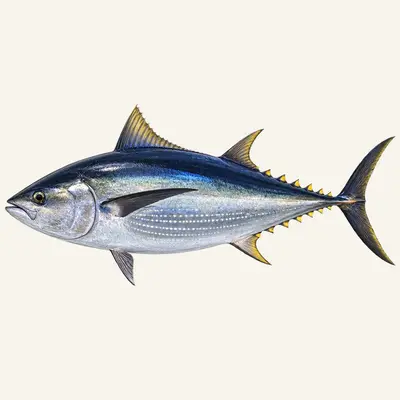
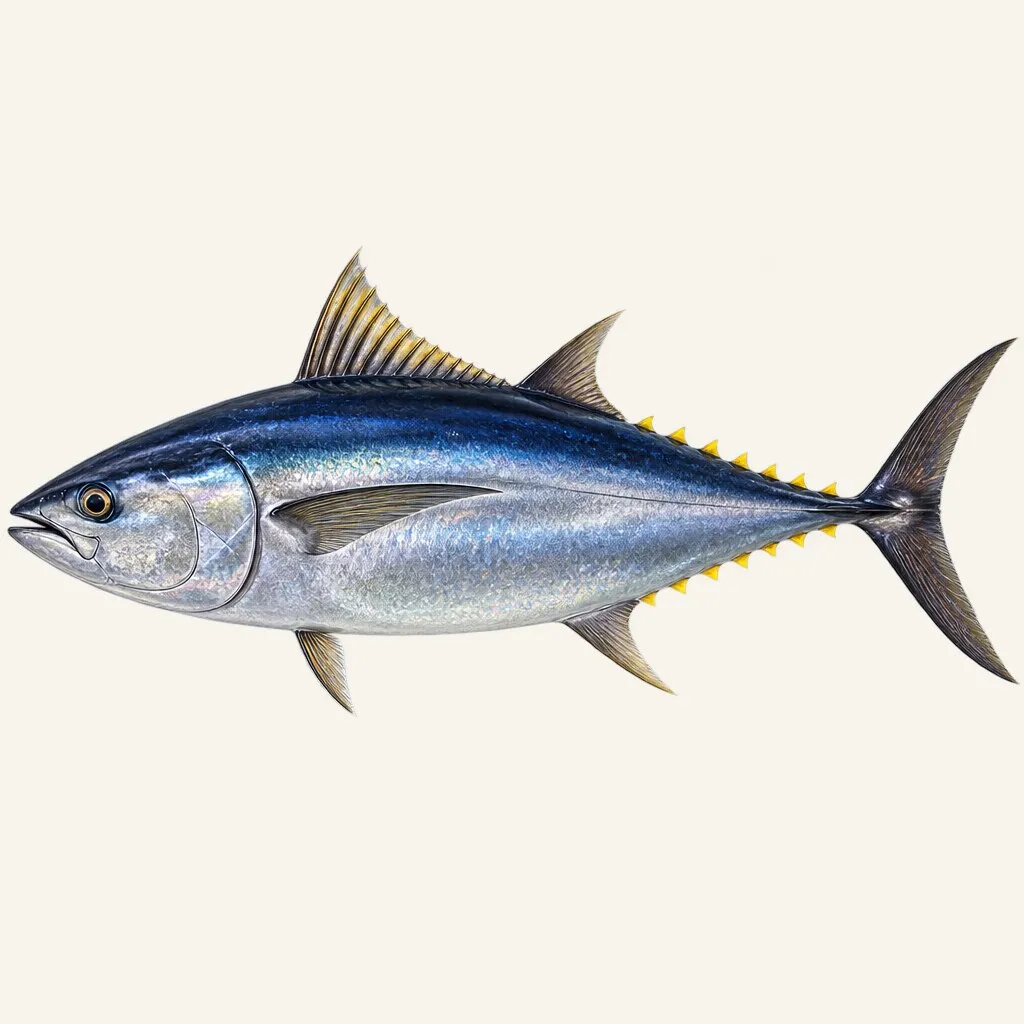
The Pacific bluefin tuna is a large pelagic predator in the Scombridae family with a streamlined, hydrodynamic body, blue-black back, and silver belly. It migrates vast distances across the North Pacific, from Asian to American coasts, reaching impressive sizes.
Calendar
Recorded in 7 countries
Australia · China · Indonesia · Japan · Mexico · New Zealand · United States
GBIF occurrence records — native and introduced populations combined.
Its range
The range crosses the North Pacific from side to side: the Gulf of Alaska down to southern California and Baja California on the American shore, Sakhalin Island in the southern Sea of Okhotsk down to the northern Philippines on the Asian one.
Only four records are substantiated in the southern hemisphere — off Western Australia, in the southeast Pacific at 37°11'S, and in the Gulf of Papua. Against those strays sits one movement that is regular: the species is in New Zealand water for at least three months in spring and early summer.
The best-documented movement of all is coastal. Between June and September the fish run north along the coasts of Baja California and California, and that appointment is what the sport fishery of the American seaboard is built around.
Identifying it
Nothing on the outside will settle it, or almost nothing. The caudal keels are dark, and that is the whole of what an intact fish shows.
The three remaining criteria require a scalpel. Gill rakers average 35.9. The first ventrally directed parapophysis sits on the eighth vertebra. And the dorsal wall of the body cavity carries a narrow bulge, flanked by a lateral concavity and a wide trough.
Laboratory anatomy of that kind says something plain about the field: identification here is geographic. A large bluefin caught in the North Pacific is this species, and the question does not arise in any other form.
The size is a bluefin's — two metres for an ordinary fish, and fifteen years of recorded life.
The water it needs
Epipelagic, normally oceanic, closing on the coast with the season. The depth range runs from one metre to 550, and a tolerance of brackish water is on record.
Wide temperature intervals are tolerated, which is what allows one species to hold water from Alaska to the Philippines. Schools assemble by size, sometimes in company with other scombrids.
Areas
- Pacific open ocean
- Thermal convergence zones
- Around islands and seamounts
- Warm coastal currents
Techniques
- Offshore trolling
- Live bait fishing
- Surface popping
- Vertical jigging
Baits
- Live mackerel
- Anchovies
- Squid
- Coloured trolling lures
What it eats
A voracious predator, taking small schooling fishes and squid along with crabs and, less often, sessile organisms.
That last entry is unusual. A tuna tearing at attached organisms is no longer hunting in midwater; it is working a bottom or a structure, which fits the seasonal inshore excursions rather than the life offshore.
How to catch it
The window is known and it is short. From June to September the northward migration brings fish within reach of the Californian coast, and it is the only period when a tuna of this size is met regularly from an eastern Pacific port.
For the rest of the year the species is offshore and behaves as the other bluefins do: shoals sorted by build, sight-hunting on schooling baitfish, moderate depths.
Regulated — Often governed by quotas, size limits, seasons, or reporting rules.
Conservation · Near Threatened (IUCN) — This species is in decline. Release your catch quickly and handle it with care — wet hands, as little time out of the water as possible.
Conservation
The North Pacific stock fell to a very low level before the management organisations on either rim agreed a joint rebuilding plan. The difficulty is that the animal crosses the ocean: born in the west, grown partly in the east, it is then taken at two different ages by two fisheries that do not necessarily talk to one another.
A second factor weighs. The species is highly sought on the Japanese market, where the flesh reaches the highest prices in the genus, and most of the pressure falls on juveniles caught before their first spawning.
Aquaculture grew out of that, at first as the fattening of wild fish. It is also on this species that the first complete rearing cycle for a bluefin was closed in Japan, from egg to breeding adult — a technical achievement whose effect on the wild stock stays limited for as long as the farms keep drawing juveniles out of the sea.
Regulations
Check the local regulations in force (legal size limits, closed seasons, bag limits). Highly regulated species — verify applicable quotas and licences.
For guidance only. Legal sizes, quotas and open seasons vary by location and season: always check the local regulations in force before fishing.
Other names
Pacific bluefin tuna in English. The Japanese call it kuromaguro, the black tuna, where Europe sees red: two names describing different parts of one animal, the back for one and the flesh for the other.
Its position in the nomenclature is recent. The fish was long counted inside Thunnus thynnus, as a population or as a subspecies of the Atlantic bluefin, and reference works still label it a subspecies here and there. The separation rests on the counts and the internal anatomy set out above, not on anything a photograph would show — which is why catch records from before the split cannot simply be reassigned to one species or the other.
Sources: fishbase.se · api.gbif.org