Black snapper
Apsilus dentatus · Lutjanidae
- Saltwater
- Coastal
- Medium
- Size
40–65 cm
- Weight
0.8–3.2 kg
- Depth
40–300 m
Where to fish
- Reef
- Rocky shore
- Offshore
Habitat icons: Flaticon
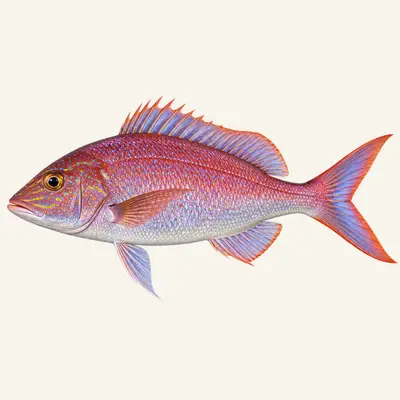
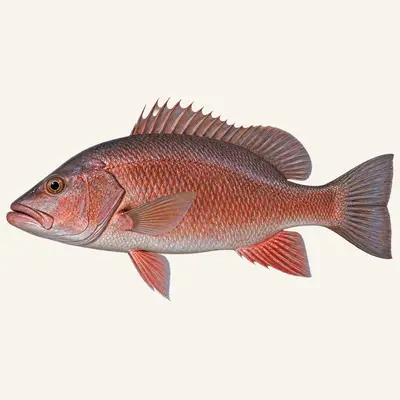
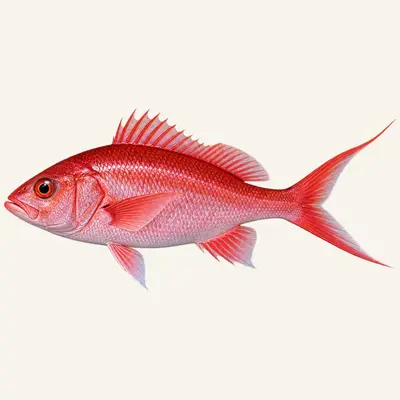
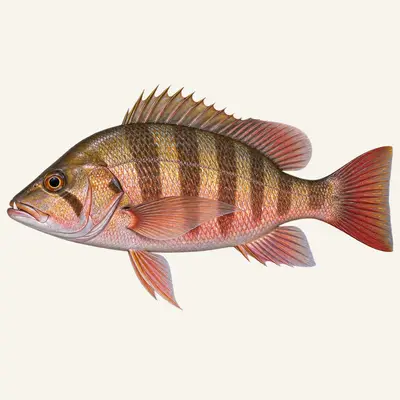
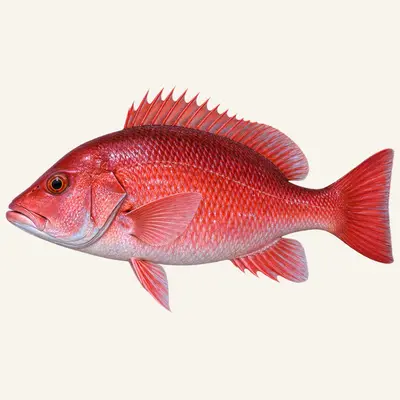
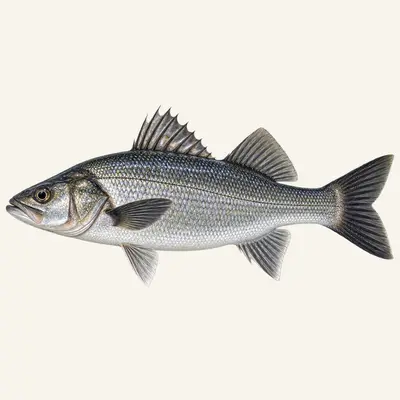
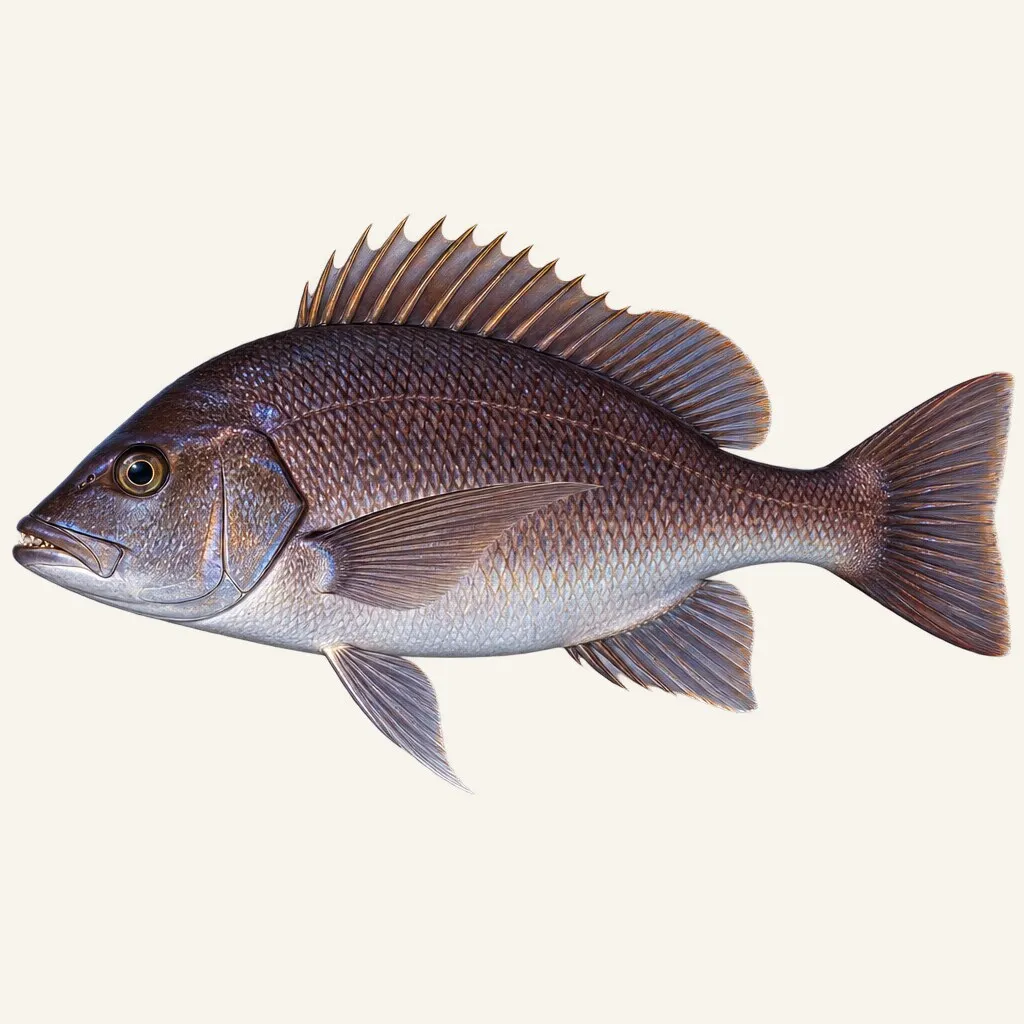
The black snapper is a slender lutjanid with slate grey to blue-black flanks and a strongly forked caudal fin that gives it speed and agility. It inhabits deep waters and rocky drop-offs throughout the Caribbean and western tropical Atlantic.
Calendar
Its range
The western central Atlantic, between 29°N and 8°N: the West Indies, the Florida Keys, the western Gulf of Mexico and the western Caribbean off Belize.
The source attaches a caveat to that list which is worth passing on rather than quietly dropping. The species is probably more widespread through the Caribbean than the published records show. That is the expected shape of the record for a fish whose adult habitat begins below the depth divers work and above the depth most fisheries target — the map describes where people have looked, and there is a broad middle band of the Caribbean where nobody had reason to.
Identifying it
The teeth at the front of the upper jaw are enlarged and canine-like. That is the character the epithet was built on, and it is the one to check first on a fish in hand.
Around it sit four points that do not change with age or handling. The snout is short and pointed. The space between the eyes is convex — domed, not flat. The pectoral fins are long, reaching back as far as the level of the anus. And the rows of scales across the back run parallel to the lateral line rather than crossing it at an angle. The bases of the dorsal and anal fins carry no scales at all.
Colour is the character that will mislead, because the fish has two of them. An adult is violet or dark brown over the back and upper sides, paling towards the belly. A juvenile is mainly blue. Those are not shades of one another, and two specimens of different sizes laid side by side do not look like one species.
Counts: 10 dorsal spines with nine or 10 soft rays behind them, three anal spines and eight rays. The body is slender and oval in section, and the tail deeply forked.
The water it needs
The two colour phases go with two depths, and the gap between them is the striking part.
Adults live over rocky ground. The full recorded range runs from 40 to 300 m, but the useful figure is narrower than that: they are usually found between 120 and 180 m. Everything about the adult animal happens inside a band 60 m thick, well below any diving.
Young fish are sometimes found near the surface. Not shallower — at the top of the water column. That puts more than a hundred vertical metres between the two age classes of the same species, and it means the blue fish near the light and the violet fish on the drop-off are one animal at two points in its life.
Areas
- Deep reef drop-offs
- Outer oceanic slopes
- Offshore rocky bottoms
- Submarine canyon heads
Techniques
- Deep bottom handline fishing
- Deep-water live bait fishing
- Deep jigging
- Drop-off drift fishing
Baits
- Deep-water live fish
- Whole squid
- Deep-water shrimp
- Cut octopus
- Cut mackerel
What it eats
Fishes and benthic organisms, cephalopods and tunicates included.
The tunicates are the entry that changes the reading. A predator with canines at the front of its jaw suggests pursuit, and a diet that contains sea squirts does not: they are sessile, they do not flee, and taking them means picking over the ground rather than chasing across it. Both things are true here, and together they describe an animal that lives on a piece of rock and works it, rather than one that patrols the water above it.
How to catch it
This is sounder work on rocky drop-offs, and finding the relief is harder than getting a bite once you have found it. The productive band is 120 to 180 m, and the standard approaches are deep handlines, heavy bottom rigs and baits fished on the ground.
One pair of figures should be read before the first drop. The length at first maturity is 40 cm. The common capture length is also 40 cm. They are not close together; they are the same number.
There is therefore no margin at all between the size a fish is routinely taken at and the size at which it begins to count for the population. Every ordinary fish in the box has just started breeding, or is about to. Nothing can be selected for, because the whole catchable class sits on the threshold: a smaller fish has not bred, a larger one is not what the gear usually produces.
That fact settles what the release question is, and it is not the one it looks like. A fish hauled from 180 m has decompressed on the way and will not swim back down; putting it over the side at the surface achieves nothing. But this species has an unusual property for a deep-slope fish — its recorded range starts at 40 m. The shallow end exists. A fish taken at the top of the range arrives in a condition where letting it go is a real act, and one from the bottom of the range does not, so the decision is made by choosing which part of the slope to fish, before the line goes down.
Everything after that is arithmetic on quantity. If size selection is unavailable, the number of fish kept is the only lever left.
Reports of ciguatera poisoning attach to this species. The risk belongs to the ground a fish fed over and not to the species in general, and it is a question for the dock rather than for a book.
Conservation
The pressure here is not a collapse and not a trend. It is a fishery working with no margin, on an animal nobody has measured properly.
Take the margin first. When the routine landing size and the first-maturity size are the same number, the population is being harvested at the exact moment individuals enter it as breeders. A fish that spawns once and then goes into a box has contributed a single season. Nothing about that is dramatic in a small fishery — the species is classed as minor commercial and sold fresh and frozen in modest quantity — but it means there is no slack in the system to absorb an increase in effort.
Then the measurement. There is no maximum reported age for this species. There is no observed range around the maturity figure, only a single value. The reference assessment dates from 2009. And the source's own distribution statement concedes that the real extent of the range is unknown. Four gaps in a row, in the same file, all pointing the same way: what is on record about this fish is thin, and it is thin because the animal lives at a depth that is expensive to study and unrewarding to fish commercially.
Handling one commits you to that uncertainty. A 40 cm black snapper is a fish at the start of its breeding life, taken from a population whose size, age structure and geographic extent have not been established.
Regulations
Check the local regulations in force (legal size limits, closed seasons, bag limits).
For guidance only. Legal sizes, quotas and open seasons vary by location and season: always check the local regulations in force before fishing.
Other names
Six languages, and all six of them say black: black snapper, vivaneau noir, pargo negro, Schwarzer Schnapper, lutiano nero. Brazilian Portuguese does something more interesting and calls it vermelho-preto — black red — because vermelho is the trade word for the snapper group there, so the name places the fish inside the reds and then contradicts itself to pick it out again.
What none of those names describes is the fish the diagnosis describes. The published colour is violet or dark brown for an adult and blue for a juvenile. Black is what a dead specimen looks like on a deck, in air, after the dive out of 150 m of water has finished with it — and every one of the six names is recording that moment rather than a character an ichthyologist wrote down. It is a rare case of unanimous naming across languages that is unanimous about an impression.
The epithet is the one part of the nomenclature that answers to the description. Dentatus points at the enlarged canines at the front of the upper jaw, which is where the diagnosis itself starts.
Sources: fishbase.se · api.gbif.org