Rainbow runner
Elagatis bipinnulata · Carangidae
- Saltwater
- Coastal
- Medium
- Size
90–180 cm
- Weight
3.5–0.0 kg
- Lifespan
6 years
- Depth
0–150 m
Where to fish
- Offshore
Habitat icons: Flaticon
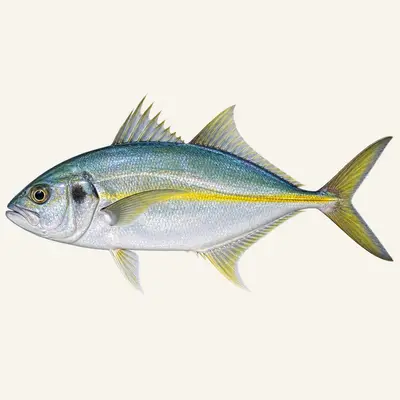
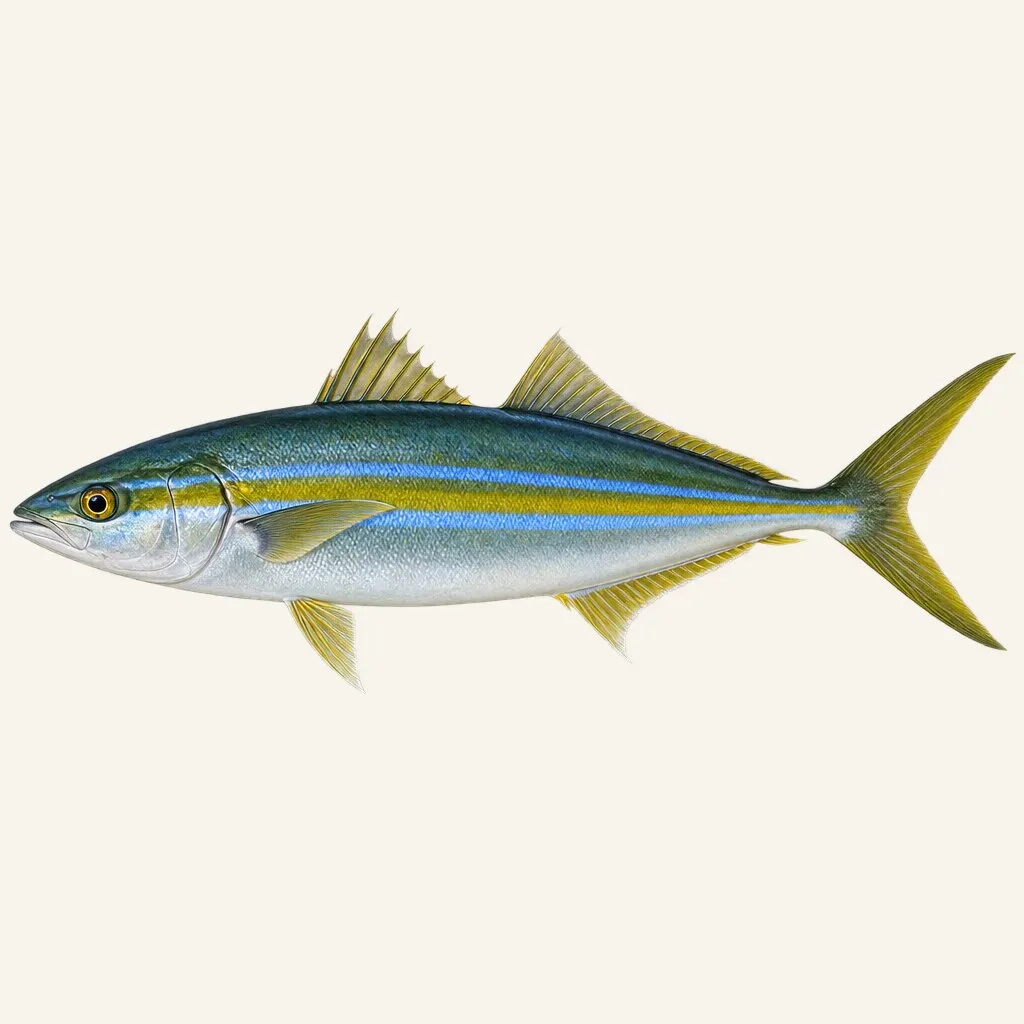
The rainbow runner is a slender pelagic carangid, easily identified by two blue stripes and a yellow stripe running along its silvery flanks. A fast and aggressive oceanic species, it is found in all tropical and subtropical seas worldwide.
Calendar
Recorded in 47 countries
American Samoa · Australia · British Indian Ocean Territory · Cameroon · Cape Verde · Colombia · Comoros · Costa Rica · Côte d’Ivoire · Ecuador · Equatorial Guinea · Fiji · French Polynesia · French Southern Territories · Gabon · Ghana · Guinea · Indonesia · Japan · Kiribati · Liberia · Madagascar · Maldives · Marshall Islands · Martinique · Mauritius · Mayotte · Mexico · Mozambique · New Caledonia · Nigeria · Northern Mariana Islands · Palau · Panama · Papua New Guinea · Philippines · Puerto Rico · São Tomé & Príncipe · Saudi Arabia · Seychelles · Sierra Leone · Solomon Islands · Somalia · Taiwan · Tanzania · Thailand · United States
GBIF occurrence records — native and introduced populations combined.
Its range
The species occupies the tropical belt of every ocean, and the edges of the list are where the information is.
In the western Atlantic it runs from Massachusetts and the northern Gulf of Mexico to Rio de Janeiro. In the eastern Atlantic, from Côte d'Ivoire to Angola. Across the Indo-Pacific it is general, though rare or absent in the Persian Gulf. In the eastern Pacific, from the mouth of the Gulf of California to Ecuador, the Galápagos included.
Two entries there do not describe a resident population. The Mediterranean record is a single locality, off Genoa, in a sea the species otherwise does not occupy; and the northern Atlantic limit at Massachusetts sits a long way outside the tropical belt where the rest of the range lies. A fish that lives around drifting objects goes wherever the current takes the object, and the far ends of its map show it.
Identifying it
The back of the dorsal fin ends in a detached finlet of two rays, and the back of the anal fin does the same. Two finlets, and the epithet bipinnulata is a record of them.
Detached terminal rays are not the property of this fish alone: the mackerel scad's own description carries one behind each of those two fins. What the published account of Elagatis records is that the finlet is two-rayed, front and back, which is a narrower statement and the one to check on a specimen.
The anal fin holds a further oddity. Its first spine stands slightly apart from the rest of the fin and, on larger fish, lies buried under skin; the second spine runs continuous with the 18 to 22 soft rays behind it. On a big one, one of the two anal spines cannot be seen at all.
The body is long and fine, tapering at both ends, and the fins are long-based — a second dorsal of 25 to 30 rays and an anal nearly as long, on 24 vertebrae. The upper jaw stops distinctly short of the eye, and further forward still in young fish, reaching only to below the eye's front margin.
Live colour is dark olive-blue above, white below, with two narrow pale blue stripes along the flank and a broader olive or yellow band between them. The fins are olive to yellowish.
Seven dorsal spines and 25 to 30 soft rays; two anal spines and 18 to 22 rays.
Breeding
Maturity is reached at 64.6 cm. The oldest fish on record was six years old.
Those two figures taken together describe the growth rate. A fish that has to reach 65 cm before it breeds, in a life running to six years, is growing fast and is left with room for very few spawning seasons. Eggs are pelagic.
The water it needs
Adults hold near the surface over reefs, in oceanic and coastal water alike, and are also met a long way from any coast around floating logs and other debris. Most of it happens between 2 and 10 m, though the species has been taken to 150.
The debris association is the part worth planning around, and here it belongs to the adults as much as to the young. In several jacks it is the juveniles that live under a drifting object and the adults that give the habit up; a mature rainbow runner is still there.
Large schools form.
Areas
- Offshore pelagic waters
- Around floating objects and FADs
- Seamounts and oceanic banks
- Surface convergence zones
Techniques
- Fast lure trolling
- Vertical jigging
- Metal lure casting
- Fishing around floating objects (FAD)
Baits
- Chrome metal lures
- Coloured lead jigs
- Small live fish
- Rapalas and fast-swimming plugs
What it eats
Invertebrates, chiefly the larger crustaceans of the zooplankton, and small fishes.
A predator of this length living substantially on planktonic crustaceans is feeding in the top few metres rather than hunting down through the water column, and the top few metres is precisely where it is found. The drifting log completes the account: the log holds the plankton and the plankton holds the fish.
How to catch it
Fish the floating object. A log, a raft of weed, a buoy, a moored platform — that is the position, it is at the surface, and it holds adults and not merely young fish.
Once one shows, expect more. This is a schooling species, so a hit is information about the rest of the school rather than an isolated event, and repeating the same drift is worth more than moving on to fresh water.
Lure size is where the fishery catches people out. A partly planktonic diet means small lures take this fish, which is awkward to accept when the tackle was chosen for a large carangid. Trolled fast, jigged vertically, or cast with a metal lure: all three work, and none of them has to be big.
Ciguatera poisoning has been reported from the species. That is unexpected in a fish feeding on plankton at the surface, and it is a reminder that the toxin is a property of the ground the animal came off rather than of its depth in the water.
Conservation
Six years of life against maturity at 65 cm leaves a narrow margin, and it is the pair of figures to hold on to for a species rated highly commercial. Very few spawning seasons stand behind each adult, so every year class carries weight, and a run of poor recruitment cannot be absorbed by an older fraction of the population that does not exist.
Regulations
Check the local regulations in force (legal size limits, closed seasons, bag limits).
For guidance only. Legal sizes, quotas and open seasons vary by location and season: always check the local regulations in force before fishing.
Other names
Rainbow runner in English, after the blue and yellow banding, which is the first thing seen on a fresh fish and among the first things lost after death. On a fish that has been out of the water for an hour the colour argument is gone, and the finlets are still there.
"Runner" is not a precise word in English. The blue runner, Caranx crysos, carries it too; the two are not confusable in the hand but are easily confused on a list. Spanish says macarela salmón, and the borrowed "salmon" in that name is a judgement about the flesh and not a statement about relationship.
Sources: fishbase.se · api.gbif.org