Adriatic sturgeon
Acipenser naccarii · Acipenseridae
- Freshwater
- Sturgeons
- Medium
- Protected
- Regulated
- Size
120–200 cm
- Weight
12–40 kg
- Depth
10–40 m
Where to fish
- Estuary
- River
Habitat icons: Flaticon
Endemic to the Adriatic basin - Nearly extinct in the wild
Calendar
Recorded in 4 countries
Belgium · France · Italy · Switzerland
GBIF occurrence records — native and introduced populations combined.
Its range
The range covers the Adriatic and its tributaries between the Po and the Buna, with the fish present in the lowermost parts of the rivers from the Soča to the Drin, and one record from Corfu. This is an endemic in the strict sense: none of it exists anywhere else.
The reference file is explicit on one point. Records from the Tyrrhenian slope of Italy, from Spain and from France are erroneous. A qualification is nonetheless needed, because sequences obtained from museum specimens, published in connection with the European sturgeon, place this species from the Adriatic to the Iberian Peninsula. Both statements sit in the literature, and the old western extension remains open.
The question is not scholarly. It decides what can reasonably be restored, and where breeders for a programme outside Italy could legitimately come from.
Identifying it
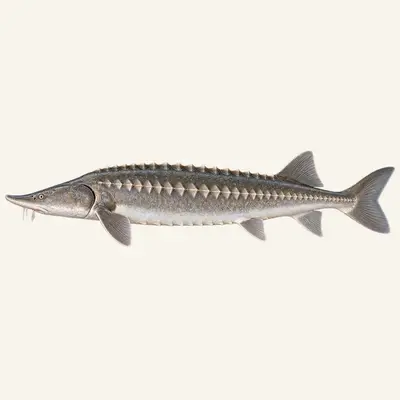
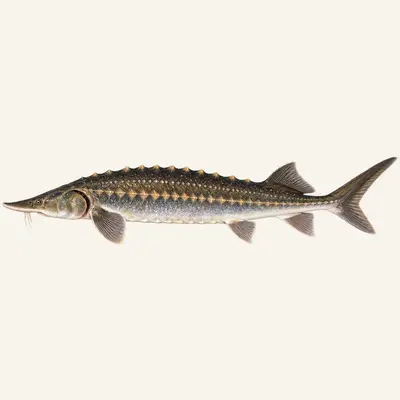
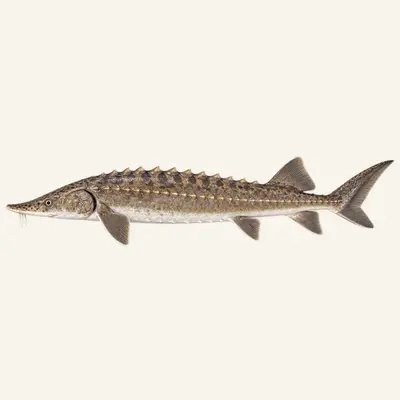
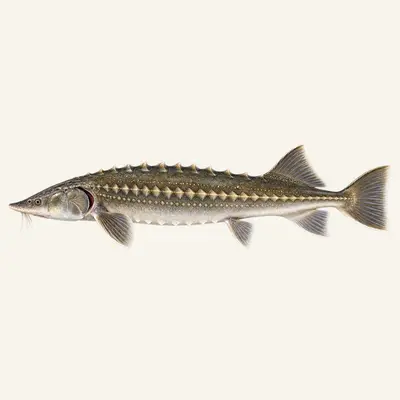
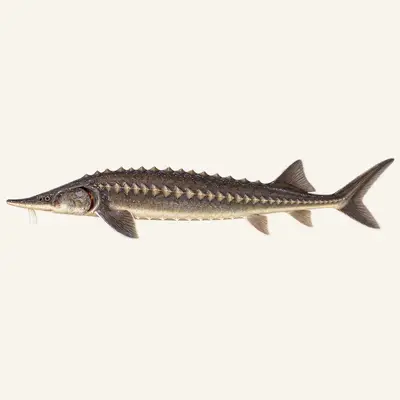
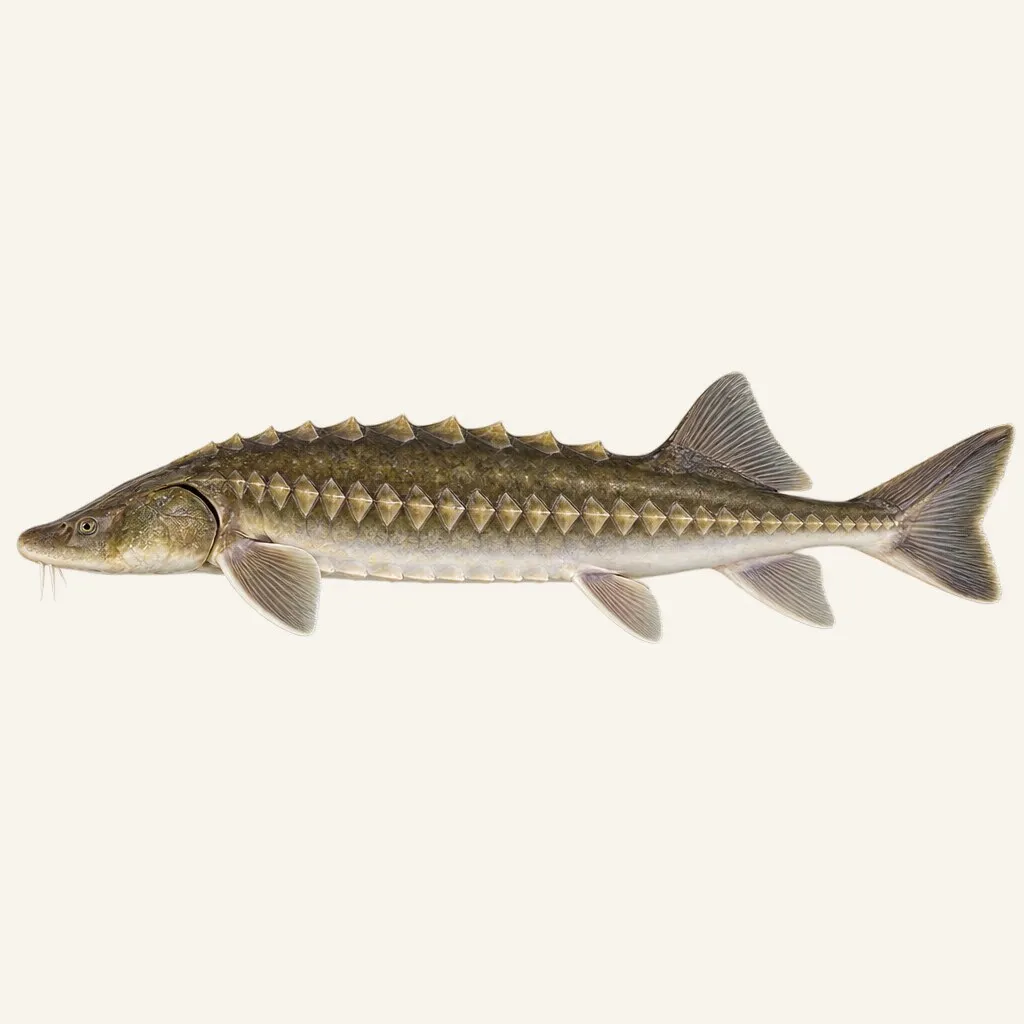
The snout is short, very broad, and rounded at the end. It is the exact opposite of the narrow pointed rostrum most European sturgeons carry, and it shows at a distance without handling the animal.
The second character is a gap. Between the dorsal row and the lateral rows the skin is bare; nothing fills the interval, where the European sturgeon carries a tight scatter of rhombic platelets. The two species shared the same water, and that detail is what separates them on a live fish as on a carcass.
The rows themselves have a peculiarity. The 10 to 14 dorsal scutes are not equal: those in the middle of the back are deeper and generally larger than those at the front, which gives the profile a slight hump. Count 32 to 42 plates per flank and eight to 11 down each side of the belly.
The body is circular in section. The back is olive-brown, the flanks paler, the belly white. The dorsal carries 36 to 48 soft rays, the anal 24 to 31.
Breeding
Adults run into the rivers from March to May and breed between May and July. The season is short, and it plays out in the lower sections of the Adriatic rivers, which is to say in the most urbanised, most regulated and most heavily loaded reaches those rivers have.
The water it needs
The fish uses the sea close inshore and the estuaries, and never goes into properly marine water. It keeps between 10 and 40 m, mostly over sand and mud; in fresh water it occupies large deep rivers.
That limit is what makes it singular among the anadromous sturgeons. There is no oceanic phase. The whole life fits inside the coastal fringe of the Adriatic and the lower valleys draining into it, and the domain does not extend more than a few tens of kilometres either side of the shoreline.
Areas
- Large rivers with muddy and sandy bottoms
- Adriatic estuaries and tidal zones
- Deep river pools
- Confluences of major waterways
Techniques
- Bottom fishing with static rig
- Feeder fishing in deep river
- Nocturnal bottom fishing
- Static estuarine bottom fishing
Baits
- Earthworms
- Maggots and bloodworms
- Fresh shrimps
- Fish pieces
- Flavored paste baits
What it eats
It feeds on bottom-living invertebrates and small fish, taken off the soft substrates it holds. Estuarine sand and mud concentrate that resource, which is why the animal and the most degraded part of the system occupy exactly the same ground.
How to catch it
Endemism is what makes this fish's position different from that of the other sturgeons. A species spread over several seas can lose a basin and recolonise it from another. This one has nowhere to fall back to, and a pollution event on the Po reaches a major fraction of everything that exists.
International trade falls under Appendix II. What is permitted in rivers and estuaries is a matter for the Italian regional authorities and the other Adriatic states, and is worth asking about before a line goes into that water.
One confusion remains possible and it has consequences, since both species concerned are protected: the broad rounded snout and the bare space between the dorsal and lateral rows rule out the European sturgeon without hesitation.
Protected — Sensitive or protected species depending on area: check local rules before taking action.
Regulated — Often governed by quotas, size limits, seasons, or reporting rules.
Conservation · Critically Endangered (IUCN) — This species is threatened with extinction. Always release it (no-kill), handle it with the utmost care and check local rules — fishing for it may be prohibited.
Conservation
Three pressures are recorded, and they concentrate on a tiny space: habitat destruction, pollution, overfishing. The lower Adriatic valleys accumulate gravel extraction, flow regulation and the discharges of one of the densest industrial basins in southern Europe, and that is precisely where laying and juvenile growth take place.
The flesh was eaten and the eggs turned into caviar, on a species whose entire range fits inside one gulf. The take did not have to be large to matter. Set against a stock that narrow, it weighed far more from the outset than the same effort applied to the Caspian sturgeons.
The absence of an oceanic phase compounds everything. An animal that never leaves the coastal fringe is exposed to the same river discharges for its whole life, without the dilution the open sea gives to species that move out into it.
Regulations
Check the local regulations in force (legal size limits, closed seasons, bag limits).
For guidance only. Legal sizes, quotas and open seasons vary by location and season: always check the local regulations in force before fishing.
Other names
Adriatic sturgeon in English, named for the only sea it has. The epithet honours Fortunato Luigi Naccari, the Venetian naturalist who worked on the fishes of that coast. Italian keeps storione cobice, a regional word with no equivalent in other languages.
There is no older English name, only a translation of the range, which fits an animal that never entered the waters where English fishing vocabulary was built. That absence is worth noticing: a species with no vernacular name in a language is a species that language never had to talk about.
Sources: fishbase.se · api.gbif.org