Shortbill spearfish
Tetrapturus angustirostris · Istiophoridae
- Saltwater
- Coastal
- Hard
- Regulated
- Size
190–230 cm
- Weight
94–52 kg
- Depth
0–1,830 m
Where to fish
- Offshore
Habitat icons: Flaticon
Although occasionally found in the Atlantic Ocean, this species is believed to have its spawning grounds and main populations only in the Pacific and Indian Oceans. A highly migratory species.
Calendar
Recorded in 15 countries
Australia · Chile · Costa Rica · French Polynesia · French Southern Territories · Iceland · Mayotte · Mexico · New Caledonia · New Zealand · Portugal · Réunion · South Africa · United States · Vanuatu
GBIF occurrence records — native and introduced populations combined.
Its range
The range is Indo-Pacific, from tropical into temperate water. Individuals reported from the Atlantic do exist, but they are strays: the spawning grounds and the principal populations of the species lie only in the Pacific and Indian Oceans. An Atlantic capture therefore indicates no population and predicts nothing.
The shape of the range is markedly lopsided. It reaches 43 degrees north and 56 degrees south, thirteen degrees further in the southern hemisphere. The southern branch attains latitudes the northern one never approaches, which puts part of the population in water that is frankly cold for this group.
Identifying it
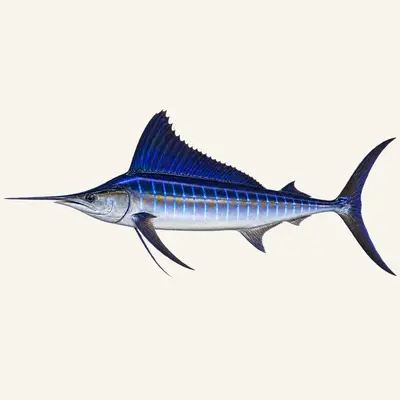
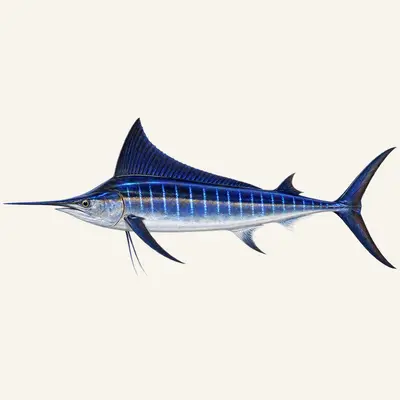
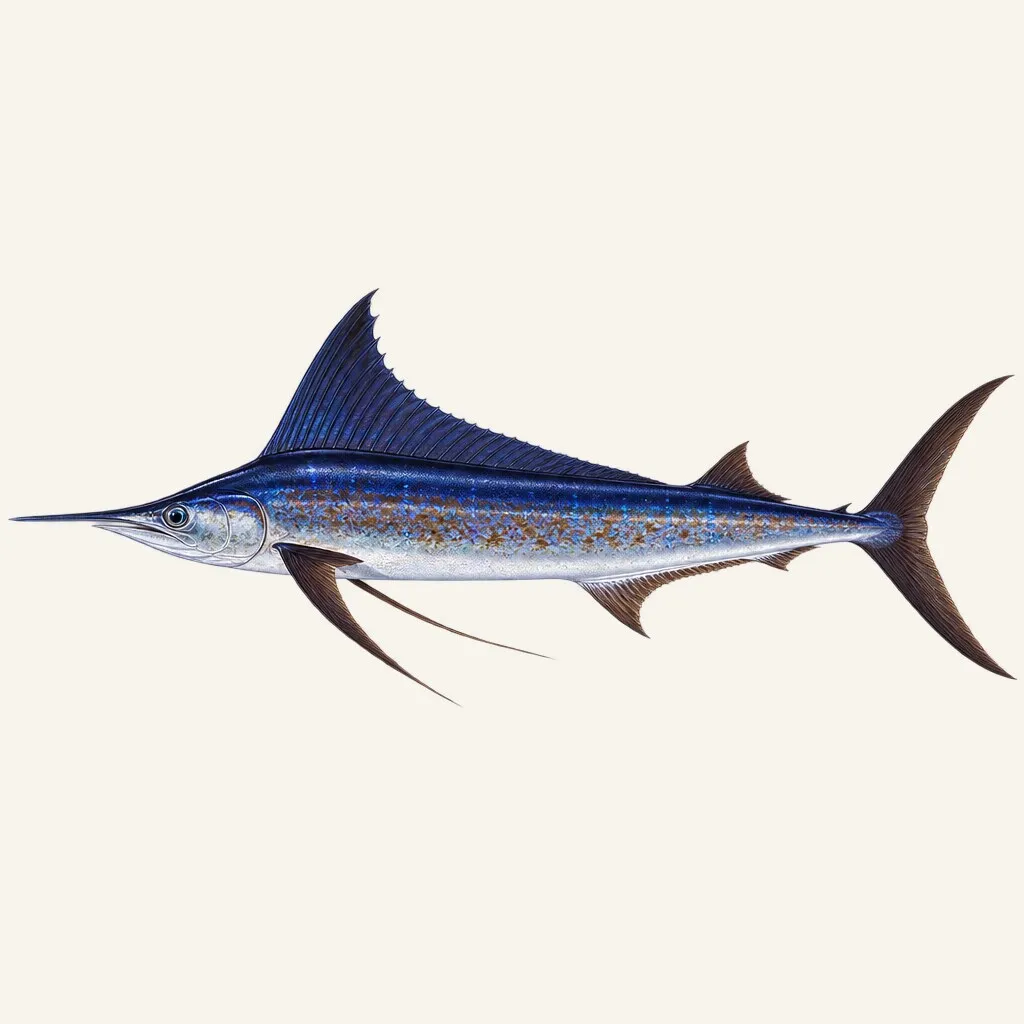
The long sail on the back carries no spines at all. Fifty-one to 57 rays, every one of them soft: that is how the group is built, and it explains how a fin that tall can fold away completely into a groove along the spine. The anal fin has 18 to 23 rays on the same pattern.
That first dorsal is a plain dark blue, without mottling. The character removes the sailfish and the white marlin, whose equivalent membrane is spotted with black, but it does not finish the job in the Pacific, where more than one relative carries an unmarked fin. What settles it is the bill, and the vernacular names of this species speak of nothing else.
The remaining fins are brown to dark brown. The bases of the anal fins lighten to a silvery white, the only pale note in an otherwise dark set. The back is dark blue, the flanks blue splattered with brown, the underside silvery white.
The body is elongated. A commonly encountered fish measures 190 cm, and set against that length the animal is thin: the outline has nothing of the bulk of a large marlin.
Breeding
Spawning is placed in the winter months, and it requires warm offshore currents whose surface runs at about 25 degrees.
The two conditions pull in opposite directions, and that is what makes the fact usable. Twenty-five degrees at the surface during the cold season is not found just anywhere: it has to be sought out in a warm vein of water. Reproduction in this species is therefore attached to a current rather than to a region, and the fish has to move towards one as the water around it cools.
Neither size at first maturity, nor fecundity, nor the number of spawnings is documented.
The water it needs
Two figures describe the species and they have to be held together. The usual band runs from the surface to 350 m. The greatest recorded depth is 1,830.
The second does not invalidate the first. It shows that the animal is able to leave the surface layer altogether, which its Atlantic relatives are not recorded as doing — their depth ranges stop at 200 m. Ordinary life nonetheless takes place high up, above the thermocline, in oceanic water offshore.
Areas
- Tropical offshore waters
- Cold upwelling zones
- Island edges
Techniques
- Surface trolling
- Live bait fishing
- Surface lures
- Deep trolling
Baits
- Small mackerel
- Whole squid
- Rigged sardines
- Vinyl lures
What it eats
Fishes, cephalopods and crustaceans. The crustacean share is what marks this list out from the two-item diet recorded for the longbill spearfish of the Atlantic, where fish and squid take up all the room.
How to catch it
The documented route to a capture is the longline. The species is taken on hooks intended for tuna, and that detail directs the search: those hooks work a great deal lower than a trolled surface spread, and the usual band of the fish, down to 350 m, corresponds to the depth of that gear rather than to a line towed behind a boat.
It counts among recognised gamefish all the same. Anyone targeting it deliberately is therefore working against the statistics, since it is almost always taken by accident on the margins of a tuna fishery.
The seasonal marker follows from the breeding requirement. A warm offshore current in winter, with a surface near 25 degrees, assembles the conditions described for spawning and therefore the mature fish. That is a usable search instruction for anyone with access to thermal charts.
Regulated — Often governed by quotas, size limits, seasons, or reporting rules.
Conservation
Nobody is looking for this fish, and that is the heart of the problem. It arrives in the hold as bycatch of a tuna fishery, it is logged — when it is logged at all — against somebody else's line, and a species counted inside the catch of another cannot be assessed on its own account.
The missing data are not a side issue here. Size at maturity is unknown, fecundity likewise, growth no better. There is consequently no way of saying whether the take falls on breeding adults or on juveniles, nor how quickly a stock that has been hit recovers.
The commercial outlet closes the last door. The flesh goes out frozen and supplies processed products in Japan, from fish cakes to sausage by way of sashimi. A fish with a market in every form is never thrown back, and bycatch becomes a harvest in its own right.
And the range covers two oceans and 99 degrees of latitude, spread across the exclusive economic zones of dozens of states and vast stretches of high seas. No authority sees the whole of it.
Regulations
Check the local regulations in force (legal size limits, closed seasons, bag limits).
For guidance only. Legal sizes, quotas and open seasons vary by location and season: always check the local regulations in force before fishing.
Other names
Every language in the catalogue agrees on the short bill: shortbill spearfish, marlín trompa corta, Kurzschnäuziger Speerfisch, aguglia rostro corto.
The scientific name says something else. Angustirostris means narrow-billed, not short-billed, and those two properties of the same organ do not coincide — a bill can be slender and long at once. The binomial and the common names therefore describe two different characters of one bill, which accounts for a few contradictory descriptions in the older literature.
Sources: fishbase.se · api.gbif.org