Florida gar
Lepisosteus platyrhincus · Lepisosteidae
- Freshwater
- Predators
- Medium
- Size
60–132 cm
- Weight
1.0–9.6 kg
Where to fish
- Lake
- River
Habitat icons: Flaticon
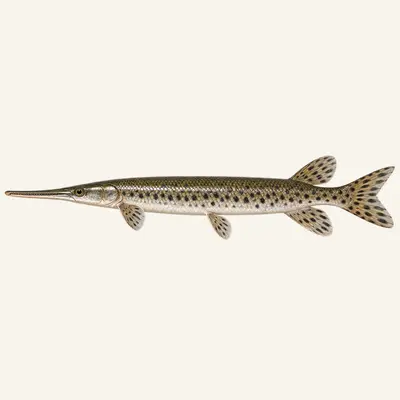
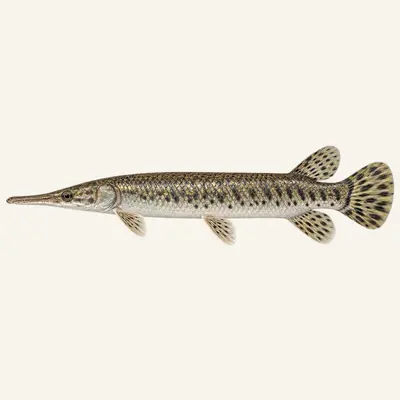
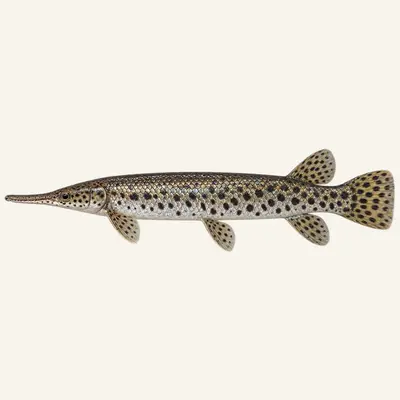
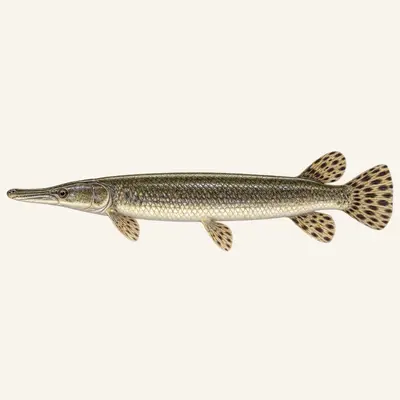
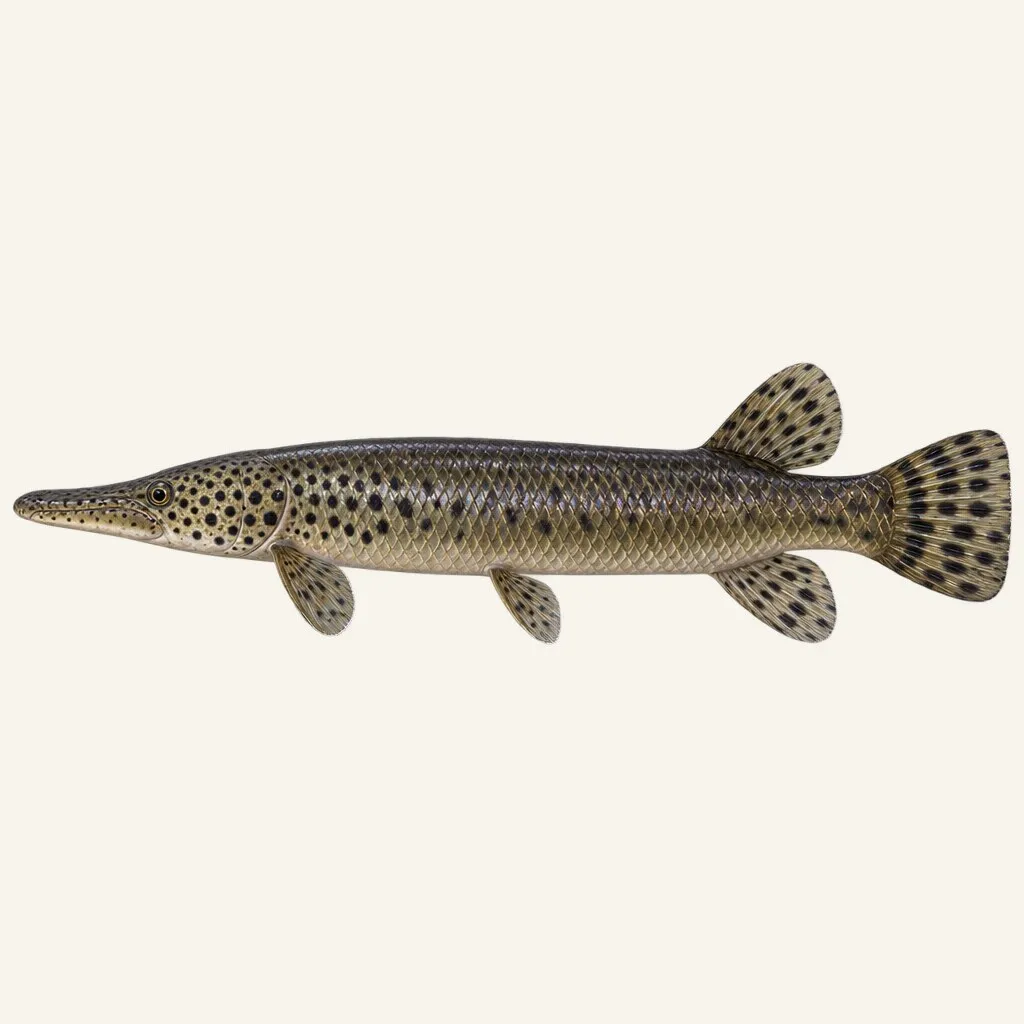
Medium-sized gar with a characteristically broad and flattened snout, covered in the hard, diamond-shaped ganoid scales typical of the family.
Calendar
Recorded in 1 country
GBIF occurrence records — native and introduced populations combined.
Its range
From the Savannah drainage in Georgia west to the Ochlockonee in Florida and Georgia, and throughout peninsular Florida.
The file also records the species as non-migratory, and that is what makes those boundaries as abrupt as they are. A fish that does not run and does not shift between systems stays inside the drainage it hatched in, so the edge of the range is the edge of the last river holding it, with no gradient beyond.
Identifying it
The character that settles this fish is underneath it. The isthmus — the strip of throat between the gill openings — carries no bony plates, where its relatives have them, and the check is made with a thumb rather than with an eye. A photograph cannot decide it.
Above the waterline the marks are the spots, and their position is what counts. They gather on the front of the body and on the head, running forward onto the snout, instead of being distributed over the rear and the median fins where the longnose gar's description places its own. The general tone is dark.
The snout is broad and so are the lower jaws — the description makes both comparisons explicitly, against the long-beaked members of the genus. On a wet fish in poor light the width of the jaw is the quickest of the three checks, and the plate test is the one that ends the argument.
Breeding
The ovary is group-synchronous. A study found two distinct waves of oocytes developing at once, which means the eggs do not all ripen together but in successive batches.
The inference drawn from that is a second spawning within the same breeding season — and the study states plainly that it could not verify one. The finding is an ovary, not an event, and it should be read at that strength. If the second spawning does occur, the breeding season here has internal structure and a female's contribution is spread across it rather than committed in one go.
The eggs themselves are not food. Gar roe is toxic to people, a property recorded across this genus and not specific to any one member of it, while the flesh is eaten and sold. Nothing in this species' own file suggests an exception, and no method of preparation removes the problem. A female found ripe on the cleaning table is a female whose ovaries go in the bin.
The water it needs
Sluggish pools with mud or sand bottoms, in quiet lowland streams and in lakes, and almost always close to vegetation.
Like the rest of the family it can supplement its breathing from the air above, which is what keeps a warm, weed-filled pool usable in August after its oxygen has gone.
Areas
- Florida swamps
- Slow-moving rivers
- Vegetated lakes
- Bayous and oxbows
Techniques
- Surface lures
- Fly fishing
- Float fishing with live bait
- Slow deadbait retrieve
Baits
- Small live fish
- Streamers
- Topwater lures
- Freshwater shrimp
How to catch it
Common length is 59.5 cm, which puts this gar within reach of ordinary tackle — fly gear, light lures, a float and a small live bait — rather than the heavy outfits its larger relatives require.
The ground is shallow, slow and full of plants, so the fish is generally seen before it is cast to. That makes this a stalking fishery, and the same clarity showing the fish shows the angler.
Weed decides the fight more than the fish does. In a bed of vegetation a hooked gar cannot be turned, and it is lost to the plants rather than to the hook — so the tackle is chosen for lifting an animal out of salad rather than for its weight, and the fight is kept short and close.
The hook itself meets the usual difficulty of the family: a hard narrow jaw set with fine teeth and nowhere for a point to seat, which is why the frayed-rope rigs exist at all. Fish come off at the strike as a matter of course.
Ganoid scales cut. A hand run along the flank of a landed gar comes off worse than the fish does.
Conservation
The whole of this species is a peninsula and a strip of Georgia, and it does not move between drainages. Those two facts together are the entire conservation question.
A non-migratory fish cannot recolonise. When a stream loses its population the gap is not filled from the next stream over, so losses accumulate locally and permanently while the species goes on looking secure at the scale of a map. What gets reported as a healthy range is an average across populations that no longer exchange anything at all.
What the fish needs is also what disappears first. Slow, shallow, vegetated water over a soft bed is the earliest casualty when a lowland stream is straightened, dredged or drained, and none of that requires a dramatic event — a change in what happens on the land beside the water is enough.
Regulations
Check the local regulations in force (legal size limits, closed seasons, bag limits).
For guidance only. Legal sizes, quotas and open seasons vary by location and season: always check the local regulations in force before fishing.
Other names
Florida gar names a state and gets the range slightly wrong, since the fish reaches well into Georgia. More to the point, it is the only one of the North American gar names that says where the animal is instead of what it looks like. Its congeners are named for the shape of the beak or for the pattern on the body; this one is named for an address. In a genus separated on snout proportion, that is the least useful kind of name available.
The scientific name repairs it exactly. Platyrhincus is flat snout, which is the character the published description leads with — and agreement between a binomial and a diagnosis is rarer in this genus than it ought to be.
The Italian entry in the catalogue goes the other way and calls this fish an alligator gar of Florida, importing the name of the far larger Atractosteus for a species that is neither in that genus nor anywhere near that size. Moving between languages, treat the name as decoration and go back to the binomial.
Sources: fishbase.se · api.gbif.org · fishbase.se