Arctic grayling
Thymallus arcticus · Salmonidae
- Freshwater
- Salmonids
- Medium
- Size
34–76 cm
- Weight
0.4–3.8 kg
- Lifespan
18 years
Where to fish
- Lake
- River
Habitat icons: Flaticon
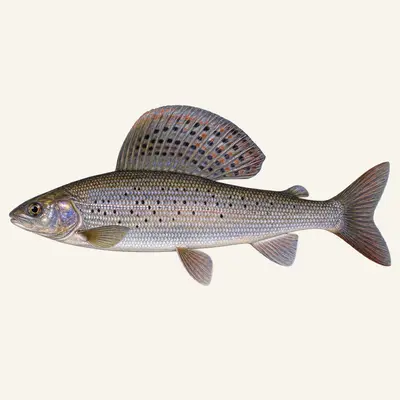
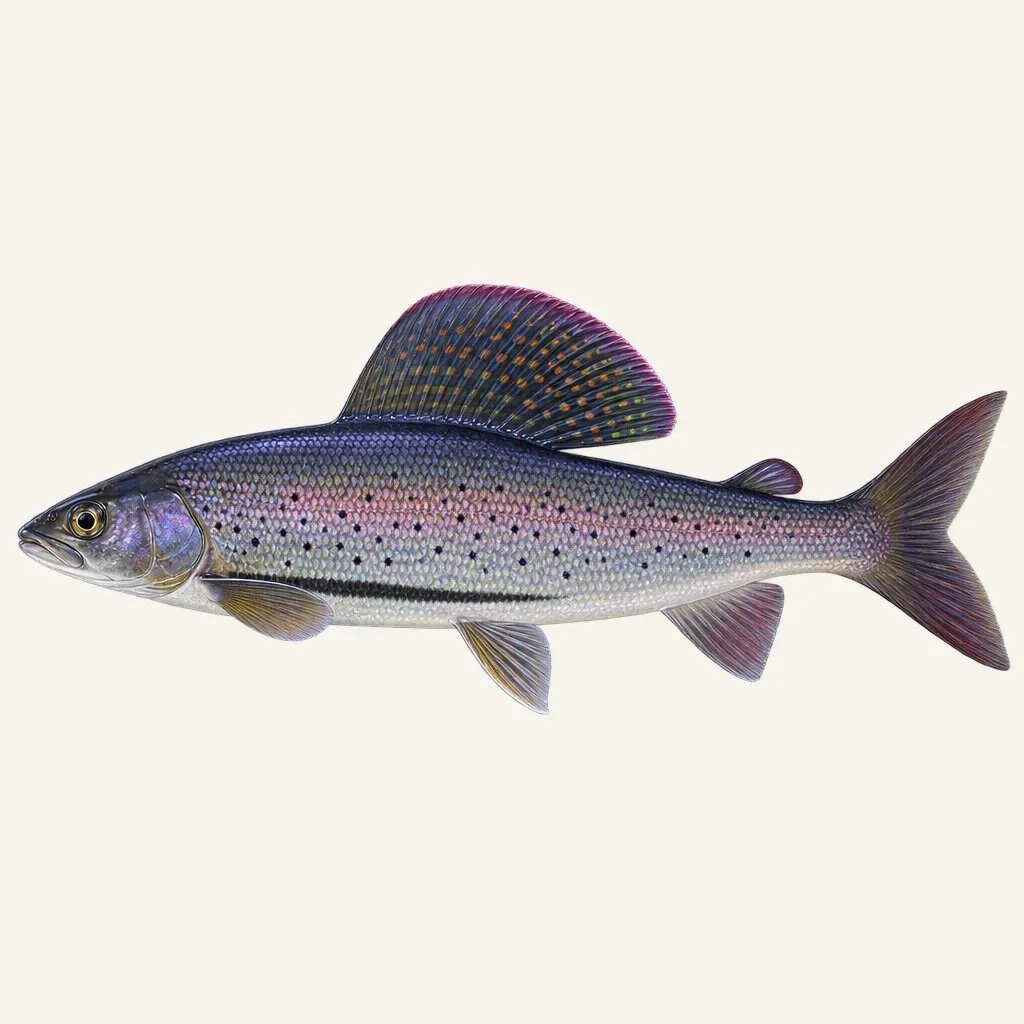
The Arctic grayling is a coldwater salmonid found in clear, fast-flowing rivers of North America and northern Asia, instantly recognizable by its large, sail-like dorsal fin with iridescent purple and orange hues. Its streamlined silver body is marked with dark spots along the flanks.
Calendar
Recorded in 3 countries
Canada · Russia · United States
GBIF occurrence records — native and introduced populations combined.
Its range
In North America the species is widespread in Arctic drainages from Hudson Bay to Alaska, and in Arctic and Pacific drainages to central Alberta and British Columbia. It reaches the upper Missouri in Montana. It formerly occupied the Great Lakes basin in Michigan.
In Asia it holds the Arctic Ocean basin in Siberia from the Ob to the Yenisei. In Europe it appears only in a few tributaries of the Pechora — the Usa, Kosyu and Kozhim — plus the Korotaikha and the Kara.
That map follows cold. The species lives between 71°N and 44°N, and the extinct Michigan population marked its furthest southern reach.
Identifying it
Nothing else in the family carries this fin. The dorsal runs 17 to 25 soft rays with no spines at all, and in an adult male it reaches the adipose fin when laid flat. In a female it stops short — which gives a usable sex character on a living fish.
The pelvics follow the same rule: long, reaching the anal in an adult male, not in a female. The lower lobe of the tail is often longer than the upper.
The mouth is small, with fine teeth on both jaws. Vertebrae run 58 to 62.
The colouring is what people remember. The back is dark, the flanks shift through blue, violet and bronze with the light, and the dorsal is spotted and edged in red on a fish in condition.
Breeding
Adults move into tributaries and the males set up territories. The courtship is all fin: the male follows the female with his dorsal spread, then drops in alongside her and folds that sail over her back.
The pair vibrates together and releases eggs and milt. No redd is dug — the tails' vibration stirs the substrate and forms a slight depression, which is enough to bury part of the spawn.
A female may spawn only once, or several times in different places. Spawning happens in mountain streams with heavy current, over shallows of rock and gravel.
Maturity comes at about 24.5 cm, within a narrow range of 23 to 26.
The water it needs
Adults hold the open water of clear, cold, medium to large rivers and lakes, and enter rocky creeks to spawn. They occur in piedmont and montane streams, rivers and lakes with high oxygen.
They shoal in moderate numbers, and depth runs to about 30 m — which makes them reachable by methods a European river grayling never calls for.
Areas
- Arctic fast rivers
- Riffles and runs
- Clear subarctic lakes
- Stream confluences
Techniques
- Dry fly fishing
- Euro nymphing
- Toc fishing
- Small spoon
Baits
- Dry flies
- Nymphs
- Small spoons
- Insect larvae
- Earthworms
What it eats
The young take zooplankton, shifting gradually to immature insects. Adults feed mainly on surface insects but also take fish, fish eggs, planktonic crustaceans — and lemmings.
That last item is not an isolated curiosity. It says a grayling of any size will take whatever falls in the water, small mammals included, which is an appetite that the fish's small mouth gives no hint of.
How to catch it
This is a surface fishery first. Adults feed mainly on insects taken at or near the top, so the dry fly is the obvious method rather than a refinement.
The fish shoal in moderate numbers: locating the group is worth more than covering distance. Rocky tributaries in spring, open lake and river water for the rest of the season.
The opportunism widens the field. A fish that takes eggs, fry and crustaceans will also answer something fished under the surface, which is the answer when nothing is hatching.
Maximum recorded age is 18 years. A large fish is an old animal in water that grows nothing quickly, and handling matters accordingly.
Conservation
The species has gone from the Great Lakes basin, where it survived in Michigan. That is the one documented contraction of its range, and it happened at the southern margin — the thermal edge, which always yields first.
Elsewhere it occupies Arctic basins with little development and few people. Its vulnerability is therefore geographic before it is ecological: it depends on the latitude of a population, and the southernmost are the ones their isolation protects least.
Regulations
Check the local regulations in force (legal size limits, closed seasons, bag limits).
For guidance only. Legal sizes, quotas and open seasons vary by location and season: always check the local regulations in force before fishing.
Other names
Arctic grayling in English, khariuz in Russian. The genus name records the smell of thyme on a freshly caught fish — a character shared across all the graylings and one of the few fish names taken from a scent rather than a shape.
Sources: fishbase.se · api.gbif.org