Atlantic salmon
Salmo salar · Salmonidae
- Saltwater
- Salmonids
- Hard
- Size
70–150 cm
- Weight
4.0–47 kg
- Lifespan
13 years
- Water temp.
2–9 °C
- Depth
0–210 m
Where to fish
- River
- Estuary
Habitat icons: Flaticon
Legendary migratory fish - Runs up rivers to spawn - Does not feed in freshwater
Calendar
Recorded in 23 countries
Belgium · Canada · Chile · Denmark · Finland · France · Germany · Greenland · Iceland · Ireland · Isle of Man · Luxembourg · Netherlands · Norway · Poland · Portugal · Russia · Spain · Svalbard & Jan Mayen · Sweden · Switzerland · United Kingdom · United States
GBIF occurrence records — native and introduced populations combined.
Its range
Temperature draws this map more than anything else does. A salmon river has to warm past 10 °C for about three months of the year, and must not stay above 20 °C for more than a few weeks in summer. The fish is comfortable between 4 and 12 °C. That window is narrow, and it accounts for both the northern spread and the retreating southern edge.
On the western side, Atlantic drainages from northern Quebec down to Connecticut and New York, and inland to Lake Ontario, where the species has been extirpated. On the eastern side, the White and Barents Sea basins through north-eastern Europe to the Baltic and North Sea, Iceland included. Introductions have put salmon into New Zealand, Chile, southern Argentina and Australia.
Some populations never reach salt water. Landlocked stocks in North America and northern Europe run the whole cycle in fresh water, treating a lake as the sea and moving into tributaries to spawn. The Australian landlocked fish are a different case: there is little evidence of any natural spawning, and they persist because they are restocked.
Identifying it
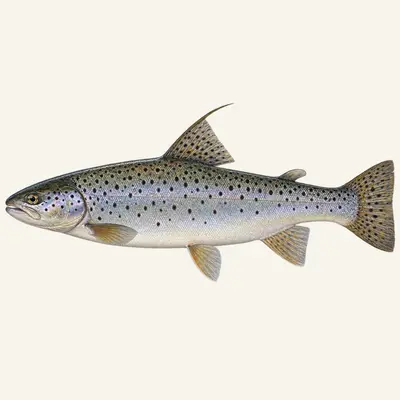
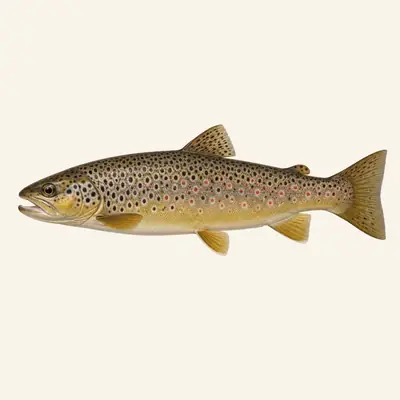
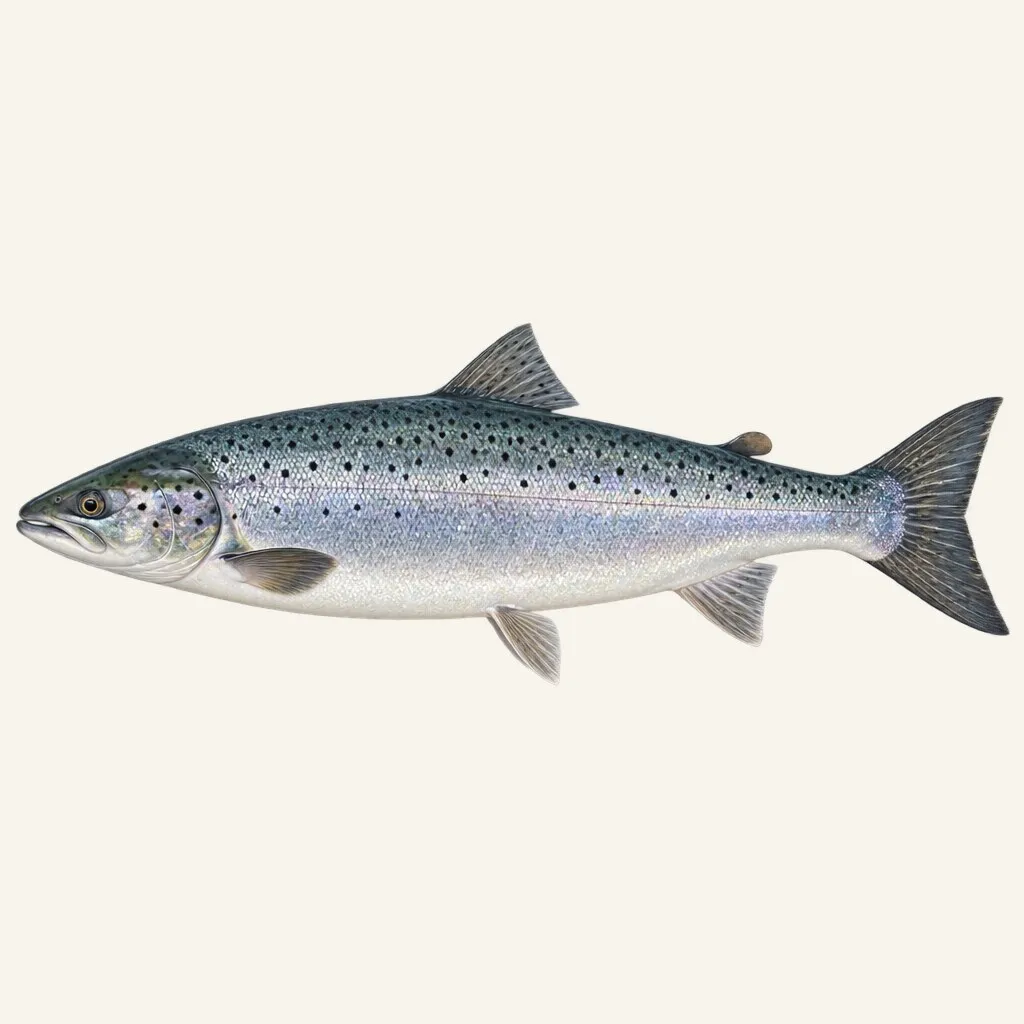
A salmon is identified by two absences. Nothing is marked below the lateral line — the black spots stop there, where a brown trout's carry on down the flank. And the rear of the vomer, the bone along the roof of the mouth, holds no teeth at all; the few it has are weak and set at the front.
The mouth is the next check: it reaches back only as far as the rear of the eye, never past it. Then the counts — 10 to 13 scales between the base of the adipose fin and the lateral line, 17 to 24 rakers on the first gill arch, 19 rays in the tail. The adipose fin has a clear or grey margin rather than a black one, and the tail is usually unspotted, deeply forked in fish under 20 cm and squaring off as they grow. The wrist of that tail is narrow enough to grip, which is why a salmon can be tailed by hand.
Colour depends entirely on stage. Parr wear 8 to 12 blue-violet marks along the flank with small red spots between them. A fish fresh from salt water is blue-green over the back, hard silver on the sides, white beneath. Weeks in the river strip that off: the silver dulls to brown or yellow, the skin thickens to something like leather, and males blotch with red or black. The male also grows the kype, a hooked lower jaw whose tips meet, and it shrinks again once spawning is over.
Breeding
A salmon returns to the river it hatched in, and often to the exact reach of that river. Tagging has confirmed it over and over. The mechanism appears to be smell: the fish records a sequence of odours on the way down as a smolt and runs that sequence backwards on the way up. Everything in this section, and most of what is written under conservation, follows from that one habit.
Fish enter fresh water from June to November. Spawning itself happens between 6 and 10 °C, far up the system, in gravel under moderate to fast flow, on reaches that alternate riffles and pools.
The female picks the site on physical criteria: gravel of the right calibre, 10 to 30 cm deep, under half a metre to three metres of water. She cuts the redd by turning on her side and flexing her body, lifting stones without touching them. Salmon spawn in pairs, and the male's work throughout is keeping rivals off. The eggs sink in and are covered with a further layer of gravel, usually pushed over by him.
One female sheds 8,000 to 25,000 eggs in a season, roughly 500 to 2,000 for every kilo of her own weight, spread across several redds and several partners over two or three days.
Then the cost is counted. Most males die. Between 10 and 40 % of females survive, dropping back in autumn or wintering in the river before feeding a summer at sea and coming again; of those, only 0.3 to 6 % spawn a second time. Short rivers change the arithmetic — where the journey up is less punishing, as many as 34 % of returning fish are repeat spawners, and a few manage six seasons.
Eggs hatch in spring, 70 to 160 days after laying. Alevins move away from light and work deeper into the stones; when the yolk sac is spent, the fry come out and settle in shallow riffle water immediately below the redd that produced them. Somewhere between 14 and 61 % of them die in the first months.
Parr then hold in the river for one to seven years, most for two or three. Smoltification, the change that lets a river fish live in the sea, runs on a schedule set by latitude: at the southern edge of the range a parr reaches 12 to 15 cm and smolts in its first spring, while in the far north the same transformation takes five or six years. The runs themselves track rising temperature and spring flow, which is why they arrive in pulses rather than steadily.
The water it needs
Three habitats, used in sequence, and the fish needs every one of them. In the river it holds in rocky runs and pools of streams and large rivers alike, and in some lakes. At sea it works the open North Atlantic, from the surface down to about 210 m and usually between 10 and 23, sometimes thousands of kilometres from the mouth it came out of. The estuary sits between the two, and it is where the physiological switch is made in both directions.
Parr are the fussiest stage and the one that sets a river's ceiling. They are territorial, they take the upper reaches, and they want riffles with strong current over coarse gravel; through winter they spend daylight jammed under stones. A catchment produces as many salmon as its headwater riffles can hold parr, not as many as its lower reaches could feed.
The sequence is also the weakness. One impassable structure between the sea and those headwater riffles removes the species from everything above it, however good that water remains.
Areas
- Pools
- deep holes
- river currents during the run
Techniques
- Flies
- Lures
- Shrimp
Baits
- Spoon
- Devon
- Salmon flies
- Tubes
What it eats
Growth happens at sea. Adults out there take fish, squid and shrimp, and a smolt that left weighing a few dozen grams comes back weighing kilos. In the river, parr live on drifting invertebrates, aquatic insects, molluscs, crustaceans and small fish.
Adults that have entered fresh water to spawn all but stop eating. They run, hold, fight and spawn on reserves laid down in salt water, which is why a fish loses condition steadily through the season.
How to catch it
Nothing an angler does can appeal to a salmon's appetite, because a salmon in the river has stopped using one. A take is a reaction — irritation, aggression, or a reflex left from a life spent chasing prey offshore — which is why one pool can be dead for a week and then give up three fish in an hour.
Conditions therefore outrank technique. A lift in level, a shift of a degree or two, a change in the light puts fish on the move, and moving fish take far more readily than settled ones. A salmon that has sat in the same pool for three weeks is close to unfishable; one that arrived overnight is not.
The rest is knowing where fish stop. Between one push upstream and the next they rest in particular pools and creases, and those lies stay put from year to year because the bed does. Knowledge of holding water is worth more here than any refinement of tackle.
The fishing is tightly regulated wherever the species survives, the rules differ from one catchment to the next, and they are revised often. They come from the fishery authority for the water in question.
Conservation · Near Threatened (IUCN) — This species is in decline. Release your catch quickly and handle it with care — wet hands, as little time out of the water as possible.
Conservation
Many European populations are already gone, and a large share of what survives is described as depending mostly or entirely on stocking — another way of saying that the natural cycle no longer closes on its own.
Access is the first cause. Dams, weirs and culverts cut the route to the spawning gravel, and everything upstream of the obstruction is lost at once. Warming is the second, working on a thermal window that was never wide.
Then there is the farm. Pressure from fishing on wild stocks has fallen as aquaculture has grown, but the problems that replaced it have grown faster. Farmed salmon escape in large numbers, enter whatever river they come across and breed with wild fish, blurring populations that were distinct. Cage culture also concentrates disease — furunculosis, bacterial kidney disease, enteric redmouth, infectious pancreatic necrosis — in water that wild fish have to pass through.
Fidelity to the natal site turns each of these losses into a permanent one. A river emptied of salmon does not refill from the river next door, because the fish that would have to do the refilling are, by definition, going somewhere else.
Regulations
Minimum size 40-50cm / Very strict quotas / Often catch-and-release
For guidance only. Legal sizes, quotas and open seasons vary by location and season: always check the local regulations in force before fishing.
Other names
English calls it the Atlantic salmon, and in Britain the word salmon with no qualifier means this fish and no other. The life stages have a vocabulary of their own that recurs in every technical text: alevin in the gravel, fry at emergence, parr through the freshwater years, smolt on the way down, grilse for an adult back after one winter at sea, kelt for a spent fish that survives and drops back. The hooked jaw of a breeding male is a kype. Landlocked fish in eastern Canada are ouananiche. The species name, salar, is Latin for the leaper.
Sources: fishbase.se · api.gbif.org