European sturgeon
Acipenser sturio · Acipenseridae
- Saltwater
- Sturgeons
- Medium
- Protected
- Regulated
- Size
150–300 cm
- Weight
18–400 kg
- Lifespan
100 years
- Water temp.
10–18 °C
- Depth
4–93 m
Where to fish
- Estuary
Habitat icons: Flaticon
Near-extinct species - Last breeding basin: Gironde-Garonne-Dordogne (France)
Calendar
Recorded in 7 countries
Belgium · Denmark · France · Germany · Netherlands · Spain · United Kingdom
GBIF occurrence records — native and introduced populations combined.
Its range
One population still reproduces, in the Garonne. What that remnant stands for is a range that once ran from Norway to the Bay of Biscay, took in the North Sea and the European Atlantic seaboard, reached along the northern Mediterranean as far as Rhodes and into the western and southern Black Sea, with stray records from the White Sea, Iceland, Morocco and Algeria. The Danube never held it above the delta.
Two genetic results change how that map should be read. Sequences recovered from museum specimens show this fish sharing water with the Adriatic sturgeon from the Adriatic itself to the Iberian Peninsula, so old bones assigned to one or the other are not reliable markers. And Gironde fish differ measurably in sequence from those of the North Sea and the Baltic.
The practical consequence is hard. The surviving nucleus is not a representative sample of what has gone, and the lineages lost elsewhere cannot be rebuilt out of it.
Identifying it
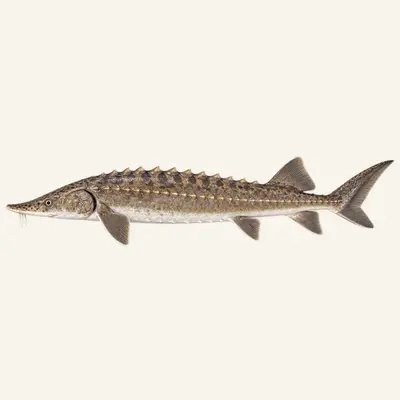
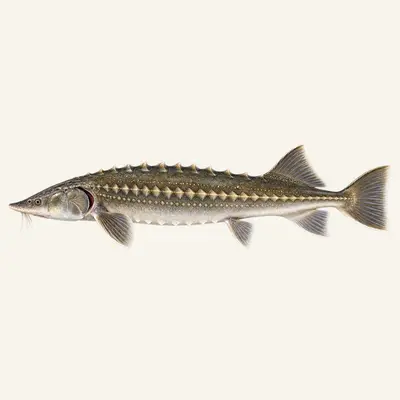
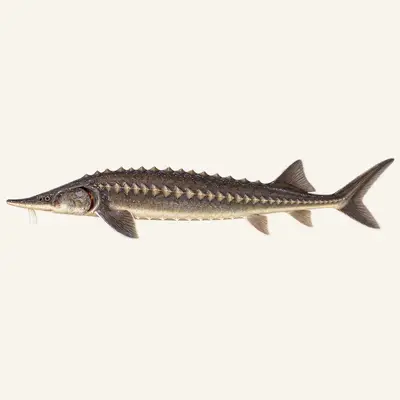
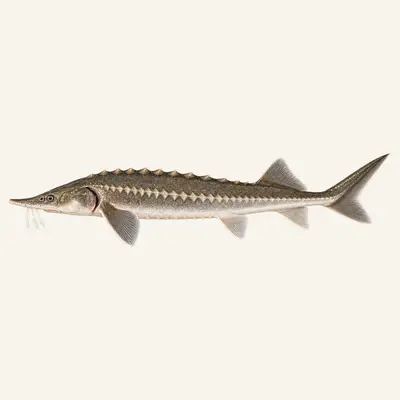
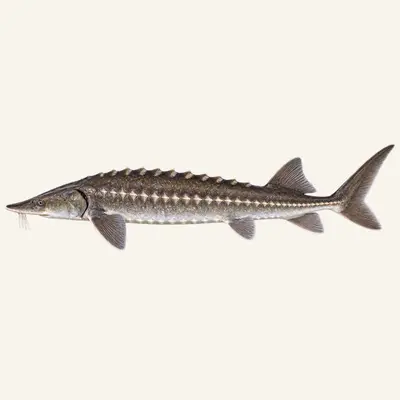
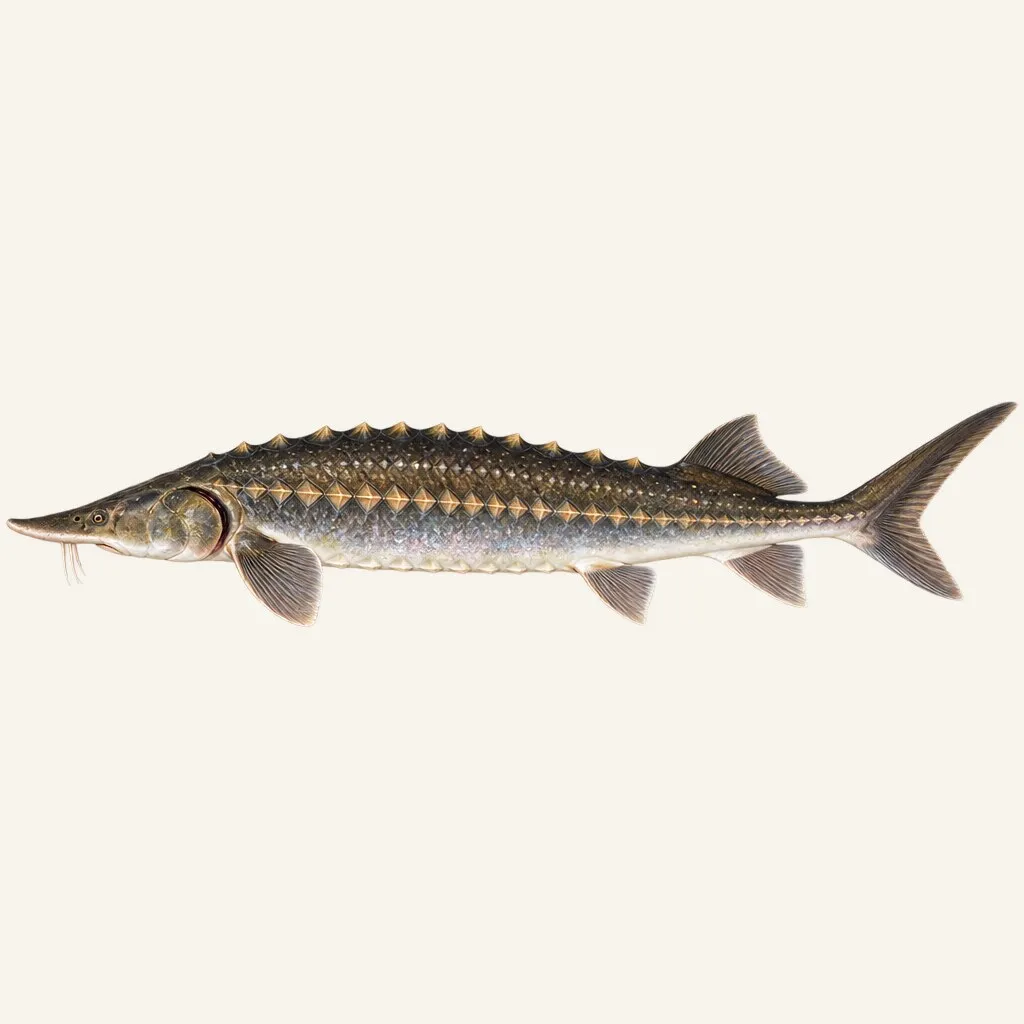
Between the dorsal row of scutes and the rows running down the flanks, the skin is not bare. It carries a dense scatter of small rhombic plates set in cross-lines, and that field is the first thing to look for: the Adriatic sturgeon, which shared these waters for centuries, has nothing at all in the same gap.
The four barbels hang halfway between the tip of the snout and the mouth and never reach it. The snout itself is moderate in length, narrow, drawn to a point; the mouth opens under the head, and the lower lip is broken at its middle.
Scales are absent. Five rows of bony scutes take their place — nine to 16 on the back, 24 to 39 along each flank, nine to 14 down each side of the belly — and the cross-section they enclose is pentagonal, which the hand registers before the eye does. The back runs greenish-brown to blackish with a gold cast, the flanks are pale and silvery, the belly white. The dorsal carries 30 to 44 soft rays, the anal 23 to 30.
One reference point has moved, and it matters. The published maxima belong to the archive, together with the hundred-year lifespan that went with them. Males alive now stop between one metre and 1.5 m, females between 1.3 and 2.15 m. Quoting the old figures describes a population that no longer exists.
Breeding
Spawning waits on a temperature threshold that a temperate river reaches late: nothing happens below 20 °C. Three further conditions stack on top of it — two to 10 m of water, a stony bed, and a current running 1.5 to 2 m per second. The window nominally spans March to August; the conditions narrow it hard in most years.
Adults run to the middle reaches of large rivers in spring and early summer, and they stop feeding for the whole of it. How far they get depends on hydrology: runs of 1,000 km and more are recorded when levels are high, and a low year shortens the reach.
The eggs are dark grey, sticky, 2.6 to 3 mm across, and take about a week to develop at 17 °C. A female lays more of them as she ages, which gives the oldest fish a demographic weight out of proportion to their number. Spent adults drop back to the sea.
The interval is what makes the arithmetic unforgiving. A male spawns every second year, a female once in three or four. Set against a life that can run to a century, that is a small number of attempts, and each one needs a flood, a warm late summer and an open channel at the same time.
The water it needs
Most of the life happens at sea, on coastal ground and in estuaries, between four and 93 m and usually between five and 60. Substrate is no constraint: sand through to rock will do. The fish is normally alone.
The estuary is a nursery rather than a corridor. Juveniles hold there for two to three years while their physiology adjusts to salt water, and only a few drop to sea in their first summer. A degraded estuary therefore writes off an entire year class while the spawning gravel far upstream is still perfectly good.
The thermal band is narrow, 10 to 18 °C, and it accounts for where the southern edge of the old range sat.
Areas
- Estuaries of major rivers
- River mouths and tidal zones
- Deep coastal pits
- Large rivers with moderate current
Techniques
- Bottom fishing with laid rig
- Feeder fishing in estuary
- Static bottom rig with long leader in river
- Nocturnal bottom fishing
Baits
- Earthworms
- Maggots
- Fresh shrimps
- Flavored paste baits
- Fish chunks
What it eats
Feeding is done blind, on the bottom. The mouth is ventral, toothless and protrusible; the barbels trail ahead of it and locate crustaceans, molluscs, polychaete worms and small fish by touch and by chemical cue. Sight plays no part.
The one interruption is the spawning run, when nothing is eaten for weeks. What a fish brings to the gravel is what it stored at sea the season before.
How to catch it
There is no fishery. Appendix I of CITES bans international trade outright, and the last nucleus capable of breeding sits in a single basin. The realistic encounter is accidental capture, which is also the first threat listed for the species, ahead of poaching.
Two points of anatomy are worth carrying. The body is armoured, and the dorsal scutes will open a hand laid on them. The mouth, at the other end of the scale, has no teeth in it and can do nothing.
Identification deserves a moment. The genus crosses freely — most of its species will hybridise, and this one has produced rare crosses with the Russian sturgeon — while several other acipenserids are farmed in Europe. A sturgeon on the line is not necessarily this one, and the position of the barbels together with the rhombic plate field settle it.
The overlap that matters is in the estuary. Juveniles occupy the Gironde for two to three years, which is exactly where bottom rigs are fished. Watching a set rod counts for more here than anywhere else.
Protected — Sensitive or protected species depending on area: check local rules before taking action.
Regulated — Often governed by quotas, size limits, seasons, or reporting rules.
Conservation · Critically Endangered (IUCN) — This species is threatened with extinction. Always release it (no-kill), handle it with the utmost care and check local rules — fishing for it may be prohibited.
Conservation
Four mechanisms brought the species down, and they strike at different points in the cycle. Bycatch and poaching remove adults at sea and in the estuary. Degraded spawning beds and nurseries remove recruitment. Physical barriers close the middle reaches, the only sector where laying is possible. One of the four is enough on its own; the rivers of the old range generally accumulated them.
The biological calendar finishes the explanation. Slow growth, a lifespan reaching a century, females laying once in three or four years and only after attaining a very large size: between a restoration measure and its first measurable effect lies more than a human generation. That, rather than cost, is what defeats recovery programmes.
The legal framework follows the scarcity. Trade is banned under Appendix I, and the fish is carried on Appendices I and II of the convention on migratory species, the instrument that commits the states along one migration route to act together. For an animal that runs 1,000 km up a river and then follows coasts belonging to several countries, no national measure taken alone would reach far enough.
Regulations
Check the local regulations in force (legal size limits, closed seasons, bag limits).
For guidance only. Legal sizes, quotas and open seasons vary by location and season: always check the local regulations in force before fishing.
Other names
European sturgeon is the usual English name, with common sturgeon and sea sturgeon both in circulation. Atlantic sturgeon is a trap: in North American usage it names a different fish on the far side of the ocean, and a literature search that ignores the distinction returns the wrong animal. German keeps Stör for the genus and the species alike; French says esturgeon commun.
Sources: fishbase.se · api.gbif.org