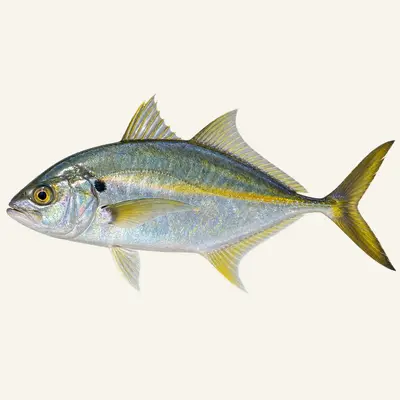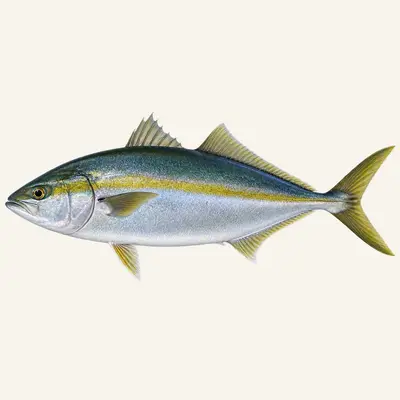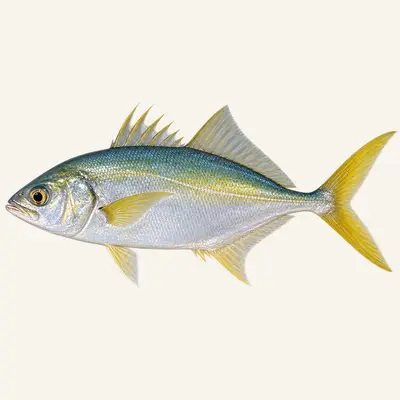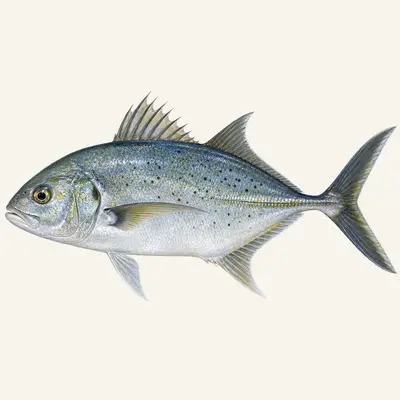
Greater amberjack
Seriola dumerili · Carangidae
- Saltwater
- Coastal
- Medium
- Size
100–190 cm
- Weight
12–81 kg
- Lifespan
15 years
- Depth
1–385 m
Where to fish
- Reef
- Rocky shore
- Offshore
Habitat icons: Flaticon
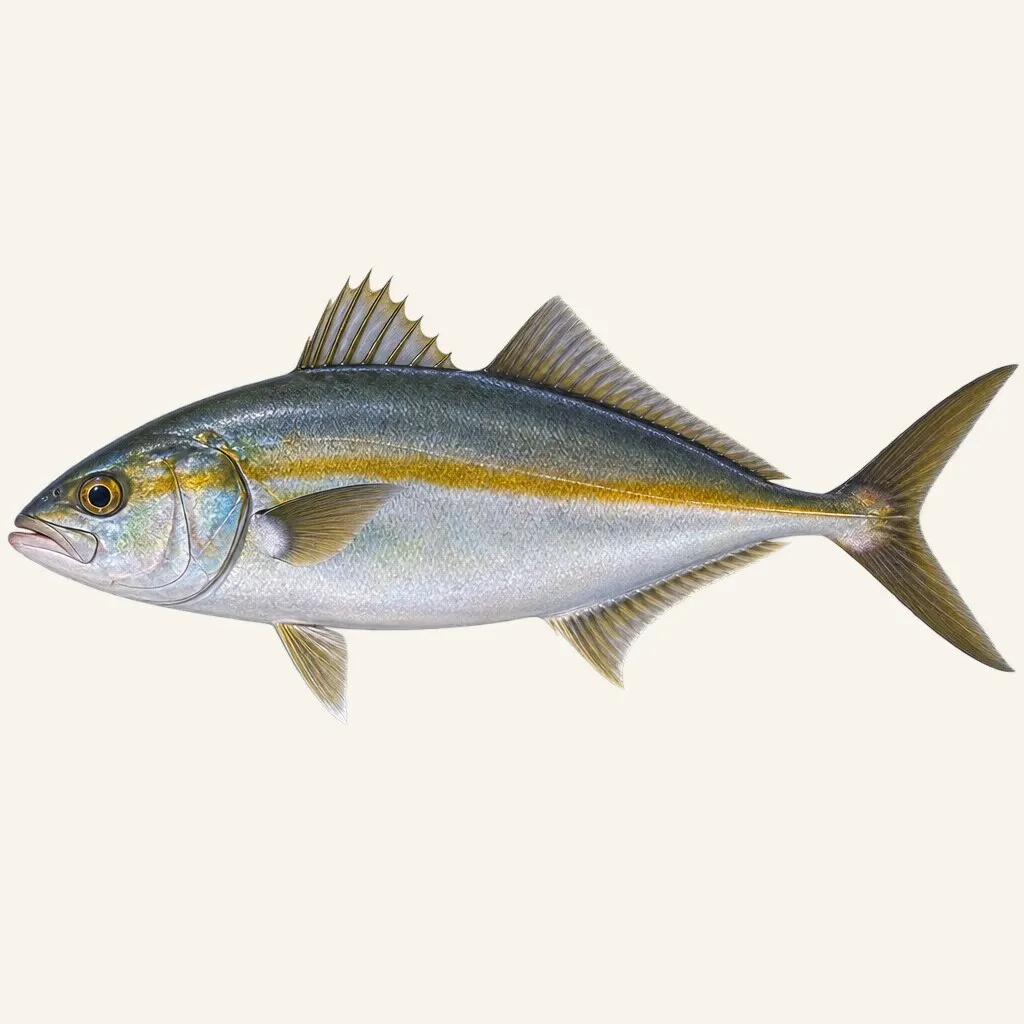
The greater amberjack is the largest member of the Carangidae family, recognized by its streamlined body, a golden stripe running from eye to tail, and a slight crest on the nape of adults. A fast pelagic fish of temperate to tropical waters, it can exceed two meters and reach considerable weights.
Calendar
Recorded in 28 countries
Australia · Benin · Cameroon · Congo - Brazzaville · Côte d’Ivoire · Croatia · Equatorial Guinea · France · Gabon · Ghana · Greece · Guinea · Guinea-Bissau · Israel · Italy · Japan · Liberia · Mozambique · Nigeria · Portugal · Puerto Rico · Senegal · Sierra Leone · Solomon Islands · Spain · Taiwan · Türkiye · United States
GBIF occurrence records — native and introduced populations combined.
Its range
The species is circumglobal in tropical and warm temperate seas.
In the Indo-West Pacific it runs from South Africa and the Persian Gulf to southern Japan and the Hawaiian Islands, south to New Caledonia and out to the Mariana and Caroline Islands. In the western Atlantic, from Bermuda and Nova Scotia to Brazil, the Gulf of Mexico and the Caribbean included. In the eastern Atlantic, from the British coast, where it is a vagrant, to Morocco and the Mediterranean.
One part of the chart is not settled. Its distribution along the African coast, in the eastern central Atlantic, remains poorly established because of past confusion with Seriola carpenteri, so records from that stretch may belong to either fish.
Identifying it
An amber band runs the length of the midside, from the head to the tail. It gave the fish its name in several languages and it remains the quickest mark to read on a fresh one.
The back is bluish grey or olivaceous, the belly silvery white, the fins dusky. The second dorsal and the anal both carry a low anterior lobe, which is worth measuring by eye: the amberjacks separate partly on the height of that lobe.
The genus announces itself through something missing. There are no scutes — the keeled, spiny scales that armour the caudal peduncle of most jacks. A smooth peduncle therefore rules out the armoured carangids in one move, and it rules out nothing else: the pompanos of the genus Trachinotus have no scutes either. The character is an exclusion and should be used only as one.
The fin counts are eight dorsal spines followed by 29 to 35 soft rays, then three anal spines and 18 to 22 rays.
Breeding
Spawning takes place in summer, in areas close to the coast.
Embryonic development lasts about 40 hours at 23 degrees, and larval development 31 to 36 days. The eggs measure 1.9 mm and the larvae 2.9 mm at hatching.
Maturity arrives late: 91 cm on average, within a range of 80 to 127. That is a high threshold, and it means a large share of the individuals encountered have bred nothing at all. The oldest reported fish was 15 years old.
The water it needs
Adults hold deep seaward reefs and enter coastal bays occasionally. The depth range runs from 1 to 385 m, with most of it between 18 and 72.
Juveniles live somewhere else entirely. Small ones associate with floating plants and drifting debris in oceanic and offshore water, alone or in small schools.
That association of the young with floating objects is shared by several jacks, and it is why they turn up under a plank or a raft of weed a long way from any coast.
Areas
- Offshore wrecks
- Underwater drop-offs and cliffs
- Deep reefs
- Rocky banks
Techniques
- Vertical jigging
- Deep live bait fishing
- Drop-off trolling
- Squid jigging
Baits
- Heavy metal jigs
- Live bait (mackerel, scad)
- Squid
- Large soft plastic lures
What it eats
Adults feed mainly on fish, the bigeye scad named specifically among them, and on invertebrates.
This is a pursuit predator of open water rather than a fish that waits in a station. Its build says so before any stomach content is examined.
How to catch it
The offshore drop-off is the position. This amberjack holds deep seaward reefs, most of the time between 18 and 72 m, so it is structure fishing in depth rather than along an edge.
Its power is in proportion to its size, and the first run goes straight down. That is what breaks undersized rigs, and it happens within seconds of the hook going in.
Ciguatera has been reported from this species in certain areas, and one particularity of the fish makes the warning easier to place than usual: it is also farmed, in the Mediterranean among other places, and a caged fish fed on manufactured pellets has no reef food chain to draw the toxin from. The hazard belongs to wild fish off certain grounds, not to the species in the abstract. Which ground a fish came from is therefore the whole of the question, and it is settled on the spot rather than in a kitchen.
Conservation
Maturity at 91 cm on average, in a range running to 127, is the figure that counts. A fishery taking metre-long fish is working very largely on individuals that have not yet bred, and 15 years of possible life leaves a long stretch of it exposed.
The species is also reared in the Mediterranean, and farming a marine carnivore raises the familiar question of what has to be caught in order to feed it.
Regulations
Check the local regulations in force (legal size limits, closed seasons, bag limits).
For guidance only. Legal sizes, quotas and open seasons vary by location and season: always check the local regulations in force before fishing.
Other names
Greater amberjack in English, from the amber band. Amberjack on its own covers several members of the genus in the trade, so the word decides nothing on a label; greater distinguishes this fish from the lesser amberjack, Seriola fasciata, of the same waters.
Japanese usage is more precise than English here, and it has spread with the fish: kanpachi refers to this species, while hamachi belongs to the Japanese amberjack. Italian says ricciola, Spanish pez limón.
Sources: fishbase.se · api.gbif.org