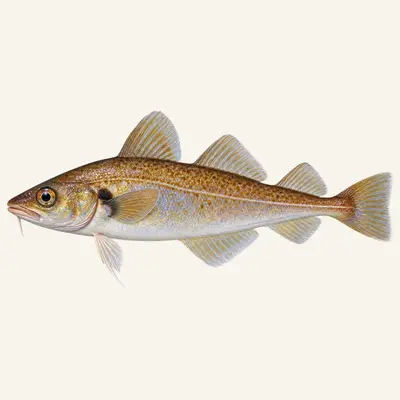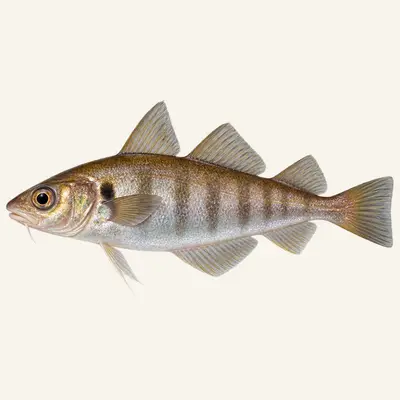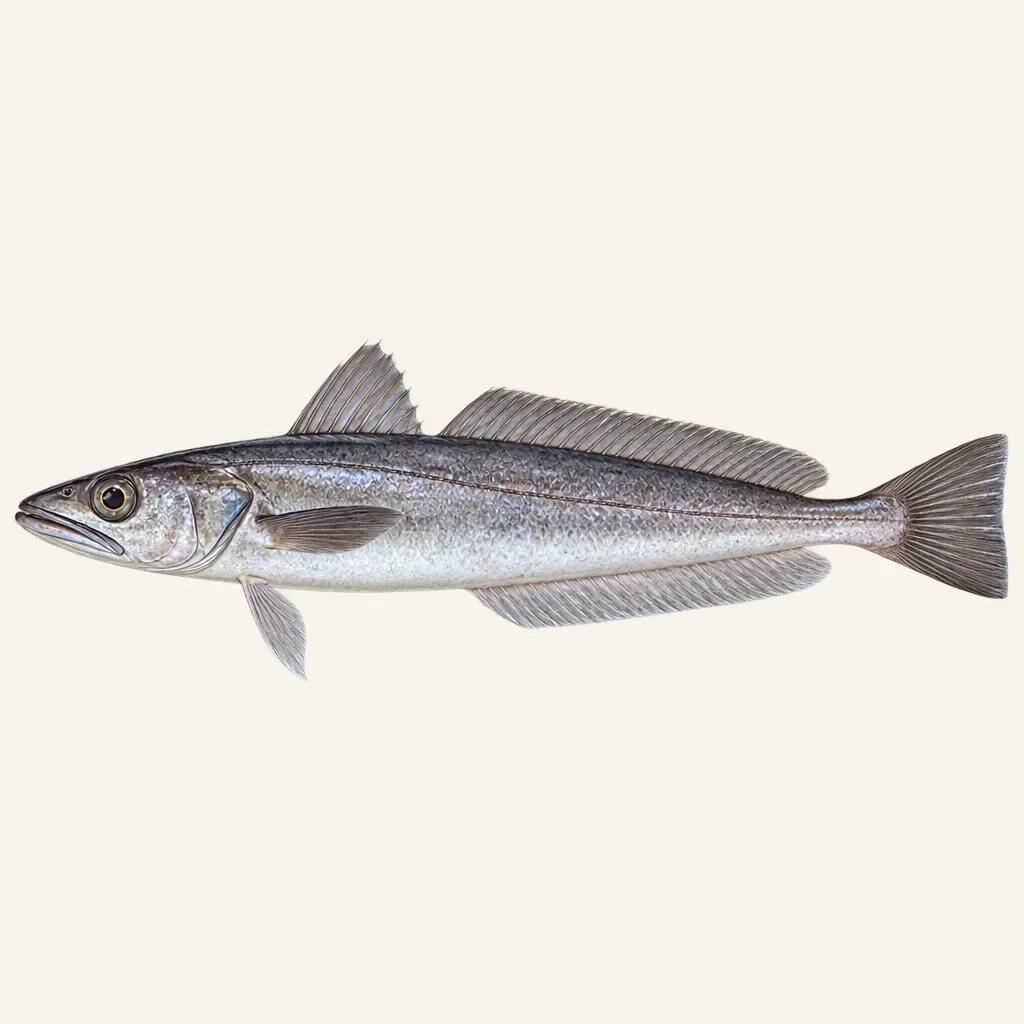
European hake
Merluccius merluccius · Merlucciidae
- Saltwater
- Bottom fish
- Medium
- Size
45–140 cm
- Weight
0.7–15 kg
- Lifespan
20 years
- Depth
18–1,075 m
Where to fish
- Rocky shore
Habitat icons: Flaticon
Slender deep-water predator of the Atlantic and Mediterranean, with a large mouth lined with sharp teeth and a blackish mouth cavity.
Calendar
Recorded in 14 countries
Albania · Algeria · Croatia · Denmark · France · Ireland · Isle of Man · Israel · Italy · Montenegro · Norway · Spain · Sweden · United Kingdom
GBIF occurrence records — native and introduced populations combined.
Its range
The eastern Atlantic from Norway and Iceland south to Mauritania, plus the Mediterranean and the southern coast of the Black Sea.
A single species covering the Arctic circle and the tropics needs explaining, and the answer is depth. This animal lives between 70 and 400 m, and a layer at that depth off Mauritania is not the water at the surface above it. What looks like extraordinary thermal tolerance is a fish choosing a stratum instead of a latitude, and letting the ocean supply the same conditions at both ends of the range.
Identifying it
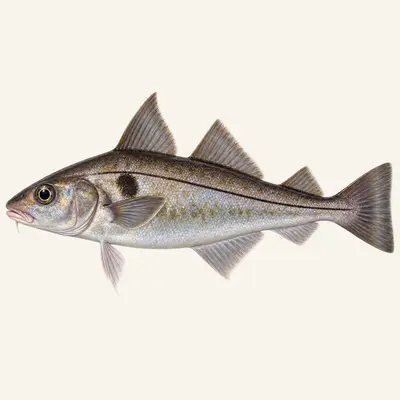
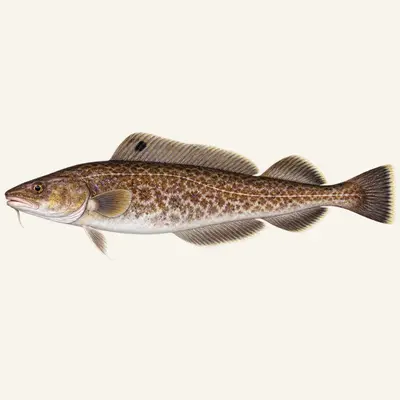
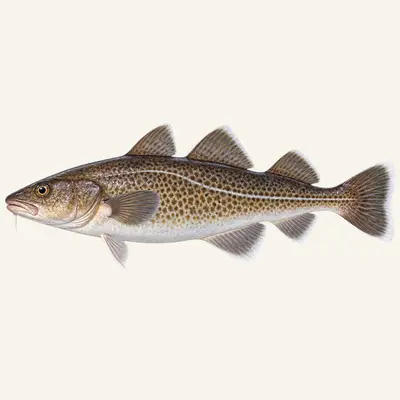
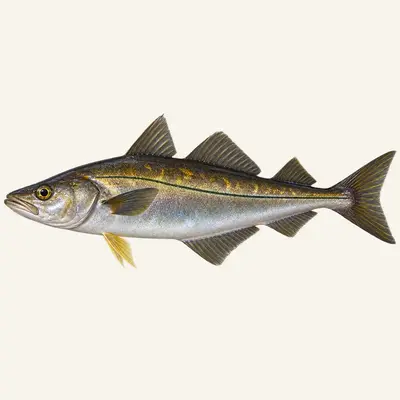
Start with what this fish is not. The catalogue files it in the Merlucciidae, the hakes' own family; the cod, the saithe, the whiting and the haddock are Gadidae, and the ling and the burbot are Lotidae. The three families are counted apart before they are told apart, and the resemblance between them is a resemblance of trade, not of kinship.
The count here is two dorsal fins and one anal, the second dorsal and the anal both notched — not the three-and-two arrangement that identifies the cods at a glance. Forty-three to 51 soft rays above, 36 to 40 below, no spines. Vertebrae number 50 to 52, and the first of them, with its neural spine, is attached to the skull.
The field character is the mouth, and it takes one second. The inside of the mouth and of the branchial cavity is black. The catalogue description rendered on this page says the same thing in different words, adding the sharp teeth: two sources in the repository agreeing on one feature, which is more than most characters get. Open the jaw and the determination is finished.
Breeding
The species spawns in batches, and there is a complication behind that word worth setting out properly: oocytes are recruited continuously through the season, which makes fecundity indeterminate.
In practice that means the eggs in an ovary at any one moment do not add up to what the female will produce. New oocytes form while she is still spawning. Counting them gives a snapshot, not a total, so the usual route from a number of females to a number of eggs is closed for this species. It is a real obstacle to assessment, and it is a property of the animal rather than of the survey.
Length at first maturity is 42.1 cm, in a published range of 20 to 70.
The water it needs
Recorded depth runs from 18 to 1,075 m, with the usual band between 70 and 400.
Inside that band the position changes with the clock. Adults hold close to the bottom during the day and move off it at night. One mark therefore holds its fish at two heights over 24 hours, and gear set for the bottom at noon and gear set in mid-water after dark are not fishing the same population by mistake — they are fishing the same fish at two of its addresses.
Areas
- Deep offshore trenches
- Continental shelf edge
- Intermediate waters (100-400 m)
- Atlantic current zones
Techniques
- Deep jigging
- Slow trolling
- Weighted soft lure fishing
- Bottom paternoster rig fishing
Baits
- Shad soft lures
- Whole squid
- Deadbait fish (sand eels)
- Luminous pirks
- Octopus pieces
What it eats
Adults eat fish and squid. The fish named are small hakes, anchovies, pilchard, herrings, sardines and gadoids; the young live on crustaceans, especially euphausiids and amphipods.
Small hakes at the head of that list means cannibalism, and in this species it is not a curiosity. Where a strong year class arrives under a large standing stock of adults, the adults are among the things eating it. Recruitment is therefore linked to the abundance of adults in the negative direction, which is the reverse of the assumption most stock arithmetic starts from.
How to catch it
The day-night cycle is the single most useful thing on this page: near the bottom by day, up off it by night. Everything else follows from where the fish is at the hour being fished.
Deep jigging, weighted soft lures, whole squid, sandeel deadbait and luminous pirks are the catalogue's list, and they are all fish-shaped or squid-shaped for the obvious reason. An adult is a strict predator of swimming prey, so nothing static on the ground plays to it.
Common length is 45 cm, and the useful band is 70 to 400 m. Below that lies a great deal of recorded depth that does not represent ordinary fishing.
Conservation
The source states plainly that stocks appear to be over-fished, so the question is what makes the species hard to manage rather than whether it needs managing.
Three things do. Indeterminate fecundity blocks the standard conversion from spawning females to egg production, which weakens every projection of recruitment built on it. Maturity spread across 20 to 70 cm means that a single threshold cannot fit populations 3,000 km apart — what is an adult in one part of the range is a juvenile in another. And cannibalism ties the survival of a year class to how many adults are above it, in a direction few models carry.
Almost all of the catch is marketed fresh, whole or filleted. That is a market that pays for condition and handling rather than for volume, and it is the one lever in this list that responds quickly to a decision.
Regulations
Check the local regulations in force (legal size limits, closed seasons, bag limits).
For guidance only. Legal sizes, quotas and open seasons vary by location and season: always check the local regulations in force before fishing.
Other names
European hake in English, and the qualifier is doing the work. Hake is spread over a dozen species of the same genus on both sides of the Atlantic and both sides of the Pacific — Cape hake, Argentine hake, silver hake, Pacific hake — so the bare word names a family and a shape while saying nothing about which ocean the fish came out of.
Spanish merluza, Italian nasello, Portuguese pescada, German Seehecht, sea pike. The French slab uses colin, which it also uses for the saithe: one word, two families, and no way to tell from the label which of them is on the ice.
Sources: fishbase.se · api.gbif.org