Haddock
Melanogrammus aeglefinus · Gadidae
- Saltwater
- Bottom fish
- Medium
- Size
35–112 cm
- Weight
0.4–17 kg
- Lifespan
20 years
- Depth
10–450 m
Where to fish
- Rocky shore
Habitat icons: Flaticon
Also processed into fish meal and animal feed.
Calendar
Recorded in 16 countries
Canada · Denmark · Faroe Islands · Germany · Greenland · Iceland · Ireland · Isle of Man · Netherlands · Norway · Russia · St. Pierre & Miquelon · Svalbard & Jan Mayen · Sweden · United Kingdom · United States
GBIF occurrence records — native and introduced populations combined.
Its range
The North Atlantic and the Arctic beside it: from the Mediterranean north to southern Greenland and Iceland, and from the southern Barents Sea east as far as the Kara Sea.
The interesting part of that span is how little of it is used at once. What governs where the fish actually is is set out under habitat, and it is a temperature, not a coastline.
Identifying it
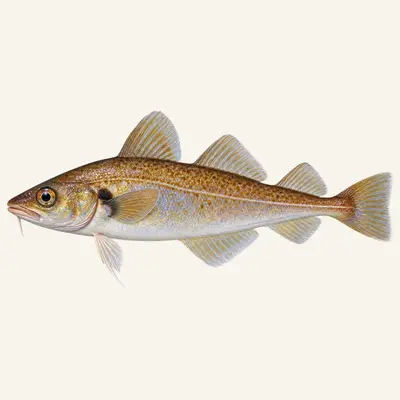
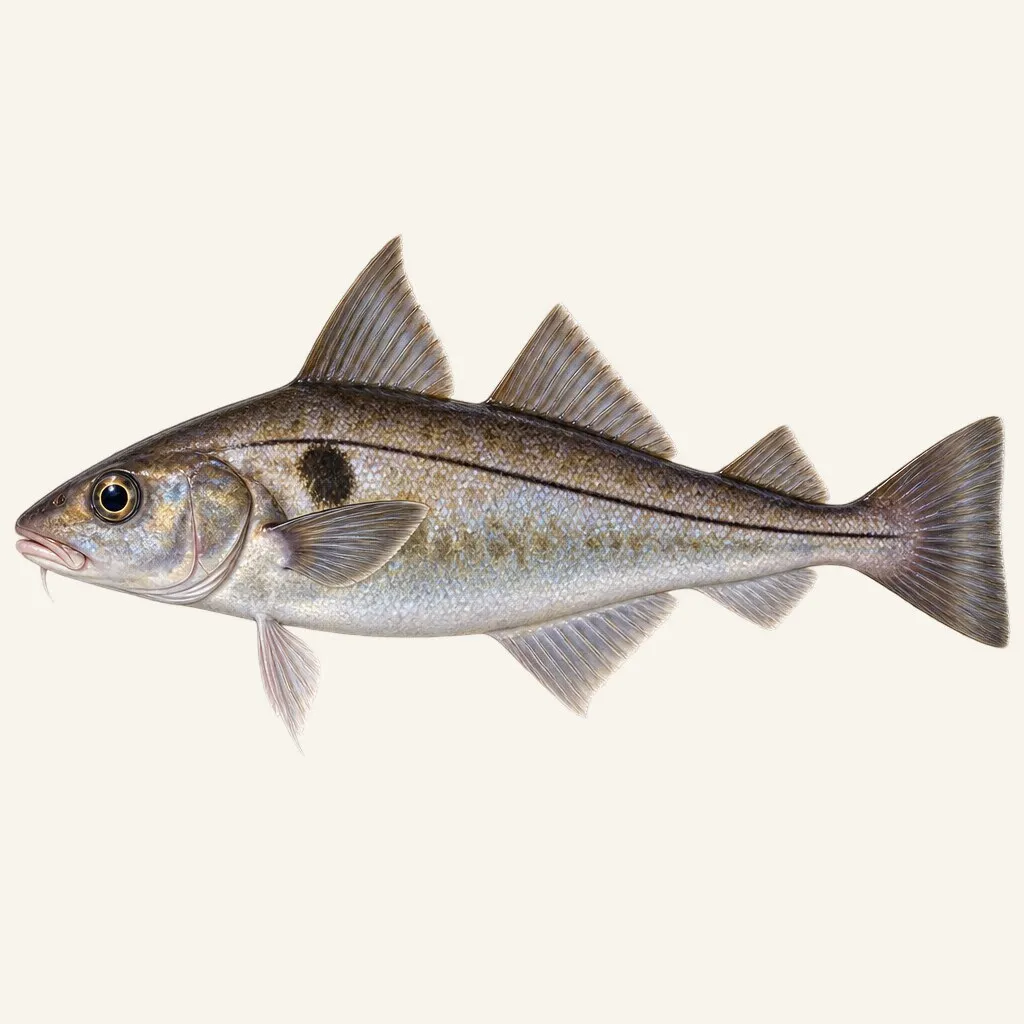
A large dark blotch sits above the pectoral fin, just below the lateral line. It is constant, it survives a night on ice, and on this fish nothing else needs consulting.
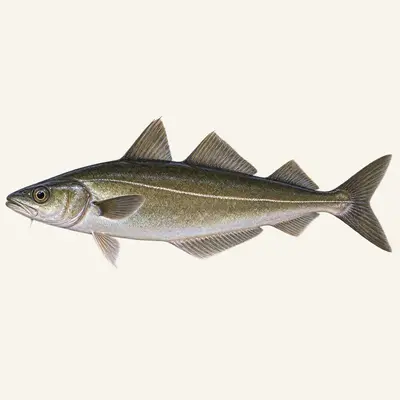
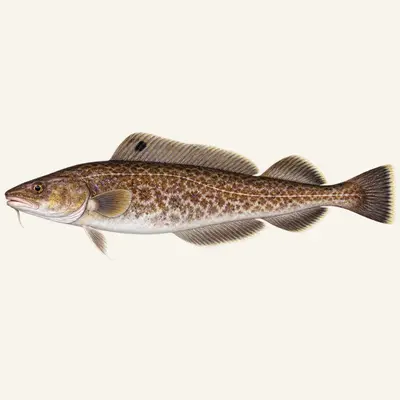
The stripe beneath it settles the second question. The lateral line here is dark and unbroken to about the end of the body; the cod's own description gives a pale, almost white one. Two fish that share the same ground and the same rigs are separated by the colour of the same feature, which is a good deal easier to judge than a shape.
The head is built small. The mouth is relatively small, the lower jaw shorter than the upper, and the chin barbel rather short — three readings that all point away from the cod, whose mouth is wide and whose barbel is well developed. Scales overlap; the lateral-line pores show on the head; there is not a spine on the animal.
Breeding
Spawning happens in fully marine water between 50 and 150 m — shallower than the 80 to 200 m the adults normally occupy. Reproduction therefore involves coming up the slope rather than going down it, which is the opposite of what most deep-shifting fish do.
The species spawns in batches. Length at first maturity is 34.9 cm, and the common length is 35: the median fish encountered is one that has just arrived at breeding.
The water it needs
Adults are found most commonly between 80 and 200 m, over rock, sand, gravel or shell, usually in water of 4 to 10 degrees. Recorded depth reaches 450 m, and the shallow limit is 10.
Six degrees of thermal tolerance is a narrow allowance for a fish with an ocean available to it, and it explains the map and the movements better than depth does. It is also why the species undertakes extensive migrations in the Barents Sea and around Iceland: the fish is not travelling to a place, it is staying inside a temperature that moves.
Areas
- Sandy and gravelly bottoms
- Rocky offshore shoals
- Northern current zones
- Deep coastal waters
Techniques
- Bottom fishing (ledgering)
- Paternoster rig fishing
- Natural bait fishing
- Bottom drift fishing
Baits
- Lugworms
- Sandworms
- Squid strips
- Small shellfish
- Shrimp
What it eats
Small bottom-living animals make up most of it — crustaceans, molluscs, echinoderms, worms — with fish alongside: sand lance, capelin, silver hake, American eels, herring and argentines.
The echinoderms in that list deserve the attention. Sea urchins and starfish are food that most fish leave alone, and a species that takes them is feeding on a standing stock nobody is competing for. On shell and gravel ground that is a substantial advantage, and it comes from a small mouth working slowly rather than from any turn of speed.
How to catch it
Mixed ground between 80 and 200 m, in water of 4 to 10 degrees. Temperature is the variable to track, and it is why a sector that produced last season can be empty this one without anything having been overfished — the fish followed its degrees somewhere else.
The small mouth has a direct consequence at the end of the line. Hooks and baits want to be more measured than those used for the cod alongside it, and lugworm, sandworm, squid strip, small shellfish and shrimp are what the catalogue records working. That is a real practical difference between two species that come over the rail on the same trip.
The diet is overwhelmingly benthic, which puts the whole presentation on the bottom rather than in the water column. There is nothing to gain by fishing this species high.
Conservation · Vulnerable (IUCN) — This species is threatened with extinction. Always release it (no-kill), handle it with the utmost care and check local rules — fishing for it may be prohibited.
Conservation
The spawning depth is the exposure that is easiest to miss. Adults sit between 80 and 200 m, but spawning takes place between 50 and 150, so the one moment when the fish concentrates is also the moment when it is shallowest and within reach of more gear than usual.
Then the coincidence of two numbers. First maturity at 34.9 cm and a common length of 35 mean the fishery is working exactly at the threshold of first reproduction. A small shift downwards in what is taken moves a large share of the catch onto fish that have never spawned, and nothing about the appearance of a 30 cm haddock announces that.
The outlet matters too, and the catalogue description rendered on this page happens to consist of it alone: the species also goes into fish meal and animal feed. A fishery with a use for every size has no commercial reason to prefer the large fish, and the size structure of the catch follows the market as much as the gear.
Finally, the thermal window of 4 to 10 degrees is not a manageable quantity. Warming displaces this stock rather than reducing it, which changes which countries fish it before it changes how much there is.
Regulations
Check the local regulations in force (legal size limits, closed seasons, bag limits).
For guidance only. Legal sizes, quotas and open seasons vary by location and season: always check the local regulations in force before fishing.
Other names
Haddock in English names the living animal, and that is worth holding on to before reading a French menu: haddock in French is the smoked product, while the fish is the églefin or aiglefin. The word crosses the Channel and changes what it refers to. English keeps separate names for the smoked forms instead — finnan haddie among them.
German says Schellfisch, Italian and Spanish eglefino, Portuguese hadoque. The dark mark above the pectoral collected a story along the way: it is told as the print of St Peter's thumb, left when he took the fish. The mark is a pigment patch and the tale is a tale, but it is the reason the blotch has a name at all in several languages.
Sources: fishbase.se · api.gbif.org