European plaice
Pleuronectes platessa · Pleuronectidae
- Saltwater
- Flatfish
- Medium
- Size
40–100 cm
- Weight
0.6–7.0 kg
- Lifespan
50 years
- Water temp.
2–15 °C
- Depth
0–200 m
Where to fish
- Beach
Habitat icons: Flaticon
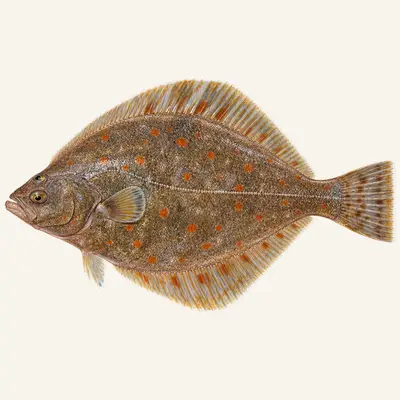
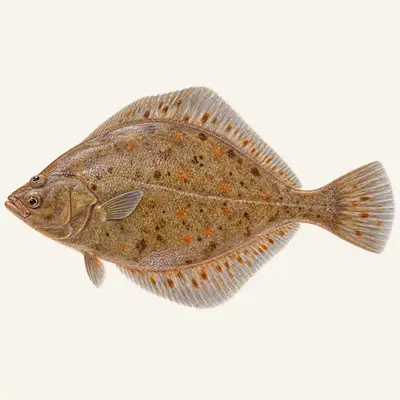
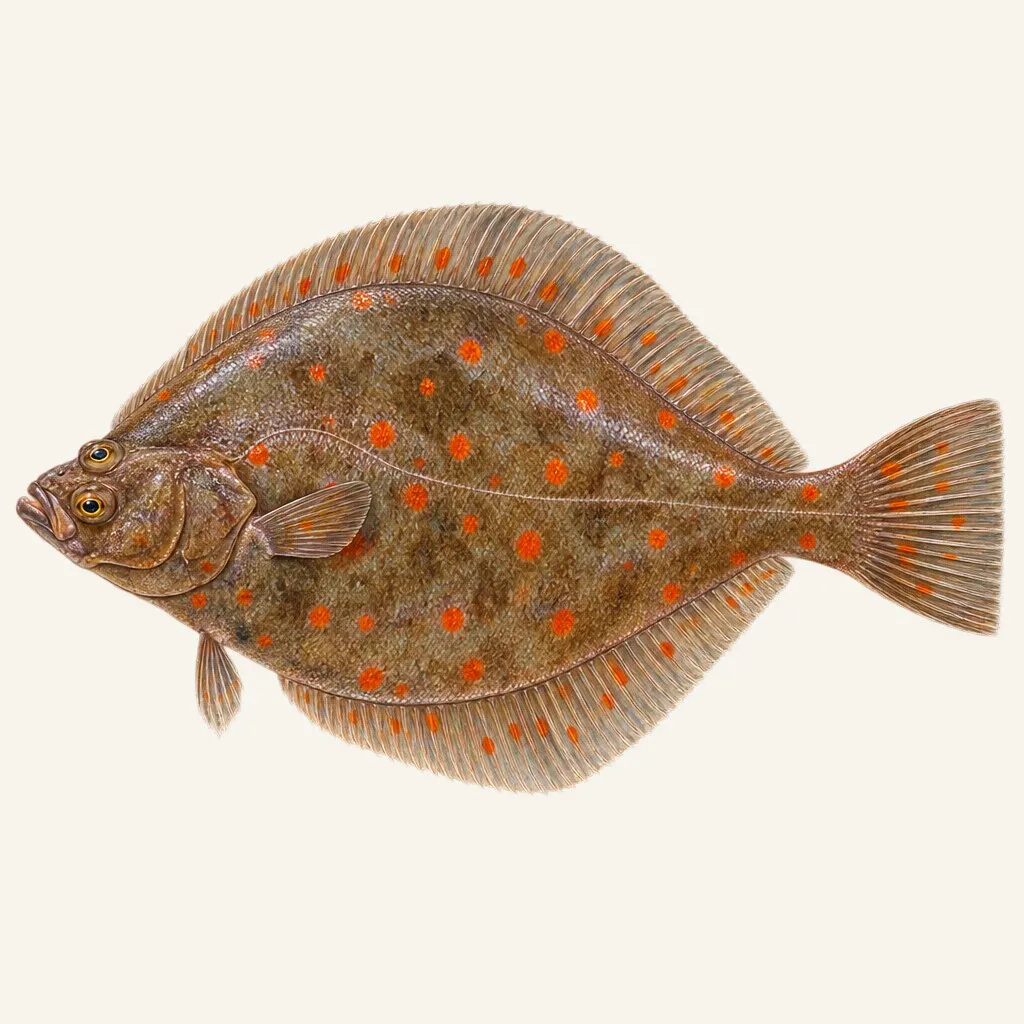
The European plaice is uniquely recognizable by its bright orange spots on the upper brown side, setting it apart from other European flatfish. It inhabits sandy and gravelly bottoms of the northeastern Atlantic and North Sea, reaching over 90 cm in length.
Calendar
Recorded in 13 countries
Belgium · Denmark · France · Germany · Ireland · Isle of Man · Jersey · Netherlands · Norway · Poland · Russia · Sweden · United Kingdom
GBIF occurrence records — native and introduced populations combined.
Its range
The species belongs to the northern seas, and its thermal envelope — two to 15 degrees — closes the range from the warm end without any coastline being involved.
The Mediterranean records are the interesting part of the file. They appear to be misidentifications of Platichthys flesus, which is to say the exact error the recognition section exists to prevent, committed at the scale of a distribution map. The species may genuinely have held parts of that sea in the past, following the climatic shifts of the ice age, but it seems absent now. The current map is a state of affairs, not a natural boundary.
Identifying it
A thumb run forward from the shoulder towards the upper eye catches on something hard. It is a bony ridge seated behind the eyes, a short row of knobs, and it is the only part of this fish that projects: the skin everywhere else is smooth and finely scaled and gives a hand nothing at all. The ridge survives bad light, a wet slab and a specimen that has lost its colour in a box.
Colour is faster, and it is what most people use. Bright red or orange spots, scattered without pattern, on a brown to greenish-brown ground, white underneath. The trap is that spots on their own decide nothing here. The published description of the European flounder records irregular reddish spots on its eyed side as well. What the two texts do not share is the word bright: one says bright red or orange, the other says reddish. Definition and intensity separate them, not presence.
Skin settles the question where colour hesitates. This species is recorded as smooth with small scales; the flounder's own entry gives rough skin, worst along the lateral line and at the bases of the dorsal and anal fins. Two rubrics, one contrast, nothing deduced.
The rest is lines and counts. The lateral line runs straight, with a slight curve where it crosses above the pectoral. The dorsal fin reaches forward as far as the eye and carries 65 to 79 soft rays; the anal has 48 to 59. More than 30 vertebrae, and no spine anywhere in either fin.
Breeding
Spawning begins when the water is around six degrees. That is a low threshold and a precise one. It places the season at the end of winter, in the coldest weeks the year has, and it means the fish is breeding while most of what shares its ground is still waiting.
Eggs leave in successive batches rather than in a single release.
First maturity averages 32.7 cm across a range running from 24 to 42. An 18-centimetre spread on a single threshold is wide, and the practical consequence is that length alone will not tell you whether a given plaice has spawned.
The animal is otherwise stationary for long periods. Tagging has nonetheless shown that its spawning migrations can be long ones. Movement in this species is not a habit but an event.
The water it needs
Age sets depth, and the rule is plain enough to fish by: the older the individual, the deeper it is found. Small ones are ordinary on bathing beaches. Adults hold mixed ground — mud and sand — from a few metres down to about a hundred, with the usual band between 10 and 50 m. Estuaries are included; fresh water only rarely.
The species is recorded as a resident intertidal fish with homing behaviour. It returns to the same place. On soft, mobile ground that is not what one expects, and of everything in this file it is the item with the most direct bearing on how a mark is treated.
Daylight and darkness produce two different animals. The day is spent buried in the sand. Activity comes at night, in very shallow water.
Areas
- Coastal sandy bottoms
- Bay shallows
- Surf-casting beaches
- Estuarine areas
Techniques
- Surf casting
- Bottom fishing
- Boat bottom fishing
- Drifting ledger
Baits
- Lugworm
- Ragworm
- Shrimp
- Mussel
What it eats
Thin-shelled molluscs and polychaete worms. The qualifier carries the section: thin-shelled. The jaws are not a crushing apparatus, so the heavy bivalves that other bottom fish work through are shut to this one, and its share of the sediment fauna is a narrow band of it — the soft-bodied and the fragile.
How to catch it
Size is a function of depth, so a big plaice is not looked for in a metre of water. The small ones live there. Fishing for a good fish in the shallows is a method error rather than a seasonal one.
Homing changes what a spot is worth. Ground that produced once deserves a return, which cannot be said of most flatfish on shifting bottoms, and it is the argument for keeping notes on a beach.
Nocturnal feeding in very shallow water is the opening from the shore. The fish that spent daylight buried comes up after dark onto ground a rod can cover.
Bait follows the menu and the jaws: marine worms first, then soft-shelled shellfish. A thick mussel is not something this animal opens.
The six-degree threshold marks where the adults are rather than what they will take. In the cold weeks they are on the spawning ground, which is not the feeding ground being worked.
Common length is 40 cm against first maturity near 33, so an ordinary fish off a good mark has usually bred at least once.
Conservation
A documented collapse sits in this file with its cause attached. Populations in the Kattegat and the Danish belts fell through the 1980s and into the early 1990s, and the reason recorded is the discharge of nutritive salts. Nutrient enrichment, not a net. The general statement alongside it is blunter still: changes in environmental conditions have been disadvantageous.
Homing turns that into a compounding problem. A fish that comes back to the same patch does not walk away from a patch that has deteriorated. Site fidelity is an asset while the ground holds and a liability once it stops holding, and it explains how a local decline can be steep while the outline of the range never moves.
The demographic side is slower again. First maturity near 33 cm against a maximum reported age of 50 years means a stock of this species is decades of accumulation. It answers a decision on that timescale, not on the timescale of a season — and it is at the same time the most important flatfish for European fisheries, which puts the clock of removal and the clock of replacement badly out of step.
Regulations
Check the local regulations in force (legal size limits, closed seasons, bag limits).
For guidance only. Legal sizes, quotas and open seasons vary by location and season: always check the local regulations in force before fishing.
Other names
European plaice in English. The word arrives through Old French from the Latin platessa, so the common name and the species name say the same thing twice.
The name has been lent out, and the loan matters. In North America, plaice on its own usually means American plaice, Hippoglossoides platessoides, a cold deep-water fish of a different genus that shares neither the ground nor the depth; Alaska plaice is a third animal again. Only in Europe does the bare word point here.
German says Scholle and Dutch schol; Italian passera di mare puts a sparrow in the sea. The genus name Pleuronectes means side-swimmer, and it describes the family's one great trick rather than anything particular to this member of it.
Sources: fishbase.se · api.gbif.org