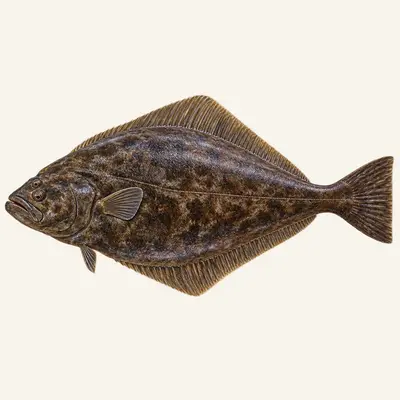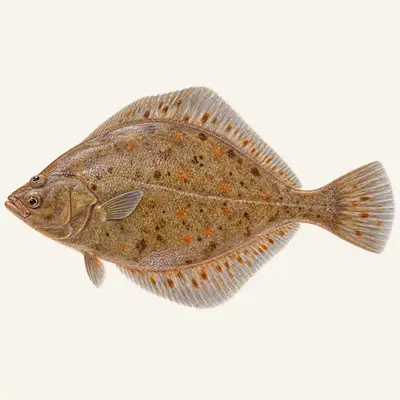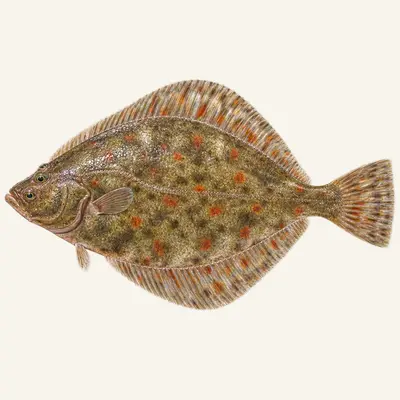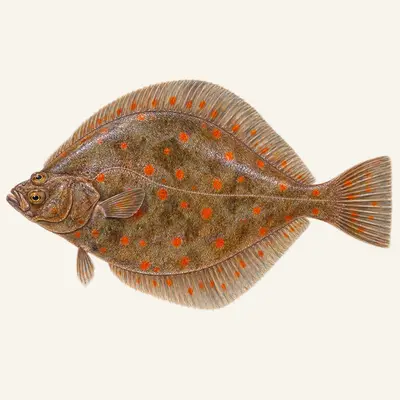
American plaice
Hippoglossoides platessoides · Pleuronectidae
- Saltwater
- Flatfish
- Medium
- Size
83 cm
- Weight
6.4 kg
- Lifespan
30 years
- Depth
10–3,000 m
Where to fish
- Rocky shore
Habitat icons: Flaticon
American plaice - a cold-water flatfish of deep northern seabeds.
Calendar
Recorded in 14 countries
Canada · Denmark · Germany · Greenland · Ireland · Isle of Man · Netherlands · Norway · Russia · St. Pierre & Miquelon · Svalbard & Jan Mayen · Sweden · United Kingdom · United States
GBIF occurrence records — native and introduced populations combined.
Its range
Two subspecies divide the North Atlantic and the Arctic Ocean between them, one north-western and one north-eastern. The split follows the ocean rather than any difference in habitat.
The northern limit at 80°N makes this the most boreal flatfish in the catalogue. Latitude is nevertheless the wrong parameter to read the map by. Cold bottom water is what governs, and that layer sits high in the column in the north of the range and very deep in the south. The result is a range that looks continuous on a flat map while in fact it descends steadily as it moves south.
The published depth envelope runs from 10 to 3,000 m. The bulk of the population holds 90 to 250.
Identifying it
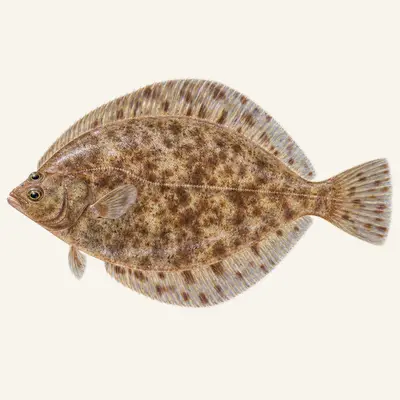
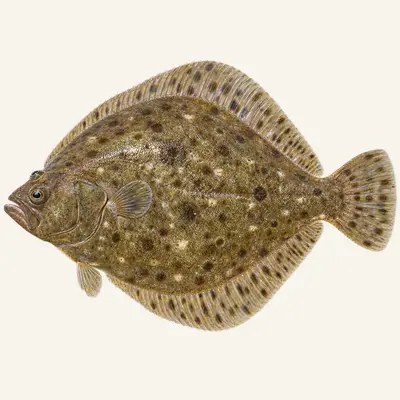
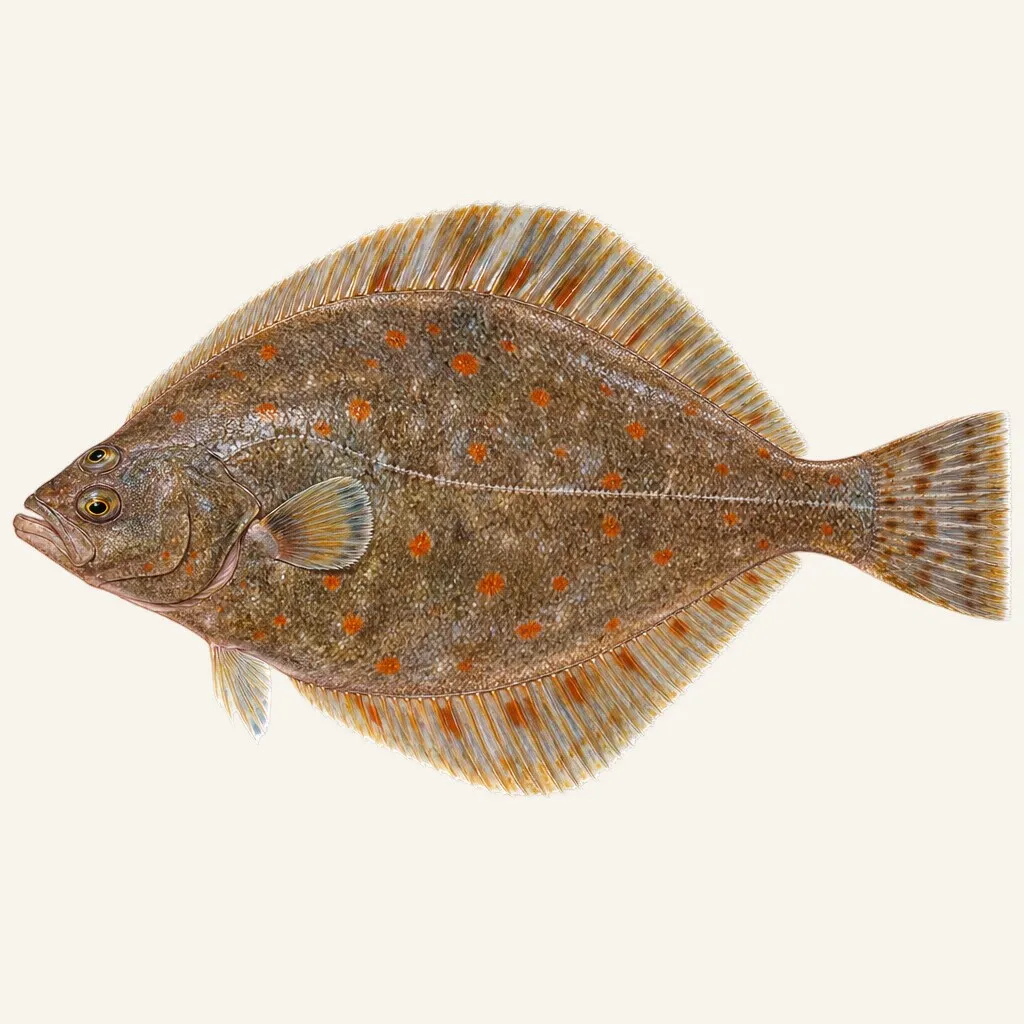
The dorsal fin begins above the left eye, the upper of the two on a fish that carries them both on its right side. An origin that far forward is read at a glance and does not depend on the size or the freshness of the specimen.
The second mark is the mouth, which is large for this family. It is not an anatomist's detail: it fixes what the animal can swallow, and it accounts for the fish in the diet.
The body is slender rather than disc-like, the scales are rough, and the lateral line runs almost straight — it crosses above the pectoral without any real arc.
Breeding
Eggs leave in successive batches through the season, which spreads spawning instead of concentrating it.
Maturity comes at around 35 cm; the source publishes no individual range for it. The oldest fish on record was 30 years.
Those two figures have to be read together with the water. Where the species is most abundant the bottom temperature runs from half a degree below zero to two and a half degrees above. Thirty years of life, 35 cm to breed for the first time, and water that never rises past two and a half: growth cannot be anything but very slow, and each centimetre stands for an amount of time with no equivalent among the flatfishes of temperate seas.
The water it needs
Soft bottoms, 90 to 250 m for most adults, in water close to freezing.
That temperature band is the species' real territory, and it is why the fish is absent from the mild coastal water along the southern edge of its range even where the latitude would permit it.
Areas
- Deep sandy bottoms
- Sand-mud transition zones
- Cold coastal grounds
- Continental shelves
Techniques
- Boat bottom fishing
- Bottom fishing
- Weighted ledger
- Bottom drift
Baits
- Sea worm
- Squid
- Shrimp
- Mussel
What it eats
Invertebrates and small fishes. The large mouth authorises the second half of that list, and it is what separates this species from the small-mouthed flatfishes that live entirely off sediment fauna.
A predator taking fish on soft ground at two hundred metres is hunting from ambush, lying down, in complete darkness. Sight contributes little at that depth, and the lateral line takes over the work.
How to catch it
Boat work, vertical, 90 to 250 m over soft ground. Nothing done from a shore reaches this animal.
The wide mouth accepts baits the other flatfishes here refuse: strips of fish, squid, a large marine worm. There is no need to scale down the way a dab demands.
The handling comes out of the biology rather than out of a rule. A fish that takes years to reach its first spawning length in water at two degrees is not replaced on the scale of a season. Careful release is the default here, and local rules are to be checked with the competent authority before anything else is contemplated.
Conservation · Endangered (IUCN) — This species is threatened with extinction. Always release it (no-kill), handle it with the utmost care and check local rules — fishing for it may be prohibited.
Conservation
Everything in this file returns to the cold. At half a degree below zero as at two and a half above, growth is slow, maturity late and life long — three traits that always travel together. Together they mean a stock accumulated across 30 years can be taken off in a few campaigns without rebuilding at anything like the rate it went.
A large-scale fishery has been working that stock for decades. The unit of time on one side of the exchange is the year; on the other it is the decade.
Soft bottom adds a mechanical exposure on top of the arithmetic. It is the ground that towed gear works, and this fish lives lying on it, over a depth band that commercial gear reaches without difficulty.
Assessments are published area by area, and a sound verdict in one does not carry across to the next.
Regulations
Check the local regulations in force (legal size limits, closed seasons, bag limits).
For guidance only. Legal sizes, quotas and open seasons vary by location and season: always check the local regulations in force before fishing.
Other names
American plaice on one side of the Atlantic, long rough dab on the other: one species, two English names, and which one you hear depends on which shore you are standing on. The second at least describes something, since the scales are rough. The first borrows the name of a European fish this one does not resemble.
The scientific name compounds the borrowing. Hippoglossoides is halibut-like and platessoides is plaice-like — a binomial announcing that the animal resembles two other fishes and naming nothing of its own.
German Doggerscharbe attaches it instead to a fishing ground, the Dogger Bank, and to the dab word rather than the plaice one. On that point the German is closer to the European English name than the American one is.
Sources: fishbase.se · api.gbif.org