Megrim
Lepidorhombus whiffiagonis · Scophthalmidae
- Saltwater
- Flatfish
- Medium
- Size
25–60 cm
- Weight
0.1–2.0 kg
- Lifespan
16 years
- Depth
100–700 m
Where to fish
- Beach
Habitat icons: Flaticon
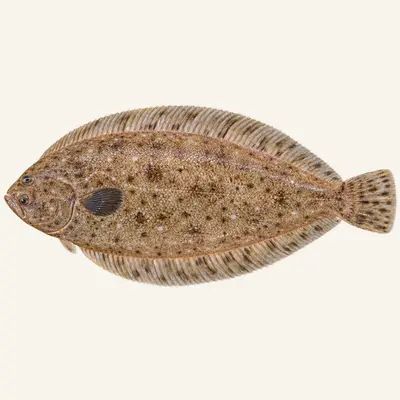
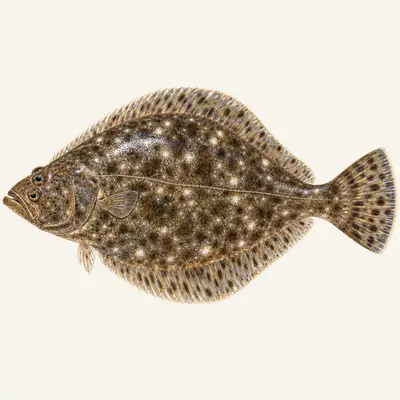
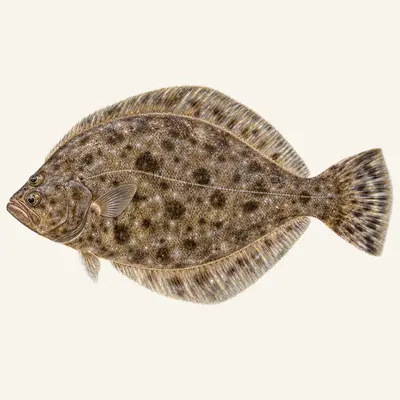
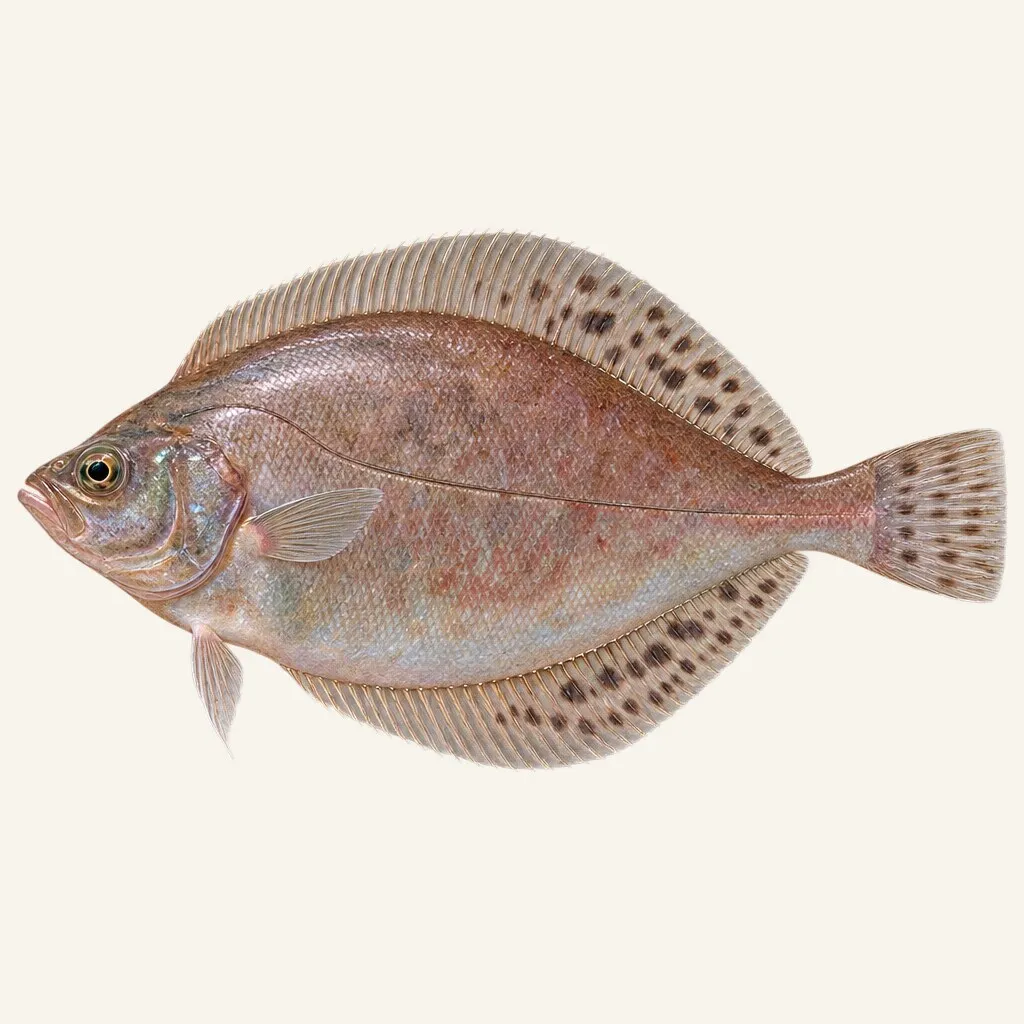
The megrim is a flatfish in the Scophthalmidae family recognisable by its elongated oval body, large oblique mouth, and widely spaced eyes. Light brown and mottled, it inhabits sandy and muddy Atlantic and Mediterranean bottoms off Europe at depths of 100 to 600 metres.
Calendar
Recorded in 7 countries
Croatia · Ireland · Isle of Man · Italy · Norway · Portugal · United Kingdom
GBIF occurrence records — native and introduced populations combined.
Its range
Iceland south to Cape Bojador at 26°N, plus the western basin of the Mediterranean.
That range is a line rather than a surface. The animal lives between 100 and 700 m, which is the continental slope, so its map follows an isobath instead of a latitude. Where the shelf is broad and the slope lies far offshore, the species is absent from everything in between, however suitable the coast looks.
The occupied depth also shifts with the region: 100 to 400 m on the Atlantic seaboard, 288 to 700 m in the eastern Ionian Sea. Deeper where the water is warmer, which is the standard behaviour of a cold-water species at the southern end of its range.
Identifying it
The outline is the determination. Where the other flatfishes of European seas tend towards a disc or a broad oval, this one is fusiform — the shape guide files it under elongate bodies, laterally compressed — and nobody mistakes it for a turbot or a plaice twice. The mouth is large and oblique and the eyes are set well apart, which completes an impression closer to an open-water hunter lying on its side than to a bottom-grubber.
The dorsal fin starts almost on the snout. Its origin is nearer the tip of the snout than the front edge of the eye, which is a proportion that can be checked rather than an impression to be argued about.
Dorsal and anal fins run past the caudal peduncle and encroach slightly onto the blind side. Both carry vague dark spots towards the rear, and that is the only feature of the colouring worth recording. The lateral line describes a clear arc above the pectoral. Counts run 85 to 94 soft rays in the dorsal and 64 to 74 in the anal.
Breeding
This fish spawns once. It is a total spawner, against the batch spawning described for several flatfishes sharing the same shelf, and the difference organises everything else on the page: a female's entire egg production for the year fits inside one short window, once.
The grounds are deep and localised — off Iceland and west of the British Isles. A year class therefore leaves a restricted number of places at a precise moment, with no spread across the season to absorb an accident.
First maturity is around 25.8 cm. The maximum reported age is 16 years.
The water it needs
Soft slope bottoms, 100 to 700 m, and the classification is bathydemersal — in contact with the bottom, but well below anything a coastal fishery reaches.
No estuary, no brackish water, no shallow bank. Nothing in this animal's domain resembles the ground the beach flatfishes occupy, and nothing about the way it is caught resembles that either.
Areas
- Coastal sandy bottoms
- Depths of 100 to 400 m
- Continental shelf edge
- Bay of Biscay
Techniques
- Bottom fishing
- Slow trolling
- Drop line
- Running ledger
Baits
- Fresh squid
- Fish fillets
- Shrimp
- Marine worms
What it eats
Small bottom-living fishes, squids and crustaceans. The cephalopods are the notable entry: taking a squid means seizing a fast animal in the water column, not sifting a sediment for what cannot get away.
A slender-bodied fish hunting squid and fish at four hundred metres is, in its manner of feeding, closer to an open-water predator that happens to lie down than to a digger.
How to catch it
Boat fishing and depth, 100 m at the very least and usually a great deal more. No coastal configuration gives access to this species.
Baits follow the diet: fresh squid, fish fillets and strips, prawns, sent down vertically and held in contact with the bottom. A slow bottom troll works on the same reasoning.
The size to expect is modest. Common length is 25 cm, which sits just under the first-maturity figure — so the average megrim is a fish that has only just become an adult, or has not managed it yet.
A word on the data itself. The source is precise to the individual fin ray and publishes no maximum weight at all for the species. That gap is in the file, not in the fish.
Conservation
Total spawning is the fracture point. A species that releases its whole annual production at one time, into a small number of deep grounds, holds no redundancy anywhere. If the window goes badly — a poor larval drift, a bad thermal year — nothing later in the calendar corrects it.
Against that stands an intensive fishery, followed over a long period by published stock assessments. Sixteen years of life against a maturity near 26 cm leaves some margin, but the margin rests entirely on one appointment being kept, once a year, in a handful of places.
Regulations
Check the local regulations in force (legal size limits, closed seasons, bag limits).
For guidance only. Legal sizes, quotas and open seasons vary by location and season: always check the local regulations in force before fishing.
Other names
Megrim in English, and also whiff — the older name that the epithet whiffiagonis preserves inside the binomial.
Spanish gallo, the rooster, names an everyday market fish. This species is a staple in Spain and largely invisible on northern counters despite substantial landings from the Bay of Biscay: one animal, a commodity on one side of a border and a curiosity on the other.
Lepidorhombus is the scaled rhombus, which describes the family rather than this particular member of it, and does so badly for a fish shaped like a knife blade. German Scheefschnut and Portuguese areeiro, the sand-dweller, take the ground instead of the outline.
Sources: fishbase.se · api.gbif.org