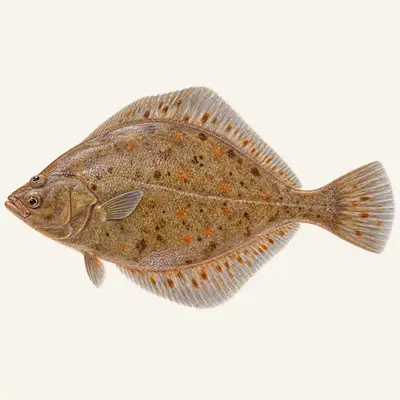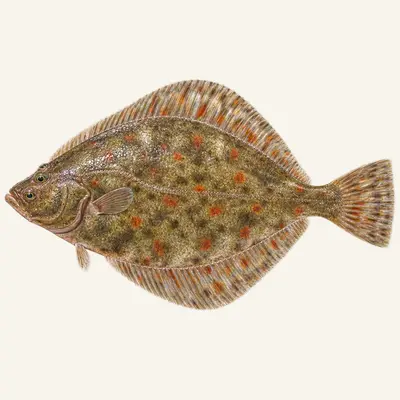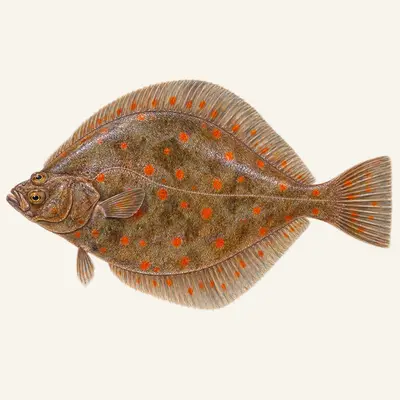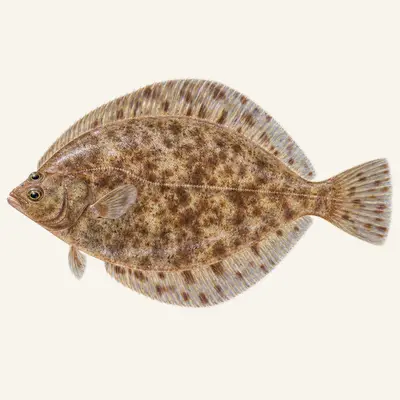
Atlantic halibut
Hippoglossus hippoglossus · Pleuronectidae
- Saltwater
- Flatfish
- Medium
- Size
470 cm
- Weight
320 kg
- Lifespan
50 years
- Depth
50–2,000 m
Where to fish
- Rocky shore
Habitat icons: Flaticon
The Atlantic halibut is the largest flatfish, capable of exceeding 300 kg, with a noticeably more elongated body than other pleuronectids. It inhabits the cold, deep waters of the North Atlantic and actively hunts other fish and cephalopods.
Calendar
Recorded in 10 countries
Canada · Denmark · Greenland · Netherlands · Norway · St. Pierre & Miquelon · Svalbard & Jan Mayen · Sweden · United Kingdom · United States
GBIF occurrence records — native and introduced populations combined.
Identifying it
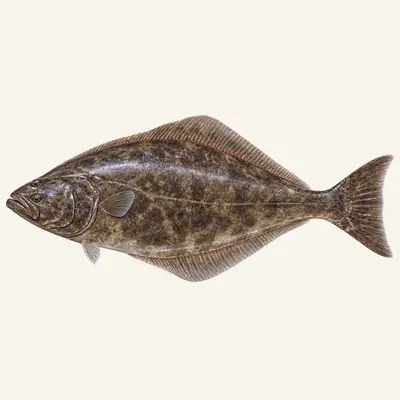
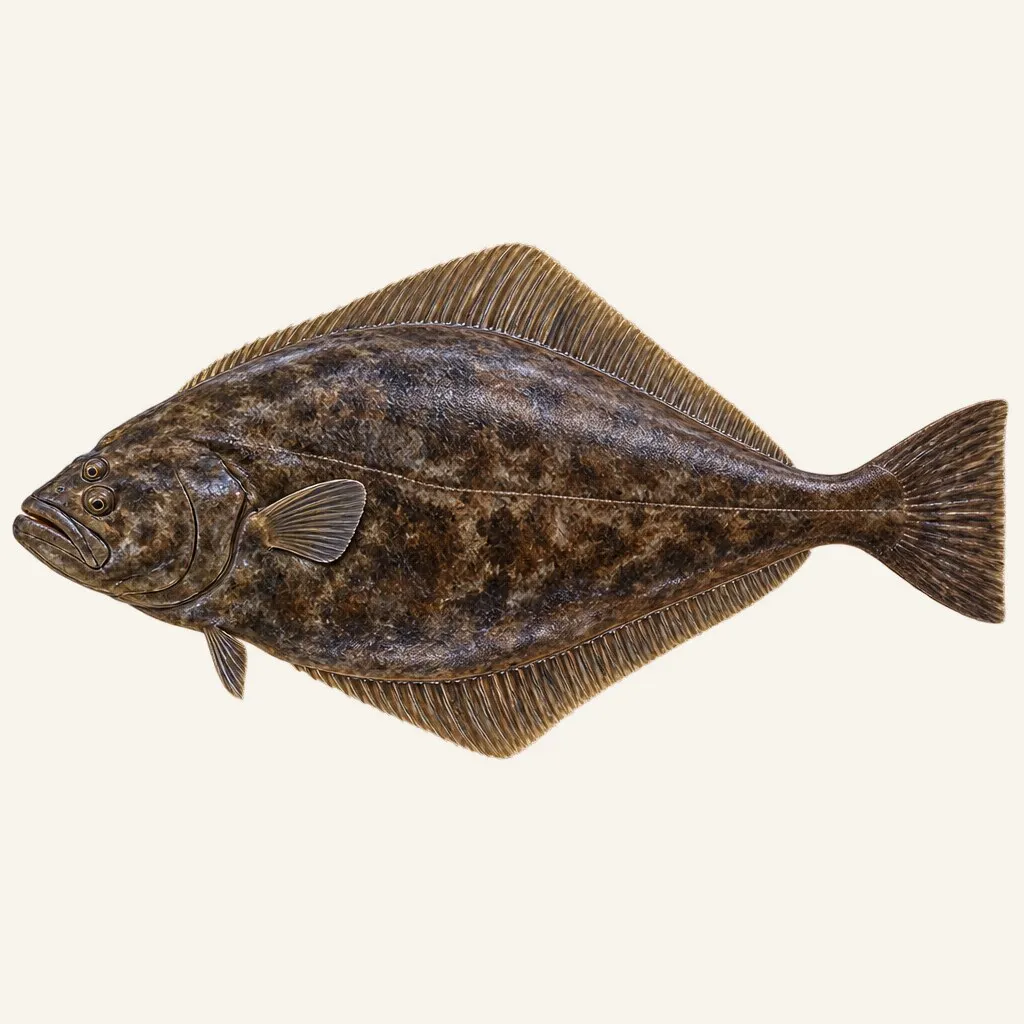
Body shape is the first surprise. Flatfishes are usually catalogued as short and deep; this one is catalogued as fusiform — the outline of an ordinary fish laid over onto its side, not a disc. That proportion is what allows the animal to leave the bottom, and it does leave it.
The fin counts are the highest of any Atlantic flatfish: 98 to 110 dorsal rays, 73 to 85 anal, and not one spine among them.
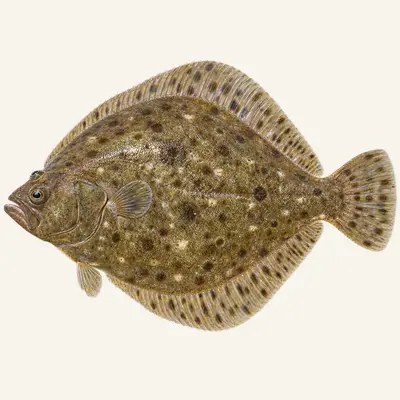
Colour depends on age and produces two different fish. Adults are uniformly dark brown or black. Juveniles are marbled or spotted with paler marks. Anyone matching a young halibut against a description of the adult will fail to recognise it.
Breeding
Females do not breed until their tenth or eleventh year. Males manage it at seven or eight. First maturity is reported at 122 cm, with a range beginning at 135.
Spawning occupies December to April, close to the bottom, between 300 and 700 m, at temperatures of 5 to 7 degrees. Every term in that sentence is a constraint, and taken together they explain why the grounds are few and localised: a depth band, a season and a two-degree thermal window all have to coincide.
The eggs are large for a marine fish at 3.0 to 3.8 mm, and the larva hatches at 6.5 mm. Spawning is done in batches. Since the animal can live to 50 years, a female's breeding career is long — once it has finally begun.
The water it needs
The recorded depth range is 50 to 2,000 m, which is exceptional for a flatfish and says the species belongs to the slope as much as to the shelf.
Adults are benthic but occasionally pelagic. A flatfish of this size leaving the bottom is worth registering, and the diet explains why it bothers.
Areas
- Deep North Atlantic holes
- Submarine canyon heads
- Deep gravelly bottoms
- Cold Nordic waters
Techniques
- Deep live bait fishing
- Heavy jigging
- Boat bottom drift
- Deep bottom longline
Baits
- Whole large mackerel
- Live herring
- Whole squid
- XXL soft lure
What it eats
The prey list reads like a landing sheet: cod, haddock, pogge, sand-eels, herring and capelin, plus cephalopods, large crustaceans and other bottom animals.
Two things follow from it. The first is trophic position. An adult halibut eats cod and haddock, which is to say it eats other predators, and it sits above the fish a fleet is usually after. The second is depth. Sand-eels, herring and capelin are schooling fish of open water rather than bottom animals, and a flatfish cannot take them lying down. The occasional pelagic excursions noted above are the same fact seen from the other end.
How to catch it
This is deep, heavy fishing. Baits are large because the prey is large, and the mass of the fish dictates the tackle rather than the other way round.
The pelagic habit widens the options beyond a bait pinned to the bottom, which is unusual advice for a flatfish and comes straight out of the diet.
Growth rate varies with density, competition and food supply, and that has a consequence at the moment of capture: length is a poor guide to age in this species. Two fish of one size taken on two grounds need not be anywhere near the same age, and the reported lifespan runs to half a century. A large halibut has crossed several decades of six-degree water, and nothing about its length says how many.
Conservation · Near Threatened (IUCN) — This species is in decline. Release your catch quickly and handle it with care — wet hands, as little time out of the water as possible.
Conservation
The source states it plainly, and the sentence is worth handing over as it stands: slow growth and late onset of sexual maturity mean halibut populations can be seriously affected by overfishing.
The arithmetic behind it belongs to the female. She reaches first maturity at 122 to 135 cm, in her tenth or eleventh year, and she may live to 50. Before her first spawning she has already spent a decade inside the range of sizes that gear takes. A stock is therefore an accumulation of several decades of survivors, and it does not rebuild on the timescale of a management plan.
The spawning grounds are the second exposure. Few, localised, and defined by 300 to 700 m within a two-degree window, they are identifiable — and what is identifiable is fishable.
Density-dependent growth makes projection harder rather than easier: the rate at which a thinned stock puts on weight is not the rate the historical records were built on. The experimental aquaculture of the species is a response to that arithmetic, not a substitute for it.
Regulations
Check the local regulations in force (legal size limits, closed seasons, bag limits).
For guidance only. Legal sizes, quotas and open seasons vary by location and season: always check the local regulations in force before fishing.
Other names
Atlantic halibut. The English word comes from the medieval name for the flatfish eaten on holy days — halibut is a holy butt, butt being the old word for a flatfish and still alive in the German and Dutch names of several of them.
The word has since been lent out too freely. Greenland halibut is Reinhardtius hippoglossoides, another genus of the same family and a different fish on every count; halibut and Greenland halibut are not two grades of one animal. German kept the holy element in Heilbutt, Norwegian in helleflyndre, while French says flétan.
Hippoglossus means horse tongue, from hippos and glossa, and the genus repeats itself as the species name — one of the tidier tautonyms in the family.
Sources: fishbase.se · api.gbif.org