Common dab
Limanda limanda · Pleuronectidae
- Saltwater
- Flatfish
- Medium
- Size
40 cm
- Weight
1.0 kg
- Lifespan
12 years
- Depth
20–150 m
Where to fish
- Beach
Habitat icons: Flaticon
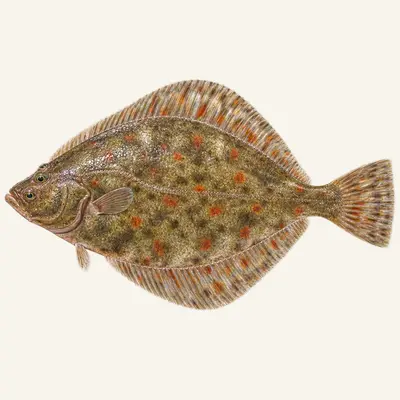
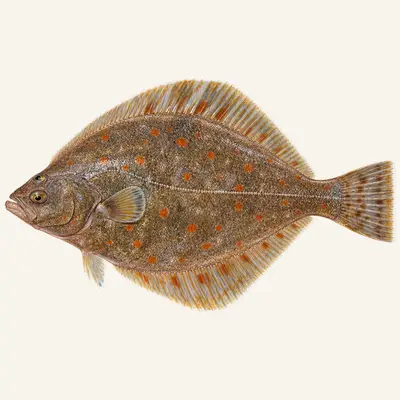
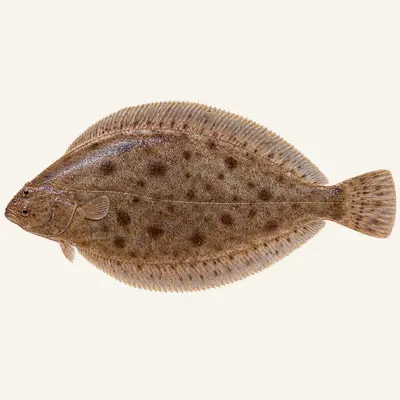
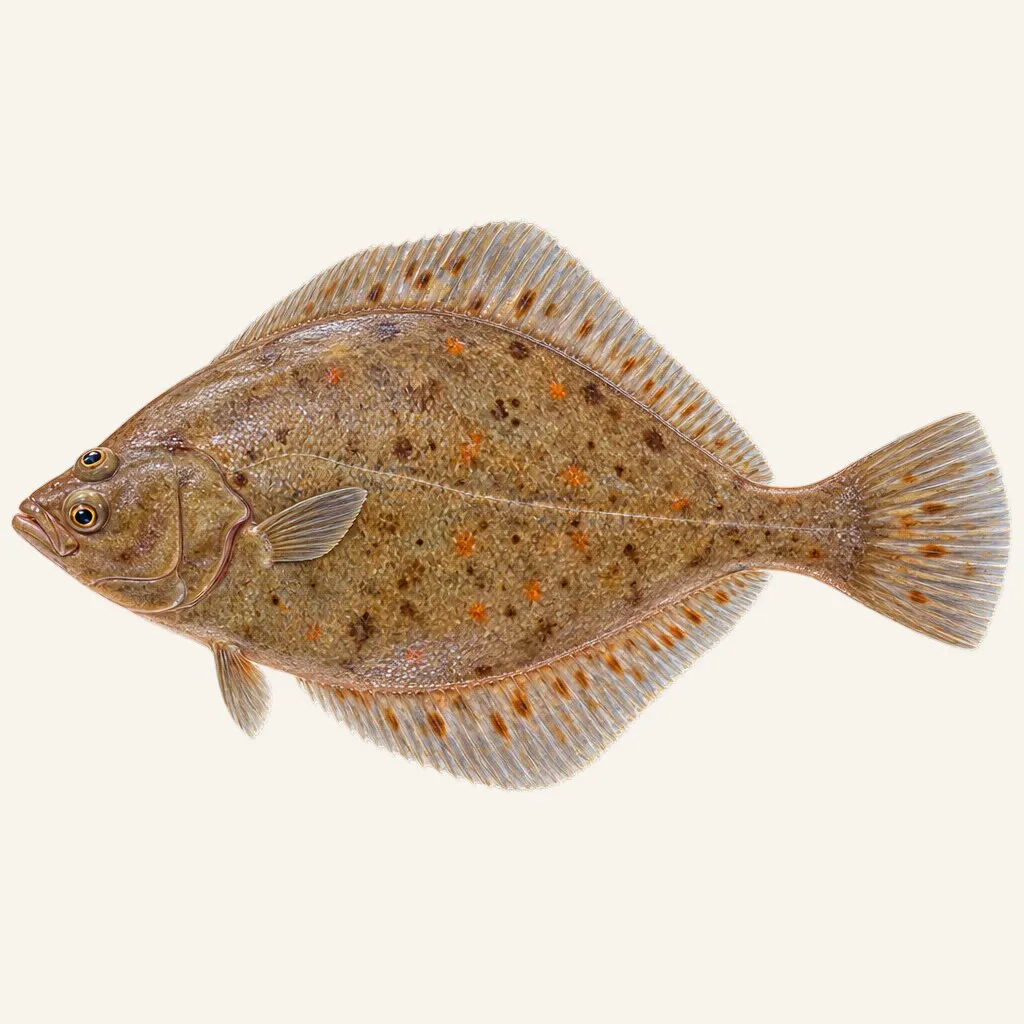
The common dab is a small flatfish with an oval body and rough-edged scales that give it a sandpaper-like feel. Its upper side is yellowish-brown with diffuse spots, and it lives on shallow sandy bottoms along European coasts.
Calendar
Recorded in 11 countries
Belgium · Denmark · France · Germany · Ireland · Isle of Man · Netherlands · Norway · Russia · Sweden · United Kingdom
GBIF occurrence records — native and introduced populations combined.
Its range
The Bay of Biscay closes the range in the south. Northwards it takes in Iceland and Norway, enters the Barents and White Seas, and holds the Baltic, which implies tolerance of a thoroughly diluted sea.
No isotherm draws this map. Sand does. The species follows the great soft sheets of the northern shelves, from the shoreline down to about a hundred metres, and where the bottom turns rocky or heavily silted the map empties at the scale of a single bay while the outer limits of the range do not shift at all. A distribution shaped that way is read bank by bank, not coast by coast.
Identifying it
Draw a hand from tail to head and the skin rasps. The scales are rough-edged and the surface reads like fine sandpaper — the quickest thing to check on a small brown flatfish, and it puts the plaice out of the running at once, since that species is recorded as smooth.
What settles the species is the lateral line. It rises in a sharp arc over the pectoral fin and then runs straight to the tail, and the curve is pronounced enough to be read rather than measured. The published description of the plaice gives, at exactly the same point, a line that is straight and only slightly curved. The two texts answer each other, and between two dull brown flatfishes of similar length that one line does the work that colour cannot.
The body is oval, the ground colour yellowish-brown with diffuse spotting that resolves into nothing usable. Both eyes lie on the right, as in the rest of the family; the 2018 revision that reorganised the group names it for that very character.
Breeding
First spawning can happen at 11 cm. That is the bottom of a range reaching 25, around a mean of 21.5, and a twofold spread on the threshold of one species is unusual enough to carry into every other section of this page.
The female releases her eggs in several batches across the season rather than in one emission. The consequence is a calendar rather than an event: spawning occupies a period, and the feeding of the spawners does not stop all at once.
Maximum reported age is 12 years. Set that against a threshold that can be crossed at 11 cm and the arithmetic comes out unlike the large flatfishes — most of the dabs on a sand bank have spawned at least once already.
The water it needs
Two depth figures sit in the same source and do not quite agree: 20 to 150 m in the environment line, and from a few metres to about 100 m in the biology entry. The disagreement is at the top of the water column, which is precisely the part that matters from a beach — the fish comes considerably shallower than the 20-metre figure allows for.
The substrate is not in dispute. Sand, to the near exclusion of everything else. Movements happen at sea; there is no run into fresh water and no dependence on an estuary.
Areas
- Coastal sandy bottoms
- Sandy shallows
- Surf-casting beaches
- Light offshore grounds
Techniques
- Light bottom fishing
- Light surf casting
- Boat bottom fishing
- Running ledger
Baits
- Ragworm
- Lugworm
- Shrimp
- Squid strip
What it eats
Crustaceans first, small fishes second. That is the order the source gives and the order is informative: this fish works the mobile fauna sitting on the sand or just beneath it, not the bivalves and worms that other flatfishes on the same bottom live on.
A crustacean diet puts a shrimp nearer its ordinary food than a marine worm, which is not the assumption most people bring to a flatfish.
How to catch it
Finding clean sand is half the job. Rock, or soft mud, at the right depth and in the right month, gives nothing at all; two hundred metres away on a sand bank the same rig catches.
Part of the range is shallow enough for the shore. Surfcasting and a static bottom line take the fish over shallow banks, and a boat earns its place mainly for the deeper bands.
The diet sets the bait: small crustaceans ahead of marine worms, presented hard on the bottom rather than lifted off it. Bites are watched for rather than felt, since a fish of this weight will not pull a rod round.
Season follows the spread of spawning rather than any peak. The species stays active across a wide part of the year, and most of what is caught is adult.
Conservation
Twelve years of life and spawning possible from 11 cm give a stock that rebuilds fast. The speed cuts both ways: a poor year is made up within a few seasons, but a good year proves nothing about the next one, because there is no bank of old fish to smooth the trough.
The other issue is one of scale. A regional population in good order says nothing about what a given sand bank holds. This species is tied to a single substrate, so anything that covers that sand, silts it or extracts it removes habitat outright while the overall count stays exactly where it was. The map does not record the loss, and neither does the assessment.
Regulations
Check the local regulations in force (legal size limits, closed seasons, bag limits).
For guidance only. Legal sizes, quotas and open seasons vary by location and season: always check the local regulations in force before fishing.
Other names
Common dab in English, usually shortened to dab, and the bare word is the trouble. Long rough dab, in European usage, is American plaice — a different genus and a fish of cold deep water. The sanddabs of the Pacific coast are Citharichthys, another family again. Dab on its own has been attached to at least three unrelated flatfishes.
German Kliesche and Dutch schar keep their own words for it. The scientific name is one of the family's tautonyms, Limanda limanda, and it is the same word as the French limande — which in a French fish shop is also applied to the lemon sole. The confusion is not confined to English.
Sources: fishbase.se · api.gbif.org