Lemon sole
Microstomus kitt · Pleuronectidae
- Saltwater
- Flatfish
- Medium
- Size
65 cm
- Weight
3.0 kg
- Lifespan
23 years
- Depth
10–200 m
Where to fish
- Beach
Habitat icons: Flaticon
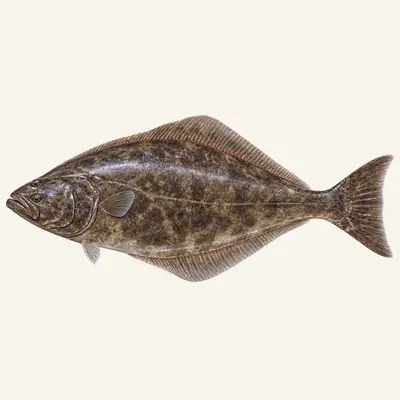
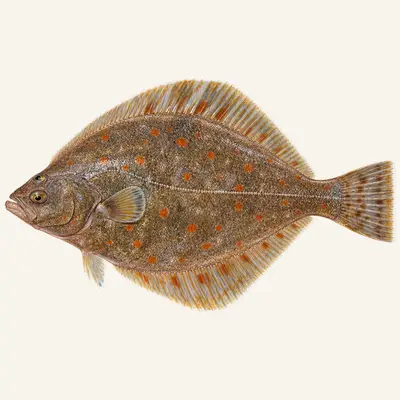
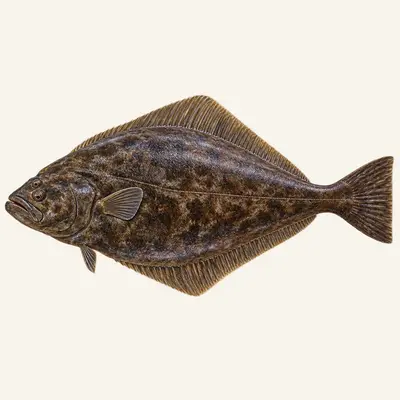
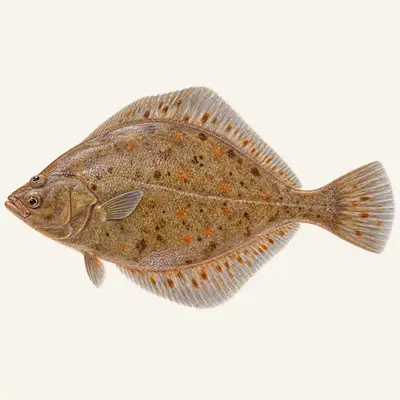
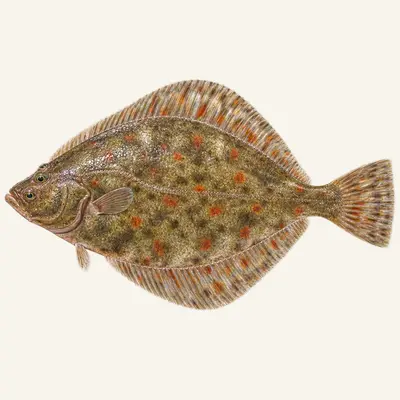
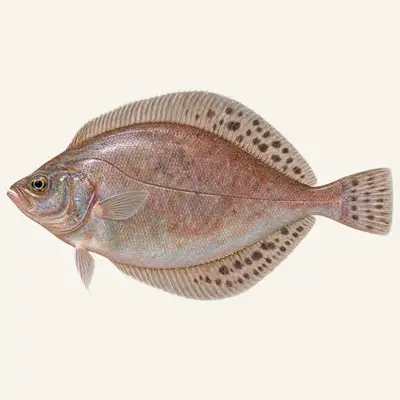
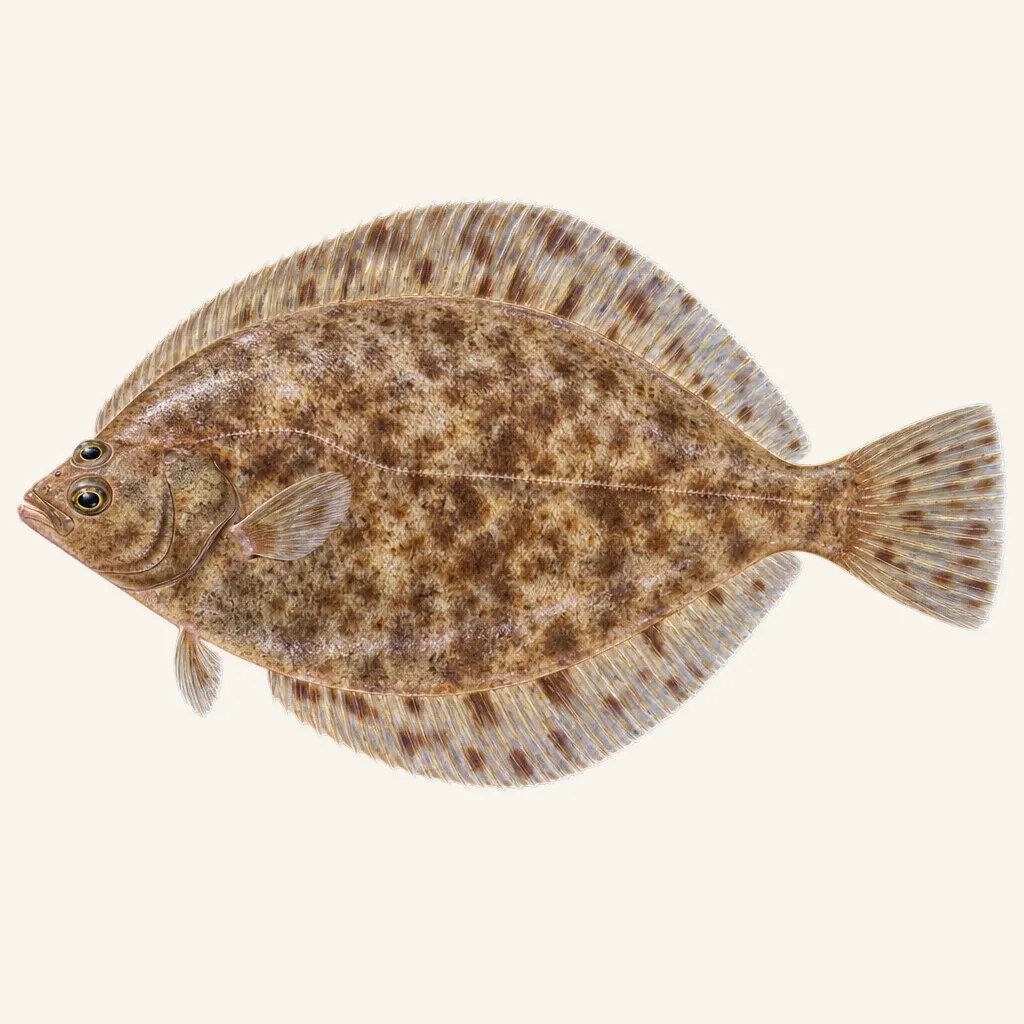
The lemon sole is a slender flatfish with an elongated body and very smooth skin, resembling the sole in shape but belonging to the Pleuronectidae family. Its upper surface is uniformly brown with yellowish reflections, and it inhabits sandy or muddy bottoms of European coastal waters.
Calendar
Recorded in 10 countries
Belgium · Denmark · France · Germany · Ireland · Isle of Man · Netherlands · Norway · Sweden · United Kingdom
GBIF occurrence records — native and introduced populations combined.
Its range
Bay of Biscay to the White Sea, with an outlier off Iceland. The range hugs the European shelf and never leaves it.
What governs the shape of it is hard bottom, and hard bottom comes in patches. A map at continental scale therefore draws a continuous band where the reality is a mosaic of stone and gravel plates separated by soft stretches the animal has no use for.
The exploited depth band runs from 10 to 200 m, mostly under 150.
Identifying it
The mouth is the name. Microstomus is small mouth, and on an animal that approaches half a metre it is startlingly small: the head is small to begin with, and the mouth is smaller again in proportion to it. That is the first thing to look at and it does not require turning the fish over.
The body is oval, the skin marbled and smooth. The lateral line runs almost straight from one end to the other, with a slight inflexion as it passes the pectoral and nothing more emphatic than that. Both eyes are on the right side.
The English name compounds two errors and the first is worth correcting here: this is not a sole. It is a Pleuronectid, right-eyed, kin to the plaice and the dab. The elongate outline is presumably what suggested sole to somebody; the mouth ends the comparison on sight.
Breeding
Spawning is bounded by two precise measurements, which is rare in this family's files. In the north-western North Sea it is largely confined between 55 and 91 m. In Scottish waters it does not begin below 6.5 degrees — a floor rather than an average, and it fixes the opening of the season more reliably than any date.
The sex ratio is the second finding. It runs about 1:1 among immature fish, then females progressively predominate as the fish mature. A sample of large individuals is therefore not a balanced sample of the population.
Maturity arrives around 29.3 cm, in a range of 20 to 30. The maximum reported age is 23 years, which leaves a great many spawning seasons behind any fish of good size.
The water it needs
A flatfish that prefers stone, which is the unexpected part of this entry. It is found most often on stony bottoms, and the source says nothing about burial — on hard ground the question does not arise the way it does for a fish on sand.
That changes how it is searched for. The work is not finding clean sand but finding plates of cobble and gravel between 10 and 150 m, with the tackle losses such ground implies.
Areas
- Coastal muddy bottoms
- Deeper sandy grounds
- Surf-casting beaches
- Moderate offshore zones
Techniques
- Bottom fishing
- Boat bottom fishing
- Slow bottom rig
- Surf casting
Baits
- Polychaete worm
- Ragworm
- Shrimp
- Small crustacean
What it eats
A variety of small invertebrates, with polychaete worms clearly dominant among them. The mouth runs that list from end to end. It cannot seize anything of size, so it takes what is abundant and cannot flee. On a fish of this length a minute mouth is not a handicap but a specialisation: it opens a dense food supply that the wide-mouthed predators sharing the ground leave where it lies.
One item of the annual cycle should be known before a trip is planned. The species apparently does not feed in winter. The fast is seasonal, and no choice of bait works around it.
How to catch it
That winter fast closes the season more firmly than any instruction could. On the warm side of the year, water passing 6.5 degrees opens both spawning and feeding; the cold months are spent somewhere else or on another species entirely.
The mouth then dictates the whole rig. Fine small hooks, a discreet trace, pieces of worm rather than whole baits — too large a mouthful is refused, and a bite on a big hook does not convert into a fish.
The ground is stony, which rules out heavy dragging and rewards a line worked vertically, right on the bottom, over plates located on the sounder. Once 6.5 degrees has passed, the band between 55 and 91 m concentrates the spawners in the north-western North Sea.
Conservation
Twenty-three years against a maturity near 29 cm: a large individual is a fish that has spent a decade or more on the same stones, and it is not replaced inside a season.
The drift of the sex ratio towards females among adults gives that longevity a direct consequence. Selection by length takes females first, without anyone selecting for sex at all. What produces the outcome is the structure of the population; the angler only sets a size.
Regulations
Check the local regulations in force (legal size limits, closed seasons, bag limits).
For guidance only. Legal sizes, quotas and open seasons vary by location and season: always check the local regulations in force before fishing.
Other names
Lemon sole in English, and both halves mislead. It is not a sole, and the lemon has nothing to do with colour or with citrus — the usual account traces it to the French limande, the dab, borrowed and reshaped by English ears.
The label has since been reassigned. On the American Atlantic coast, lemon sole on a market list generally means a large winter flounder, Pseudopleuronectes americanus, an unrelated species; there the words follow a size grade rather than an animal.
German uses both Limande and Rotzunge, red tongue, and Dutch tongschar sets the tongue image beside the dab word. The tongue is what most European languages reach for when they name the true soles. Here it has been lent sideways, to a fish that only looks the part.
Sources: fishbase.se · api.gbif.org