Indo-Pacific tarpon
Megalops cyprinoides · Megalopidae
- Saltwater
- Migratory
- Medium
- Regulated
- Size
30–150 cm
- Weight
0.3–18 kg
- Lifespan
44 years
- Depth
1–50 m
Where to fish
- Estuary
- Reef
Habitat icons: Flaticon
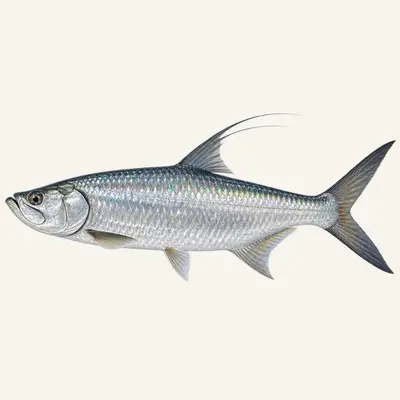
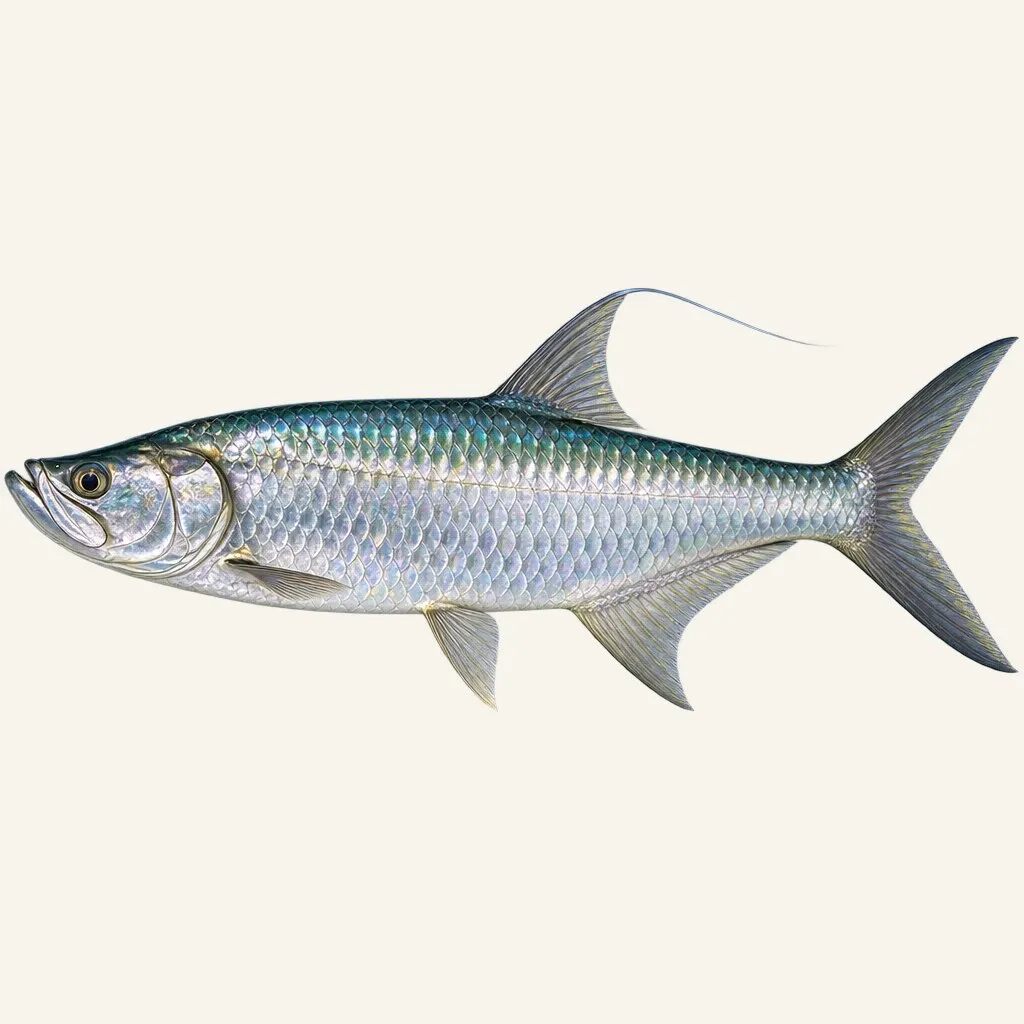
The Indo-Pacific tarpon (Megalops cyprinoides) closely resembles the Atlantic tarpon but reaches a smaller size, identified by its large silvery scales with golden hues and the elongated last ray of the dorsal fin. It inhabits warm coastal waters, mangroves, and estuaries across the Indo-Pacific.
Calendar
Recorded in 18 countries
Australia · Bangladesh · China · Hong Kong SAR China · India · Indonesia · Japan · Madagascar · Malaysia · Mayotte · Mozambique · Papua New Guinea · Philippines · Singapore · South Africa · Taiwan · Tanzania · Thailand
GBIF occurrence records — native and introduced populations combined.
Its range
The Indo-Pacific, from the Persian Gulf, the Red Sea and Natal east to the Society Islands, north to southern Korea and south to the Arafura Sea and New South Wales, taking in the South China Sea, the Taiwan Strait and the East China Sea.
Two entries in that list say what the fish actually requires. In Micronesia it is restricted to the high islands — Palau, the Carolines, the Marianas — and absent from the atolls. A catadromous fish has to be able to run up a river, and a low coral atoll has no permanent stream on it. The restriction has nothing to do with the sea around the island and everything to do with whether the island carries running water.
The other entry is how far inland it will go to find that water. It is reported from the lower Shire in Malawi, from the Save–Runde junction in Zimbabwe, throughout the Lower Zambezi channels as far up as Marromeu and in the Micelo as far as Malingapanzi. Those are a long way from any coast, reached by swimming.
So the range is not a temperature envelope. It is a list of rivers with usable mouths.
Identifying it
Elongated, compressed in section, with 16 to 21 rays in the dorsal and 23 to 31 in the anal, and no spine in either. Those counts meet the Atlantic species only at their lower edges: its dorsal stops at 16 where this one begins, and its anal stops at 25 where this one carries on to 31. A high count therefore settles the question and a low one does not.
It is also the smaller of the world's two tarpons, and by a wide margin. The measurements on this page give the difference.
The most useful line in the record, though, is one that most species files do not carry: the common length is given twice, once for males and unsexed fish at 30 cm and once for females at 45.5. The two sexes do not grow to the same size and the gap is not subtle. A big one is a female, and the ordinary female is half again the length of the ordinary male.
Breeding
Breeding takes place offshore, possibly right through the year.
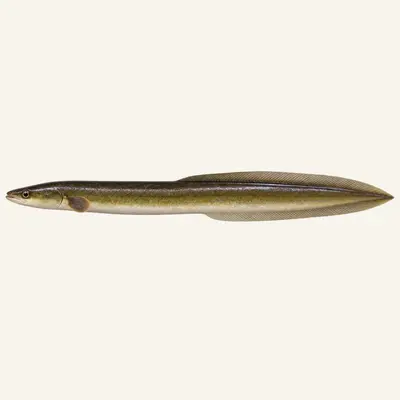
The larva is transparent and looks like a young eel, with one difference that names it: the tail is forked. That kind of larva belongs to the eels and their relatives, and finding it in a fish shaped like this one is a statement about ancestry rather than about behaviour.
Juveniles then move into fresh water, entering clear and turbid water without apparent preference, and maturity begins from around 25 cm.
The cycle therefore needs three things and the corridor between them: offshore water to spawn in, a river mouth to enter, and mangrove to grow up in. Remove any one and the other two are of no use.
The water it needs
The tolerances are the whole of this section. Salinity from 0 to 100, and pH from 5.2 to 9.1.
Read the first figure again. Sea water sits at about 35, so 100 is close to three times as salt — the state of a tropical lagoon that has been evaporating through a dry season, and a concentration that kills most things that swim. The same species is recorded in fresh water at the other end of the scale. There is effectively no salinity available on a tropical coast that excludes it.
The pH span does the same work on the other axis. From 5.2 to 9.1 covers acid swamp water and hard alkaline lagoons alike, which are the two directions in which still tropical water goes extreme.
It must breathe air, and the record says must rather than can. The surface is part of its habitat everywhere it lives, in clean sea water no less than in a stagnant backwater. It is also mainly diurnal, which fits: an animal that has to come up on a schedule gains nothing by hiding in the dark.
The two halves of its life happen in different water. Adults are generally at sea; the young hold in river mouths, inner bays and mangrove forest, and in fresh water the species occupies rivers, lagoons, lakes and swampy backwaters.
Areas
- Estuaries and mangroves
- Coastal passes
- Indo-Pacific lagoons
- Shallow estuarine zones
Techniques
- Live surface bait fishing
- Soft lures
- Fly fishing
- Estuary casting
Baits
- Small live fish
- Shrimp
- Crabs
- Silver lures
How to catch it
Diurnal, and obliged to surface. Between those two facts the fish is findable in daylight in water where nothing at all can be seen, and the hour does not have to be dawn for it to show itself.
The range of water worth trying is the widest thing about this fishery. A river mouth, a mangrove creek, an inland lagoon, a lake far up a river, a pan left hypersaline at the end of a dry season: the fish's tolerances mean that none of those can be ruled out on the water alone, and local knowledge here is knowledge of where the fish is rather than of where it could survive.
Scale matters twice over. The ordinary fish is small by the standards of the word tarpon, and the sexes differ enough that the tackle for a good female is not the tackle for an average male. Gear chosen for the Atlantic species is the wrong gear on both counts.
It is a popular angling fish, and the record calls the flesh edible but not esteemed — which tends to settle what happens to one after capture.
Regulated — Often governed by quotas, size limits, seasons, or reporting rules.
Conservation
The mangrove is the single point of failure, and it fails out of sight. The adults are at sea and show nothing; the young are in the mangrove, which is the habitat tropical coasts have been clearing fastest, for shrimp ponds, for building and for timber.
The aquaculture entry makes that concrete rather than general. The species is farmed in ponds, and the fry are sourced from the coast rather than from a hatchery. So the industry takes juveniles out of the same river mouths and mangrove channels where the year class is assembled, and it takes them before any of them has spawned. A pond fishery with no closed cycle is a fishery on wild recruitment, whatever it is called.
Longevity then hides the result. Forty-four years is the oldest age reported, and a long-lived fish conceals a recruitment failure for a long time: the adults are still at sea and still being caught for years after the water that produced them stopped producing.
And the file is thin. There is no diet study beyond fishes and crustaceans, no maturity figure beyond a lower bound, and the standing reference is an FAO identification sheet rather than a life-history study. For a fish that is farmed, netted, trawled and angled for across half the world, that is a very small amount of knowledge.
Regulations
Check the local regulations in force (legal size limits, closed seasons, bag limits).
For guidance only. Legal sizes, quotas and open seasons vary by location and season: always check the local regulations in force before fishing.
Other names
Indo-Pacific tarpon is the standard English name. Oxeye herring, and oxeye on its own, are the ones actually used in Australia, and only one word in the pair is accurate: the fish is not a herring, but the eye really is the thing you notice.
The genus name makes the same observation — Megalops, large eye. The epithet is the odd one out: cyprinoides means carp-like, presumably for the big silvery scales. Between its various names, then, this animal has been compared to a carp, a herring and an ox, and it is none of the three.
Sources: fishbase.se · api.gbif.org