European Smelt
Osmerus eperlanus · Osmeridae
- Saltwater
- Migratory
- Easy
- Size
17–30 cm
- Weight
0.0–0.2 kg
- Lifespan
10 years
- Depth
2–25 m
Where to fish
- Estuary
Habitat icons: Flaticon
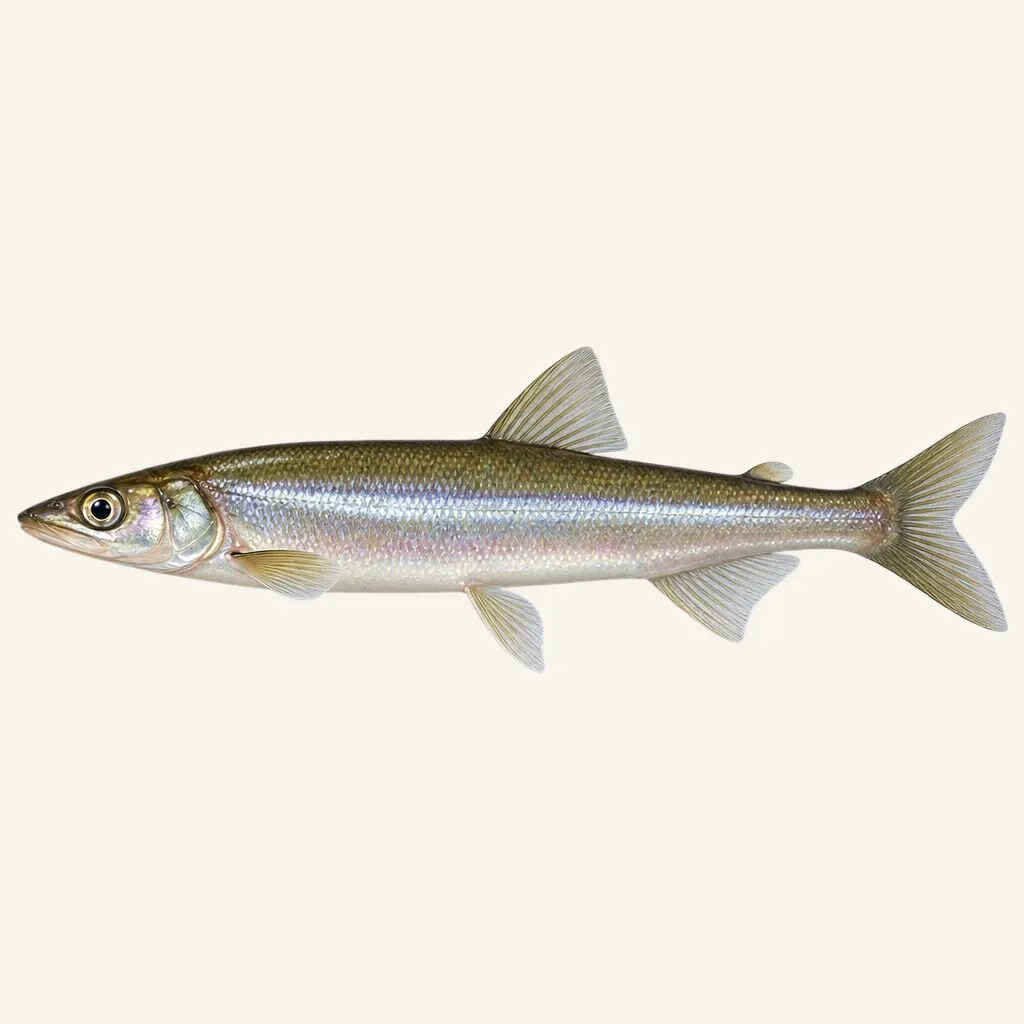
Small silvery anadromous fish whose flesh smells of cucumber, gathering in large estuarine shoals at spawning time.
Calendar
Recorded in 12 countries
Belgium · Denmark · Finland · France · Germany · Ireland · Netherlands · Norway · Poland · Russia · Sweden · United Kingdom
GBIF occurrence records — native and introduced populations combined.
Its range
The two nominal subspecies overlapped in space. One, described from the coasts and drainages of the White and Barents Seas westward through the Baltic to Denmark, is primarily lacustrine; the other is primarily anadromous and occurs alongside it in parts of Poland, Denmark and the Baltic. A pair of subspecies sharing water contradicts the term, and the division is no longer maintained — but the two ways of living are still there, and the rest of this page keeps running into them.
The geography is a coastline plus a set of lakes. White Sea south to the western coasts of France, taking in the Baltic, the southern North Sea and the British Isles, with the Gironde estuary named as the southern limit and about 68°N as the northern one in Scandinavia. Inland, landlocked populations sit in lakes near the North, Baltic, White and Barents Sea coasts and finish their entire cycle in fresh water.
Across the 64 degrees of longitude that covers, the balance shifts: anadromous in the west, lacustrine in the east.
Identifying it
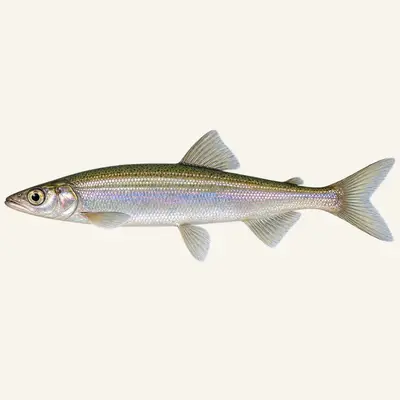
The lateral line is incomplete and develops only at the front, near the head. That is a positive character, checkable on a fish in the hand, and it belongs to the published description rather than to any impression of the animal.
The mouth is the second one. Head and snout are pointed, the lower jaw projects slightly, the upper reaches back to the hind margin of the eye, and inside, the lower teeth are larger than the upper, with strong teeth on the tongue and canines on the vomer. That is the armament of a predator on a fish of 16.5 cm.
Beyond that: a long slim body, light olive green above, a silver stripe along the flank, a creamy belly, the dorsal origin set behind the base of the pelvics. Nine to 12 soft rays in the dorsal, 12 to 16 in the anal, 55 to 62 vertebrae.
The character the entry above leads on is not visual at all. A fresh smelt smells of cut cucumber, plainly enough to settle what a small silver fish out of an estuary is, and it goes off within hours.
Breeding
The same species matures at two completely different sizes. In brackish populations it spawns first at three or four years, at 15 to 18 cm; in fresh water at one or two years, at 8 to 10. The single figure given elsewhere in the file, a length at first maturity of 12.8 cm, is an average across those two schedules and describes neither of them.
Spawning follows the melting of the snow and falls between February and May according to temperature, in the lower reaches of streams, in the tributaries of lakes or along shallow lake and river shores, by preference where the current is quick. Sand, gravel, stones and plant material all take the eggs indifferently.
A female lays 8,000 to 50,000 of them, yellow, 0.6 to 0.9 mm, stuck to the bottom. They then stay there three to five weeks before hatching, which is a long tenancy for a spring clutch in a watercourse, and the larvae drop down to the estuary afterwards.
Many adults die after spawning. It is not the obligatory death of a Pacific salmon, but the loss is heavy enough that a season wasted is not made good the following year by the same fish.
The water it needs
The estuary is the address, not the corridor. The record puts the essential part of this animal's life in the estuarine zone with only short incursions into the littoral proper, which makes it something other than a sea fish passing through brackish water on the way to spawn. It is a brackish-water fish that visits both neighbours.
It holds in midwater and rarely goes far from shore, between 2 and 25 m. Lake populations occupy the equivalent volume: the free layer of a large body of water, away from the bed and away from the banks.
Shoaling is recorded at least through the spawning season, which is when it matters to anyone looking for the fish.
Areas
- English Channel and North Sea estuaries
- Baltic and Scandinavian coastal waters
- River mouths
- Cold landlocked lakes
Techniques
- Float fishing in estuaries
- String of small hooks (sabiki rig)
- Dip net during spawning runs
- Light float fishing
Baits
- Small worm pieces
- Maggot
- Strip of fish
- Small shiny lures
- Piece of shrimp
What it eats
Shrimps and small crustaceans, then fish for the ones that get big enough. The record puts those two halves in a causal order worth keeping: individuals feeding on fish grow bigger.
So the population divides on a threshold. A smelt reaching the size at which small fish become takeable grows faster from then on, which brings more fish within reach; one that never crosses the line stays on crustaceans. The same clutch produces both trajectories.
The migratory form gets the same advantage at another scale — faster growth, more eggs, longer life than the freshwater form. A lake population is therefore not a version of the species compressed by the space available. It is what a poorer diet does to an animal capable of more.
How to catch it
Every recorded use of this fish is a bulk use. It is eaten, smoked, rendered for oil and used as bait, and none of those is a use for one fish. The fishery has always been a fishery of quantity.
Which makes locating the shoal the whole of the task. The species lives in midwater and gathers in the estuarine zone before running, so once a concentration is found the catches follow one another and ten metres away nothing happens at all. The methods listed here are all of that kind: float tackle in the estuary, a string of small hooks, a dip net on the run itself.
Tackle is set by a common length of 16.5 cm — small hooks, fine line, several hooks on a trace rather than one. The maxima are a separate question and not a useful one, since the length in the FishBase summary and the length in the measurements block above this text differ by more than a third. For this species the record is not the number to plan around.
The window is short and thermal. Between February and May, varying with the year and the river, the migratory fish assemble in the estuary before going up, and that is the one period when the species is both concentrated and reachable from the bank.
Conservation
The longest-exposed stage in this animal's life is an egg. Three to five weeks fixed to sand or gravel in a watercourse in spring, with no capacity to move: whatever settles, silts over or is discharged during that period finds the clutch where it was left. Pollution is one of the two things named in the file as threatening the species locally, and the egg is the stage it acts on.
The other is the barrier. An anadromous smelt has to leave the estuary and reach flowing gravel, and it has neither the size nor the power of a salmonid — a low weir that other migrants clear will close a basin to this one. The larvae then have to make the return trip down to the estuary inside the same season, so the corridor has to be open in both directions and at two different times.
Post-spawning mortality removes the fallback. With a large share of the adults dying after they spawn, a blocked or failed season is not carried into the next one by the survivors.
Lake populations sit outside all of this. They spawn in their own tributaries or on their own shores, and the corridor problem never arises for them — part of why the state of the species reads so differently from one basin to the next.
Regulations
Locally declining and sometimes protected (size/quota): check current regulations before fishing.
For guidance only. Legal sizes, quotas and open seasons vary by location and season: always check the local regulations in force before fishing.
Other names
Osmerus comes from the Greek for smell. Of everything the eighteenth century could have fastened on in this animal, the cucumber is what got into the genus name, and it is still the quickest way to identify one.
English calls it European smelt, or smelt without qualification around the Channel and the North Sea, where there is only the one. Dutch has spiering, German Stint, Danish and Swedish nors: old, short, local words, the kind a fish collects when it has been landed and smoked by the basket for centuries rather than caught singly.
The trap is on the far side of the Atlantic, where smelt means the rainbow smelt and arrives with the same cucumber smell attached. Neither vernacular carries an ocean.
Sources: fishbase.se · api.gbif.org