Bonefish
Albula vulpes · Albulidae
- Saltwater
- Migratory
- Medium
- Size
104 cm
- Weight
10 kg
- Depth
0–84 m
Where to fish
- Reef
- Beach
Habitat icons: Flaticon
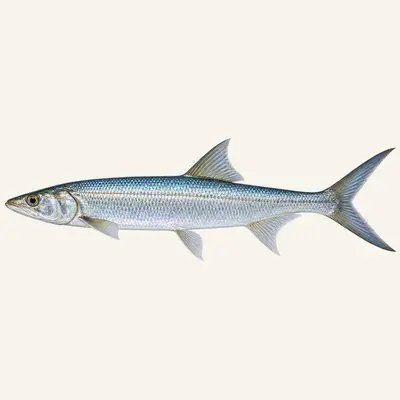
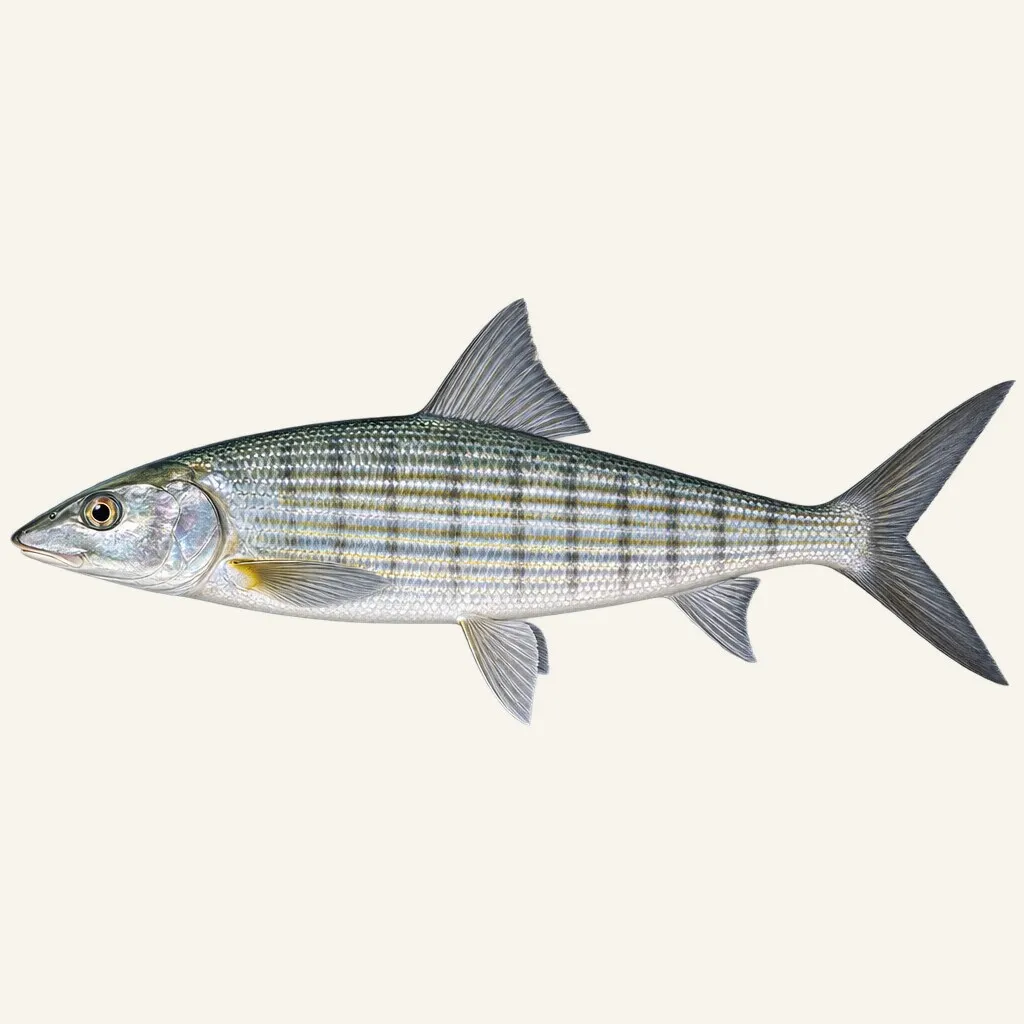
The bonefish (Albula vulpes) is a streamlined coastal fish with a blue-silver back and pearly white belly, equipped with a subterminal snout angled downward for rooting through shallow sandy flats. It haunts tropical tidal flats, seagrass beds, and lagoons of the Caribbean and warm Atlantic coasts.
Calendar
Recorded in 21 countries
Bahamas · Belize · Brazil · Cameroon · Caribbean Netherlands · Colombia · Congo - Brazzaville · Côte d’Ivoire · Equatorial Guinea · Gabon · Ghana · Guinea · Guinea-Bissau · Liberia · Mexico · Mozambique · Nigeria · Puerto Rico · Senegal · Sierra Leone · United States
GBIF occurrence records — native and introduced populations combined.
Its range
Warm seas worldwide: California to Peru in the eastern Pacific; North Carolina to Florida, the Bahamas, the Gulf of Mexico, the Antilles and the Caribbean to Brazil; with records from Canada in the northwest Atlantic.
The taxonomy is the part to take seriously. Hawaiian material has been checked by electrophoresis, and the entry states outright that Albula vulpes might be split further. The West African form has already been separated off as Albula goreensis.
So the map above may be showing several species under one name. That matters to anyone comparing two destinations, and it matters more to anyone reading a study: growth, maturity and movement measured in one archipelago cannot be carried to another if the two hold different animals.
Identifying it
One character on this fish is oddly specific: between each ray of the dorsal and anal fins, on each side of the membrane, sits a single long scale. Scales inside a fin membrane, one to a gap, are not something a hand goes looking for, and the description retains them.
The snout does the everyday work. It is bluntly conical and extends beyond the mouth, which sits underneath the head — the profile of an animal that works sediment, and the shape that settles the genus at a glance.
The species is then pinned down by a run of absences, which is how the literature does it. The last ray of the dorsal and anal fins is not prolonged. The head region is naked. There is no spot and no band on the head. The margin of the nasal pore is not black. Add silvery flanks with dusky fins and a yellow pectoral base, dorsal 15 to 19 rays, anal seven to nine, vertebrae 69 to 74, branchiostegals 12 to 14, and axillary scales at the base of the pectoral and pelvic fins.
Breeding
Spawning happens in open water and the eggs are pelagic. That is the whole entry.
The maturity figures repay a close look, because they contradict each other. Length at first maturity is given as 37.5 cm, with a range of 21 to 36 cm beside it: the point estimate sits above the top of its own range. Something in the compilation is inconsistent, and the honest reading is that maturity falls somewhere in the low thirties and that this file cannot be quoted to a decimal.
Note also what is not there. In this lineage the larva is the interesting stage, and this record says nothing whatever about larval development. Whatever the young do between the pelagic egg and the flat, the reference here does not describe it.
The water it needs
Shallow coastal water, estuaries and bays, over sand and mud. The usual band is one to 15 m — and the recorded range reaches 84. The flats are where the fishery happens, not the limit of where the fish lives.
Two entries change how a flat gets read. The dorsal fin may show above the surface, so the animal can be found by eye rather than by guesswork. And fish are often in schools, except the large ones, which are solitary: hunting a big bonefish and hunting a school are different exercises on the same water, with different signs to read.
The physiology carries one trick. The species tolerates oxygen-poor water by taking air into a swim bladder that works like a lung. It is written as a tolerance and not as a requirement, and that distinction is the useful half — this is a fish that can use bad water when it has to, not one obliged to keep coming up for air.
Areas
- Shallow seagrass flats
- Tropical lagoons
- Sandy beaches
- Mangrove edges
Techniques
- Light lure fishing
- Fly fishing on flats
- Natural shrimp drift
- Light spinning
Baits
- Live shrimp
- Sand crab
- Finesse soft lure
- Marine worms
What it eats
The diet is entirely bottom-living: worms, crustaceans and molluscs, picked out of mud and sand.
The record notes the mismatch itself — the fish is more or less pelagic, and it feeds on benthos. A pelagic build over a benthic diet produces the posture the species is known for, head down in the sediment with the tail clear of the water, and it decides what goes on the end of the line. A shrimp or a crab sitting still on the bottom is the diet. Anything swimming past is not.
How to catch it
Everything the record says points the same way, and it explains the form the fishery took. The animal is on shallow sand and mud, it feeds head-down in the sediment, its dorsal may break the surface, and the big ones travel alone. It is fished by being seen first.
The flesh then explains why nothing is kept. It is bony and not esteemed, and the same paragraph that dismisses it as food calls the species one of the most important game fishes in the world. The two facts are connected: nobody ever had a reason to take one home, so a release fishery was the only kind available.
Reports of ciguatera poisoning are on file as well, which closes the question for anyone tempted.
Conservation · Near Threatened (IUCN) — This species is in decline. Release your catch quickly and handle it with care — wet hands, as little time out of the water as possible.
Conservation
The pressure is not on the fish, it is on the ground it stands on. Shallow sand and mud flats inside bays and estuaries are the first thing a developing tropical coast spends: dredged, filled, walled, or simply clouded by whatever is being dug nearby. A flat gone turbid is no longer a flat that can be hunted, and the fish cannot see its own food on it either.
The release fishery is a genuine mitigation and worth naming as one. A fishery that keeps nothing exerts a fraction of the pressure of one that does.
What stops any of this being measured is the taxonomy. If the name covers several species, a decline in one of them is invisible inside an assessment made on all of them — and the reference assessment here dates from 2011.
Regulations
Check the local regulations in force (legal size limits, closed seasons, bag limits).
For guidance only. Legal sizes, quotas and open seasons vary by location and season: always check the local regulations in force before fishing.
Other names
Bonefish is the name everywhere, among anglers who speak other languages included, and it says exactly what the record says about the flesh: bony, not esteemed. A name that puts people off eating a fish has done more for it than any measure taken on its behalf. German translated the observation character for character: Grätenfisch.
Macabí is the Caribbean Spanish name. In Brazilian Portuguese it is ubarana, which this catalogue also gives to the ladyfish — another family, similar silver, similar water, one word for both.
The scientific name makes the same joke twice. Albula is the little white one; vulpes is the fox, for the snout.
Sources: fishbase.se · api.gbif.org