European eel
Anguilla anguilla · Anguillidae
- Saltwater
- Migratory
- Medium
- Protected
- Regulated
- Size
50–130 cm
- Weight
0.2–6.6 kg
- Lifespan
23 years
- Water temp.
4–20 °C
- Depth
0–700 m
Where to fish
- River
- Lake
- Pond
- Canal
- Estuary
Habitat icons: Flaticon
Critically endangered migratory species - Complex life cycle (spawns in the Sargasso Sea)
Calendar
Recorded in 24 countries
Austria · Belgium · Croatia · Cyprus · Czechia · Denmark · Finland · France · Germany · Greece · Ireland · Isle of Man · Israel · Italy · Luxembourg · Netherlands · Norway · Poland · Portugal · Spain · Sweden · Switzerland · Türkiye · United Kingdom
GBIF occurrence records — native and introduced populations combined.
Its range
The continental range is the Atlantic seaboard from Scandinavia to Morocco, the Baltic, the Mediterranean and the Black Sea, and every river draining into any of them. The breeding ground is on the far side of the ocean, which means the map shows the feeding range of the species and not the range of the species.
For most of the twentieth century this population was treated as panmictic, a single interbreeding stock in which any adult reaching the Sargasso could pair with any other. Recent genomic work complicates that. It finds isolation by distance and suggests three subpopulations: a northern one built mainly on Icelandic stock, a western one taking in the Baltic, the Mediterranean and the Black Sea, and a southern one including Morocco. The difference is not academic. One panmictic stock can be restocked from anywhere; three partially separate ones cannot.
The species has also been shipped continuously to Asia and to Central and South America, and at least one country records ecological damage as a result.
Identifying it
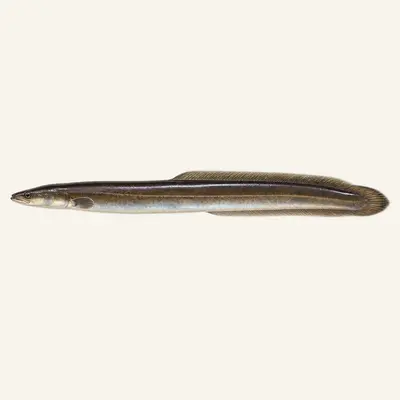
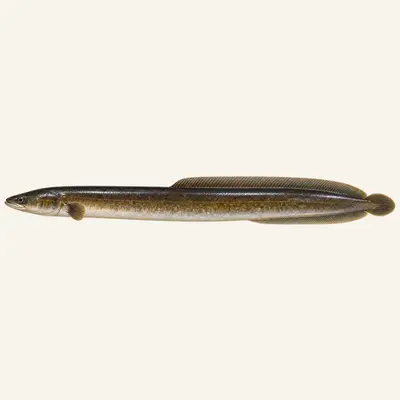
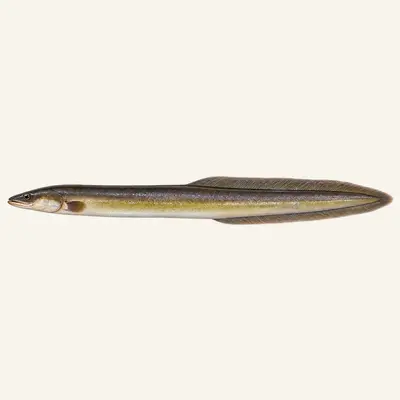
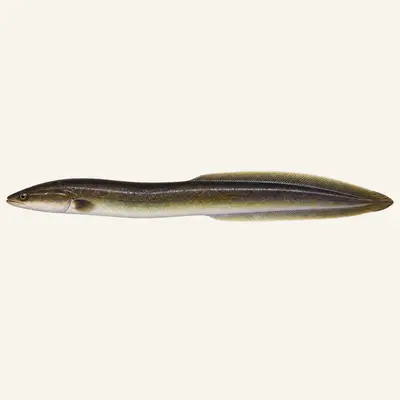
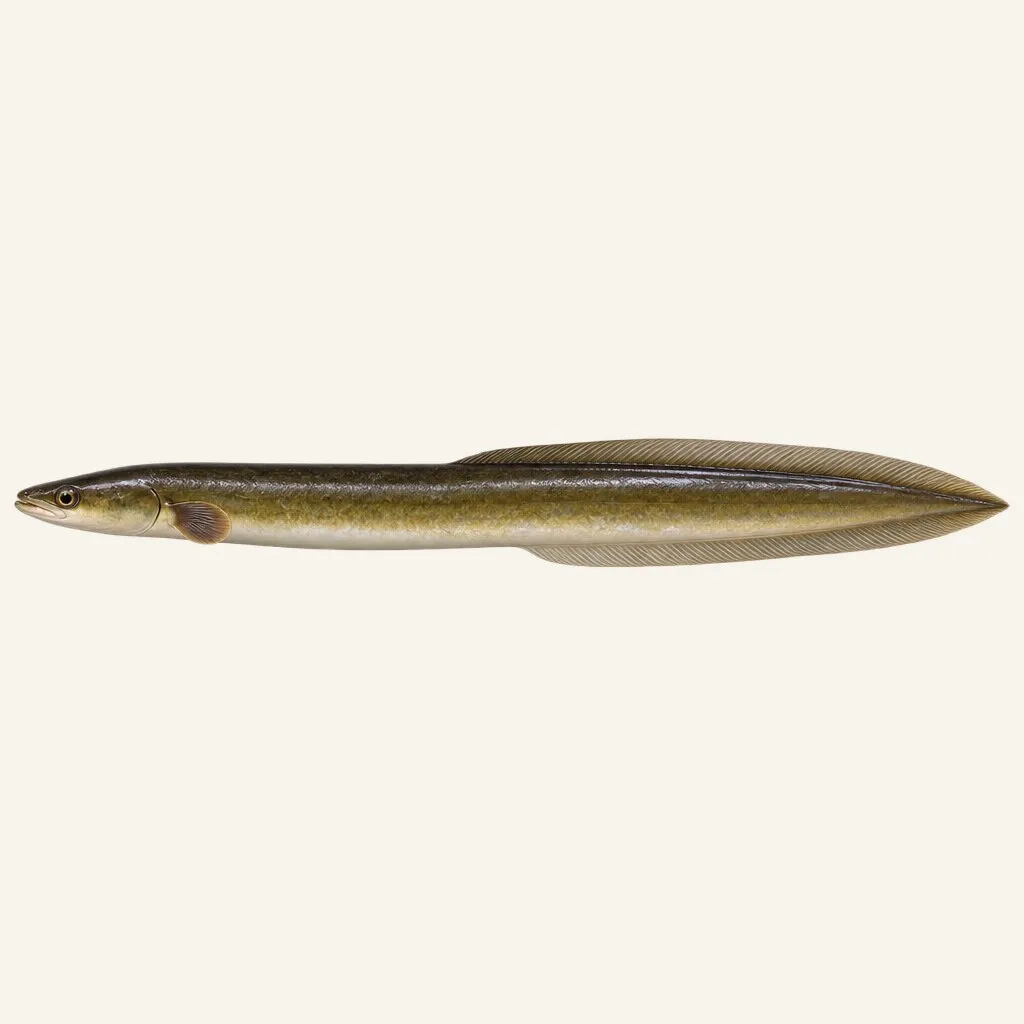
The shape gives it away, and one detail confirms it: dorsal, tail and anal are not three fins but one. They run together into a single unbroken band from the middle of the back, around the tail and forward along the belly to the vent, carried on at least 500 soft rays. There are no pelvic fins at all.
The lower jaw projects slightly beyond the upper. The gill openings are small, vertical and confined to the sides of the head, which is what gives the front end its sealed, featureless look. Behind it lie 110 to 120 vertebrae, and that count is the whole explanation for how the animal moves.
Colour is the thing that misleads, because it belongs to a life stage rather than to the fish. A yellow eel, still growing, is green-brown above with a dull yellowish belly. A silver eel, ready to leave, is near-black across the back, bright below, with a hard black line down the flank and eyes that have grown visibly larger. Those are the same individuals a few months apart, not two kinds of eel.
Breeding
It breeds once and dies. Every other fact about this animal is downstream of that.
When maturity approaches, the fish leaves the river. Departures cluster in the second half of the year and have been recorded in every month, and they begin on dark nights. The gonads are not ready at that point and do not become ready until the journey is under way: the whole of gametogenesis happens on the migration, so the animal leaves immature and arrives capable.
Spawning itself has never been seen by anyone. Its location is inferred from where the youngest larvae turn up, and the inference points to the Sargasso Sea, between March and June, at around 600 m. The adults die there.
The return trip is a separate feat. The larvae, called leptocephali, are transparent, flattened and leaf-shaped, and the Gulf Stream carries them to European coasts over 7 to 11 months, occasionally taking as long as three years. They then change into glass eels, 6 to 8 cm long, cylindrical and barely pigmented, which enter estuaries and push up into rivers and lakes. Some never leave the estuary and grow to adulthood in brackish water.
What follows is a long stationary feeding phase: 6 to 12 years for males, 9 to 20 for females, over which the yellow eel gradually becomes a silver one. Average life span runs 15 to 20 years, sexual maturity arrives around 55 cm, and males stop growing at about 50 cm while females go on to more than a metre.
The water it needs
Every kind of bottom habitat is used, from small streams to the shores of large rivers and lakes, and the only structural requirement is a route to the sea. Naturally, this fish occurs solely in water that connects to the ocean, because a life cycle that ends 5,000 km offshore allows no exceptions.
It is territorial and solitary. The aggregations of young eels that are sometimes seen are not shoals and are not sociable: they are a common response to an external circumstance, a barrier or an inflow, which packs individuals together without any of them seeking company.
Facultative air-breathing lets it survive out of water far longer than any other fish in these rivers and cross wet ground between one water and the next, which is why apparently landlocked ponds turn out to hold eels.
Depth tolerance is extreme, from the surface to 700 m, across 0 to 30 degrees. On the spawning migration the animal covers 5,000 to 6,000 km while making a daily vertical commute between about 200 m at night and 600 m by day, most likely to stay away from predators. It is also sensitive to weak magnetic fields, which is the working explanation for how it navigates an open ocean.
Areas
- Muddy bottoms
- snags
- dark areas
- nocturnal
Techniques
- Bottom ledger rig
- Night float
Baits
- Worms
- Dead fish
- Meat baits
What it eats
Feeding is nocturnal, on the bottom, and led by smell rather than sight. The diet is as broad as any in fresh water: effectively the whole aquatic fauna present wherever the fish happens to live, in salt water as readily as in fresh, plus animals that do not live in water at all, worms among them.
That combination of habits has a cost nobody noticed for decades. A high fat content plus a lifetime of feeding on and in the sediment makes this fish an efficient accumulator of heavy metals and organic contaminants. The consequences are not confined to the individual: documented effects include organ damage, reduced capacity to complete the migration, and lowered genetic variability. A pollutant load picked up in a canal in year six can be what stops an animal reaching the Sargasso in year fifteen.
How to catch it
Night, bottom, strong-smelling natural bait. This is static fishing on known marks, deep holes, rock armour, river mouths and the water around structures, rather than a matter of covering ground, and the fish come to the bait rather than the other way round.
Before any of that, the legal position has to be established. This fishery is tightly controlled across most of Europe and closed outright for certain life stages and certain periods, and what applies on a given water in a given year is a question for the competent authority. It is not a fishery where custom or a neighbour's practice is a safe guide.
There is one biological fact that ought to inform any decision at the water. A silver eel taken on its way downstream is not one fish removed from a stock; it is one entire reproductive event removed, because the animal has no second attempt and had not yet made its first.
Handling is genuinely difficult. The mucus makes a bare-handed grip impossible and the fish knots itself around whatever it can reach. A wet cloth holds better than force, and force damages the skin without improving the grip.
Protected — Sensitive or protected species depending on area: check local rules before taking action.
Regulated — Often governed by quotas, size limits, seasons, or reporting rules.
Conservation · Critically Endangered (IUCN) — This species is threatened with extinction. Always release it (no-kill), handle it with the utmost care and check local rules — fishing for it may be prohibited.
Conservation
A single reproduction per lifetime, at the end of a journey of several thousand kilometres, leaves no margin anywhere. A species that spawns annually can write off a bad year and make it up in the next one. This one cannot: every adult that fails to reach the Sargasso is a reproduction that simply does not happen, and nothing later compensates for it. That arithmetic is what turns ordinary attrition into decline.
The measurement that matters is recruitment, the count of glass eels arriving on European coasts each spring, and it has fallen by more than 90 per cent since the 1980s. Reviews of the stock place it outside safe biological limits and judge current fisheries unsustainable, and the decline covers the whole continental distribution rather than a handful of catchments.
The causes stack rather than compete. A fish that must climb from the sea as a glass eel and come back down as a silver one depends on the route staying passable in both directions, and a modern river carries weirs, turbines and pumping stations that a nineteenth-century one did not. An introduced parasite lodges in the swim bladder and damages the organ the animal needs to control its depth across an ocean crossing. Contaminant loads work on the same individuals from the inside. Wetland drainage has removed a great deal of the growing habitat. And the fishery concentrates on the two stages that carry the most weight, the ones entering the rivers and the ones leaving them.
Two international listings follow from that picture. The species sits on Appendix II of CITES, which puts its cross-border trade under monitoring, and on Appendix II of the Convention on Migratory Species, the framework for agreements between the states its life cycle crosses. Neither instrument does much on its own; both exist because no single country holds this animal long enough to manage it alone.
Regulations
Min size 37-45cm / Very strict quotas / Partial ban
For guidance only. Legal sizes, quotas and open seasons vary by location and season: always check the local regulations in force before fishing.
Other names
European eel is the full name, and the stages have separate names in English that recur throughout the regulatory literature: glass eel for the transparent stage entering the estuaries, elver for the young pigmented fish working upstream, yellow eel for the long growing phase, silver eel for the adult heading back to sea. Those terms are not interchangeable and the rules that use them do not treat them as such.
Two confusions are worth clearing up. The conger is not a life stage or a variety of this fish but a separate marine family. And the American eel is a distinct species that shares the Sargasso as a breeding ground, which is why the two turn up in the same discussions of the North Atlantic without being the same animal. English also hangs the word eel on things that are not eels at all, the sand eel and the electric eel among them.
The genus and species names are the same Latin word repeated, a diminutive of the word for snake.
Sources: fishbase.se · api.gbif.org