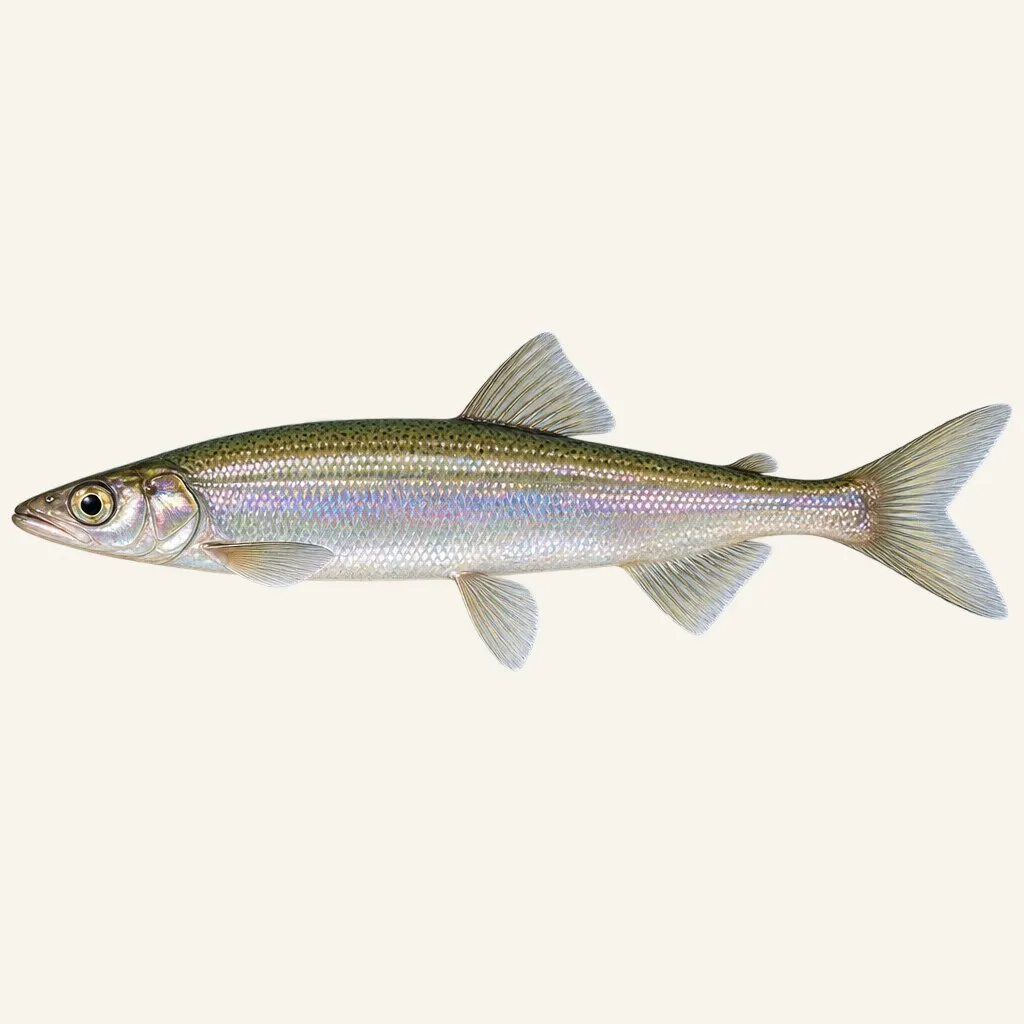
Rainbow smelt
Osmerus mordax · Osmeridae
- Saltwater
- Migratory
- Easy
- Size
18–30 cm
- Weight
0.0–0.2 kg
- Lifespan
7 years
- Water temp.
6–18 °C
- Depth
0–425 m
Where to fish
- Estuary
- Rocky shore
Habitat icons: Flaticon
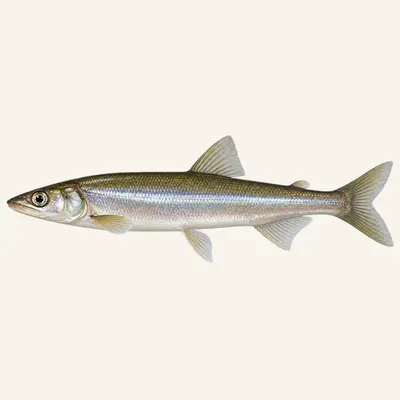
A small anadromous silvery smelt with a characteristic cucumber-like odor that runs up rivers in spring to spawn.
Calendar
Recorded in 4 countries
Canada · Japan · Russia · United States
GBIF occurrence records — native and introduced populations combined.
Its range
From 167°W to 53°W, and then Asia as well. The Atlantic side runs from Lake Melville in Newfoundland and Labrador to the Delaware in Pennsylvania and inland through the Great Lakes; the Arctic and Pacific side from Bathurst Inlet in the Northwest Territories to Vancouver Island; and Pacific drainages of Asia carry the species too. Three ocean basins for one fish.
Penetration inland matches the spread along the coasts. The record has it running as far as 1,000 km up a river. An animal maturing at 19 cm, entering fresh water to spawn and covering that distance, is doing something very few fish of its size attempt.
Identifying it
Teeth on the vomer, the palatines, the pterygoids, the basibranchial, the dentary, the maxilla and the tongue, the largest of them on the tongue itself and at the front of the vomer. The published description works through the mouth bone by bone, and what it adds up to is an animal armed along the full depth of its buccal cavity at a maturity length of around 19 cm.
The jaw is built to match. The mouth is large, the lower jaw projects, and the maxilla reaches at least to the middle of the eye.
Colour has to be read at once or not at all. A fish just out of the water carries purple, blue and pink over a pale green back, and the description ties that iridescence to the words "freshly caught". A smelt looked at later, in a bucket, is no longer showing what the name refers to.
The frame is unremarkable and worth counting anyway: body elongate and compressed from the sides, deepest just ahead of the dorsal origin, 8 soft rays in the dorsal, 12 to 16 in the anal, 58 to 70 vertebrae.
Breeding
The river fills and empties once a day. Spawning happens at night; at first light the spawners drop back downstream to the lake, and they come up again after dark. That alternation repeats for as long as the run lasts, which may be three weeks with the bulk of it inside one.
Water temperature opens the gate. Runs go when the water sits between 8.9 and 18.3 degrees, so a warm spring brings the whole event forward by weeks and a cold one holds it back.
In the current, two or more males covered in breeding tubercles hold position against a female. Eggs come out in clusters, with milt released at the same time.
The water it needs
Nought to 425 m. The usual band stops at 150, and the deepest figure arrives with the source's own hedge — possibly to 425 — but even the uncontested part of that column is a great deal of water for a small fish to have been recorded in.
Temperature narrows it. Activity is logged between 7.2 and 15.6 degrees inside a tolerated 6 to 18, and it is that ceiling rather than salinity or bottom type which sets the southern edge of the range at 41°N. Cool clear lakes, rivers of medium to large size and coastal water all satisfy it equally.
The fish holds in shoals in midwater, off the banks in a lake and inshore in the sea. Coastal populations run to sea and back. Lake populations complete an identical cycle in tributaries without ever meeting salt water.
Areas
- Estuaries and river mouths
- Coastal piers and jetties
- Large lakes (landlocked populations)
- Small spawning streams
Techniques
- Sabiki rig with small hooks
- Ice fishing
- Dip-netting during spawning runs
- Light float fishing
Baits
- Worm pieces
- Small flashy jigs
- Maggots
- Cut bait
- Weighted flies
What it eats
The prey list reads as two lists. Amphipods, ostracods, insect larvae and aquatic worms come off or near the bed; copepods, euphausiids and mysids come out of open water; and small fishes — silversides, mummichogs, herring — come from wherever they happen to be. Euphausiids in particular are oceanic animals, and finding them in the same paragraph as insect larvae is the plainest statement in the file of how much ground this species covers.
That breadth is why the depth range above is not a contradiction. A fish taking krill at one end of its column and insect larvae at the other has no need to choose a layer, and depends on no single prey being present. A lake supplies the second list, a bay supplies the first, and the animal is at home on either.
How to catch it
The big fish come first. Lengths in both sexes fall as the run progresses, which turns the date of a trip into a decision about size rather than about numbers: the head of the run carries the largest spawners, the tail of it the smallest.
Everything else is arithmetic on the shoal. Nobody catches a smelt; a passage is caught, on a sabiki rig of small hooks with line the fish will never test. Once the holding layer is found it produces, and a metre off it produces nothing.
Night sets the hour, and it inverts the usual habit of river fishing. The fish are in the river in the dark and gone by morning.
Outside the run the search goes offshore and vertical, into whatever depth is carrying the right temperature. The season listed for the species reflects both halves — ice through the cold months, the spawning run from March — and closes for the summer, when the fish is deep, dispersed and nowhere near the surface.
Conservation
Nothing in the file presses on the species. The exposure lies in the shape of the fishery.
Three facts compound. The run is short, three weeks with a one-week peak. It is concentrated, in a defined reach at a defined time of night. And the largest spawners pass first, so the part of the run easiest to be present for is also the part carrying the biggest animals.
Set against that, 7 years is the recorded ceiling on age. A short-lived species turns over quickly, which cuts both ways: a poor year class is felt fast and a good one replaces it fast, and the population is driven by recruitment rather than by a standing stock of old fish. What follows is an argument for restraint at the head of the run in particular, not for restraint in general.
Regulations
Often governed by specific seasons and quotas (with dip-netting sometimes prohibited); subject to local regulations.
For guidance only. Legal sizes, quotas and open seasons vary by location and season: always check the local regulations in force before fishing.
Other names
Rainbow smelt is the full name, and the adjective points at an iridescence that is only there for a while. Around the Great Lakes and in New England the fish is simply smelt.
The short form is the problem, because this catalogue publishes two species called smelt and nothing in either name says which is which. What separates them on paper is an ocean: this one on the American Atlantic, the Arctic and the Pacific, the European smelt from the Gironde to the White Sea. A label reading smelt has named a family.
Mordax means biting. Of everything the original description could have fixed on, the dentition is what it took.
Sources: fishbase.se · api.gbif.org