Tarpon
Megalops atlanticus · Megalopidae
- Saltwater
- Migratory
- Medium
- Regulated
- Size
130–250 cm
- Weight
25–161 kg
- Lifespan
55 years
- Water temp.
10–40 °C
- Depth
0–40 m
Where to fish
- Estuary
Habitat icons: Flaticon
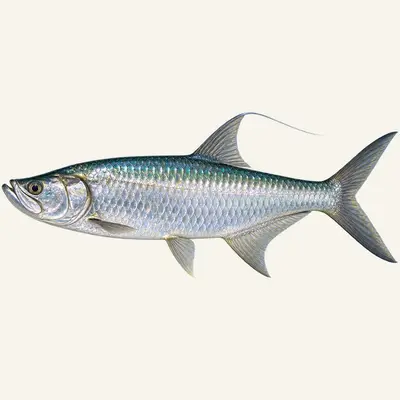
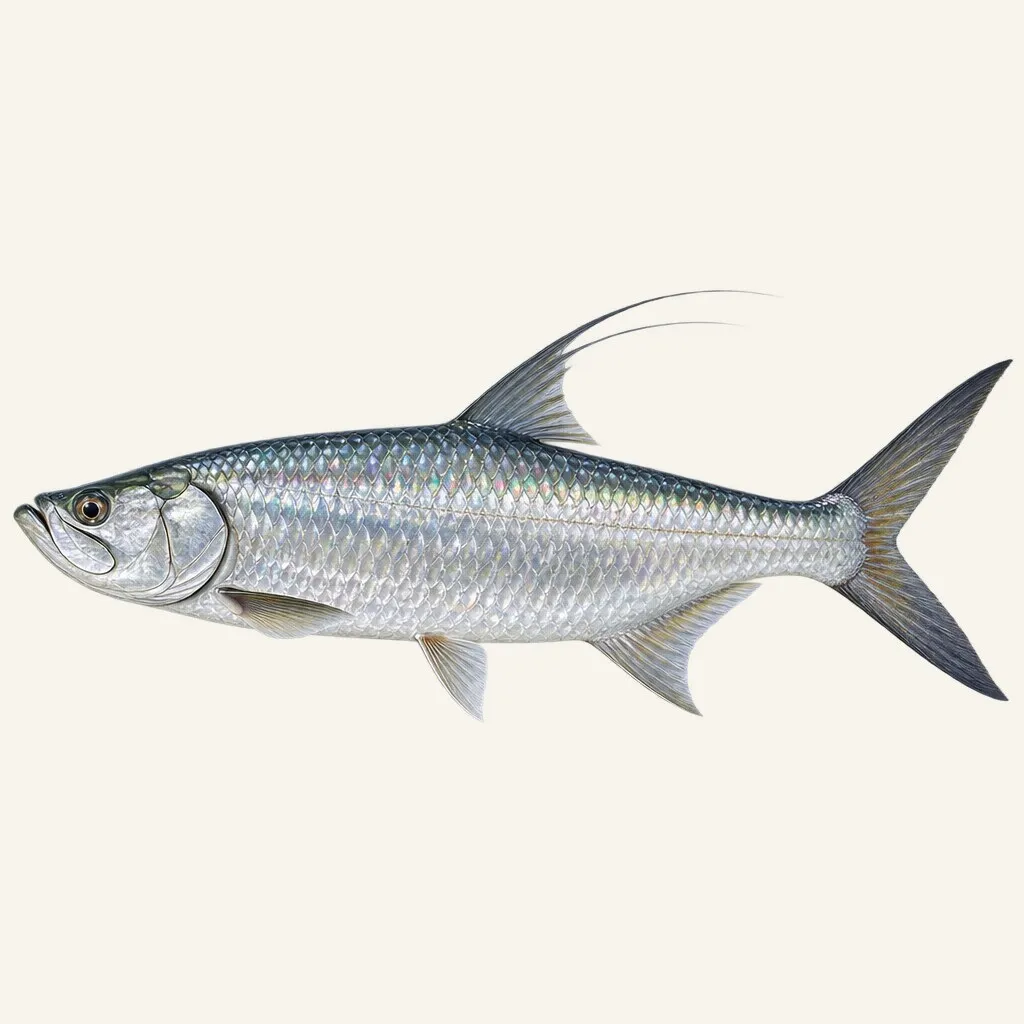
The Atlantic tarpon (Megalops atlanticus) is a massive coastal pelagic fish with brilliant silver scales and high-set pectoral fins, capable of reaching over two metres in length. A spectacular leaper, it inhabits warm tropical Atlantic waters and can tolerate estuaries and brackish environments.
Calendar
Recorded in 16 countries
Barbados · Belize · British Virgin Islands · Cameroon · Caribbean Netherlands · Cayman Islands · Colombia · Cuba · French Guiana · Guadeloupe · Honduras · Mexico · Puerto Rico · Sint Maarten · U.S. Virgin Islands · United States
GBIF occurrence records — native and introduced populations combined.
Identifying it
The character the species is defined on is a position rather than a count: the pelvic fins insert distinctly ahead of the origin of the dorsal. On a fish laid flat that is one glance, and it needs no measuring.
The counts back it up. Thirteen to 16 rays in the dorsal, 22 to 25 in the anal, 40 to 48 scales along the lateral line and 53 to 57 vertebrae. Not one spine anywhere in the fish — neither fin carries any — which is not what a coastal animal of this size usually offers a hand reaching for it.
The scales say more about the scale of the fish than a measurement does. They were worked as ornament, and they were used in the manufacture of artificial pearls. A scale that can be turned into a pearl is a scale that sits in the palm like a coin.
The body is fusiform and compressed in section, and silver over all of it.
Breeding
Fecundity is on a different order from the rest of the coastal fauna: a female of 203 cm is estimated to carry more than 12 million eggs.
Spawning is described in water that can be temporarily isolated from the open sea — a lagoon or a basin closed off by a bar for part of the year. That is a specific and destructible requirement, and it is unusual in a fish that spends its adult life on open coasts.
The larva is a leptocephalus: transparent, and of the type otherwise associated with the eels, which migrates into estuaries to grow on. A larval stage shared with the eels, in an animal built like an enormous herring, is the clearest single statement of how old this lineage is.
Some populations complete the entire cycle in fresh water, and two are on record — Lake Nicaragua in Central America, and Deep Lake in Florida. A twelve-million-egg marine spawner reproducing inside a closed lake is a wider tolerance claim than any salinity figure could make.
Maturity, finally, arrives at about 160 cm, and the common length is 130. The ordinary fish is below the size at which it would first spawn.
The water it needs
Coastal water, bays, estuaries, mangrove-lined lagoons and rivers, from the surface to 40 m and usually within the top 15. The species is classed as reef-associated and as anadromous, and it enters fresh water without ceremony.
What opens all of that up is a piece of plumbing. The swim bladder is attached to the oesophagus and can be filled directly with air the fish swallows at the surface, and the arrangement is obligatory rather than optional: this animal does not have the choice of staying down. The consequence is that dissolved oxygen stops being a constraint on where it can hunt. A hot, still mangrove lagoon in which its prey is beginning to suffocate is ordinary water for it, and it goes there because it can.
The temperature band runs from 10 degrees to 40 — thirty degrees wide, and the upper end is the remarkable half. Forty degrees is the afternoon temperature of shallow tropical lagoon water, which is water most fish cannot use at all.
One more line in the record has an unusual shape. Large schools may frequent particular spots for years. That is not a habitat type, it is an address, and it is held across seasons.
Areas
- Coastal passes and channels
- Estuaries and mangroves
- Tropical lagoons
- Shallow Atlantic zones
Techniques
- Live surface bait fishing
- Large soft lures
- Fly fishing
- Coastal trolling
Baits
- Live mullet
- Shrimp
- Crabs
- Large lures
What it eats
The prey are schooling fishes — sardines, anchovies, mullet, snook, cichlids — with crabs alongside them.
The preference for prey that shoals is stated outright, and it matches the predator's own habit. A school hunting schools does not select an individual out of open water; it drives into a mass and takes what the collision produces.
The cichlids on that list are the interesting entry, because cichlids are fresh water. This fish is not paying calls on the rivers. It is feeding in them.
How to catch it
The animal gives away its own position. An obligate air breather has to come up, and it comes up on a schedule, so the roll at the surface is not a hint — it is a count. How many, heading which way, at what speed. In water with no visibility that is the only positional information available, and it is better than an instrument would give.
The addresses hold for years, which makes this a fishery of inherited knowledge rather than discovery. Someone who knows a pass knows where in the pass, and that is worth more than any part of the tackle.
The mouth is bone hard, and that is where the whole business is decided: a hook that has not been driven through it is a hook that comes back on the first jump, and there are always jumps. What the fish does after the strike is the reason it is fished for at all.
The standing rod-caught record came out of Lake Maracaibo, a brackish lake, rather than off an open coast. That points at where the largest fish live — in the big estuarine systems, not on the beach.
One entry belongs to health rather than sport: reports of ciguatera poisoning are on file for this species. The flesh is well regarded and heavily boned, but it is that entry, not the bones, that decides whether to eat one.
Regulated — Often governed by quotas, size limits, seasons, or reporting rules.
Conservation · Vulnerable (IUCN) — This species is threatened with extinction. Always release it (no-kill), handle it with the utmost care and check local rules — fishing for it may be prohibited.
Conservation
Start with the arithmetic. Maturity at around 160 cm, an oldest reported age of 55 years, and a common length below the maturity length. In any fishery that keeps its catch, most of what is landed has never spawned, and a mature adult represents decades that no management cycle can replace.
The habitat side needs no fishing at all to work. The whole life history runs through mangrove lagoons and estuaries, and the spawning requirement — water that can be cut off from the sea for part of the year — is a coastal feature that development removes early and rarely restores.
The schools' fidelity to particular spots across years is a third exposure, and it is the one anglers create for themselves. A predictable, locatable aggregation of long-lived fish, most of them below spawning size, is the easiest thing on a tropical coast to work over repeatedly.
Handling has its own rule here, and it comes out of the physiology. A fish that must reach the surface to breathe has to be able to swim upwards when it is let go. One fought to exhaustion in warm water and released without being held up and given time is a fish that cannot get its air, whatever its gills are doing.
Regulations
Check the local regulations in force (legal size limits, closed seasons, bag limits).
For guidance only. Legal sizes, quotas and open seasons vary by location and season: always check the local regulations in force before fishing.
Other names
Tarpon does duty in English and in French alike. Silver king is the older sporting name and it comes from the scales.
In Caribbean Spanish it is sábalo, a word that in Spain names the shads — a different family in a different ocean — so a Spanish-language source needs its geography established before its fish. In parts of the range sábalo real is used to separate the two.
The family holds two species worldwide and nothing else, and both of them are called tarpon in English. Where a document has to say which one it means, the ocean does the work.
Sources: fishbase.se · api.gbif.org