Nile tilapia
Oreochromis niloticus · Cichlidae
- Freshwater
- Other
- Medium
- Size
60 cm
- Weight
4.3 kg
- Lifespan
9 years
- Water temp.
14–33 °C
- Depth
0–20 m
Where to fish
- Canal
- Lake
- River
Habitat icons: Flaticon
Nile tilapia - white fish, Africa/Worldwide
Calendar
Recorded in 28 countries
Brazil · Central African Republic · China · Colombia · Costa Rica · Côte d’Ivoire · Ecuador · Egypt · Hong Kong SAR China · India · Indonesia · Japan · Kenya · Macao SAR China · Malaysia · Mexico · Oman · Peru · Réunion · Singapore · Sri Lanka · Taiwan · Tanzania · Thailand · Uganda · United States · Vietnam · Zimbabwe
GBIF occurrence records — native and introduced populations combined.
Its range
The natural range forms two blocks that nothing connects today. In the east, the Nile basin with lakes Albert, Edward and Tana, Jebel Marra, Kivu, Tanganyika, the Awash and the Ethiopian lakes, the Omo, Turkana, the Suguta and Baringo, as far as the coastal rivers of Israel. In the west, the Senegal, Gambia, Volta, Niger, Benue and Chad basins.
That double footprint is a hydrographic inheritance: those networks were connected in wetter periods, and the Sahara has separated them since. The northern limit, the 32nd parallel, is the highest latitude a tilapia reaches naturally apart from the blue tilapia.
The rest of the map belongs to economics rather than biogeography. The species has been distributed for aquaculture through every warm zone on the planet, in many selected strains, and adverse effects are reported from several receiving countries.
One taxonomic note helps with older literature. Eight subspecies were once recognised — baringoensis, cancellatus, eduardianus, filoa, niloticus, sugutae, tana and vulcani — and the names still circulate in papers written before they were dropped.
Identifying it
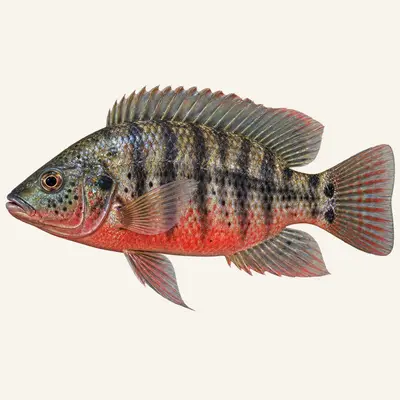
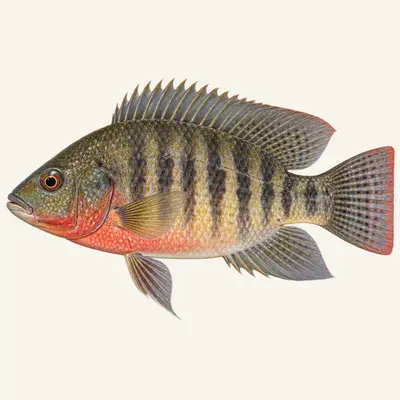
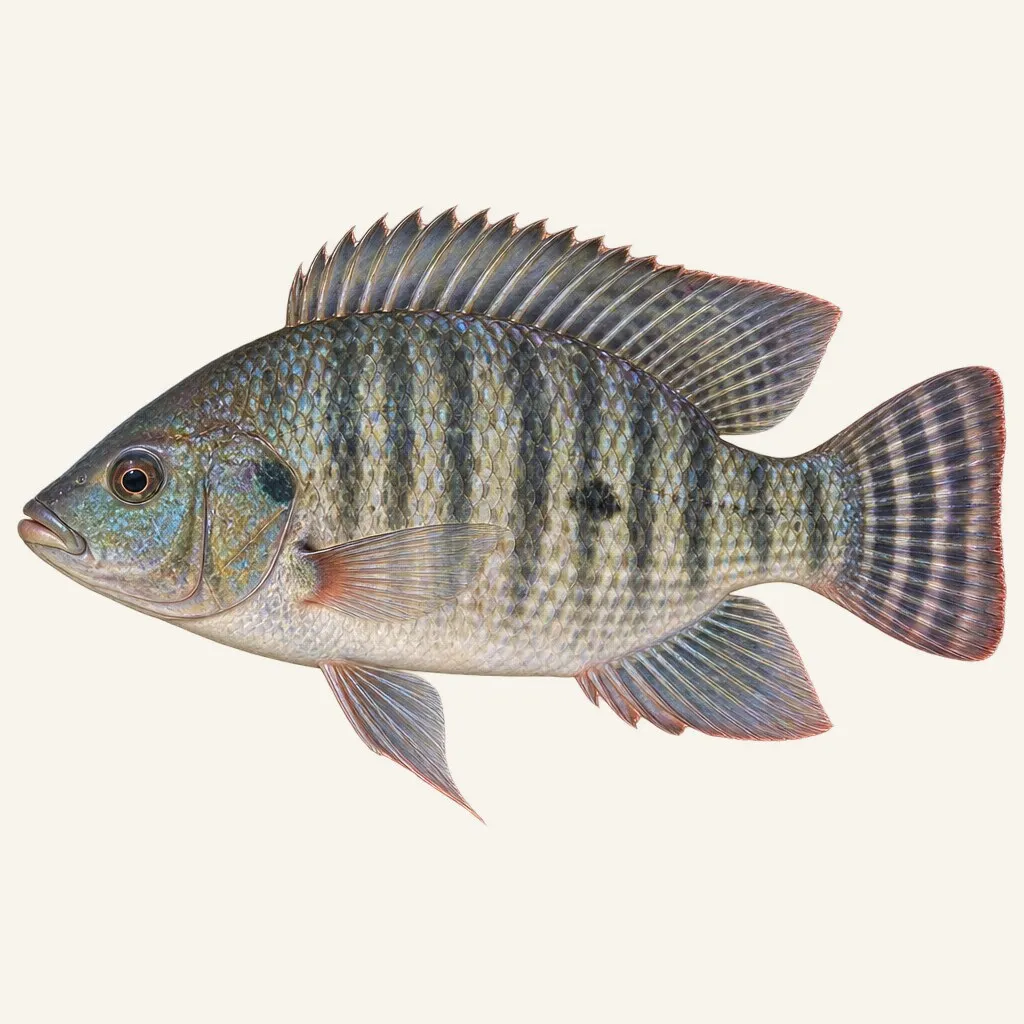
The tail settles it. Regular dark vertical bars cross the caudal fin over its full depth, and they are present at every stage of life. On small fish the bars are relatively broad, start at the base of the fin and curve into an arc. No other tilapia of the genus carries that pattern, and checking it alone dismisses the commonest confusions.
The body is deep and the head small in proportion, depth running 36 to 50 per cent of standard length. The jaws of a ripe male do not enlarge greatly — the lower jaw stays between 29 and 37 per cent of head length — and his genital papilla is never tasselled.
Colour differs by sex. The male runs bluish pink, sometimes with a dark throat, belly, anal and pelvics. The female is brownish, silvery white underneath, marked with about 10 thin vertical bars.
Counts: 15 to 18 dorsal spines, 11 to 13 soft rays behind them, nine to 11 anal rays, 30 to 32 vertebrae.
Breeding
Three to six months are enough to turn a fish into a breeder, depending on water temperature, and 30 g of weight will do. Females can ripen near 11 cm, males near 14. Nothing explains this animal's place in world aquaculture better: a generation closes inside a season.
The cycle stays quick afterwards. A female spawns several times a year, roughly once every 30 days, provided the water holds above 20 °C. Below that threshold, nothing happens at all.
Males set up territories on firm sand between 0.6 and 2 m down, in lakes and inshore water, and dig a plain pit. Females visit; courtship runs for hours. Eggs come out in batches into the nest, the male fertilises them, and each batch is picked straight up into the female's mouth. One male probably fertilises the clutches of several of them.
Two hundred eggs is the most a mouth holds. They measure 1.5 mm; the larvae are 4 mm at hatching and do not come out until the yolk sac has gone, after about a week. The whole of the brood care falls on the mother.
The water it needs
Few warm fresh waters are closed to it. Rivers, lakes, irrigation channels, down to sewage canals: tolerance of degraded water is part of the portrait. The depth range worked runs from the surface to 20 m.
Salt is the real limit. The species survives brackish water but does not prosper in properly saline water, which sets it clearly apart from the Mozambique tilapia and explains why it stays an inland fish.
Thermal tolerance spans 13.5 to 33 °C under natural conditions and eight to 42 at the extremes. Behaviour is diurnal.
Areas
- Shallow warm lakes
- Slow-flowing rivers
- Canals and irrigation areas
Techniques
- Feeder fishing
- Match fishing
- Bread fishing
- Seed fishing
Baits
- Bread
- Corn
- Earthworms
- Cooked seeds
- Vegetable pellets
What it eats
Phytoplankton and benthic algae make up the main ration. Insect larvae are added to it, along with aufwuchs — the felt of algae and micro-organisms coating submerged surfaces — and detritus. Young fish eat a more mixed diet than adults.
Feeding at the base of the food chain is what makes this animal economically decisive. A fish that converts algae directly into flesh costs a fraction of what a predator costs to produce, and that equation, more than any quality on the plate, is what carried the species into ponds across half the world.
How to catch it
Where the species is established it supports major capture fisheries, and the commercial take weighs far more than the rod fishery. Collective gear there handles the full run of sizes, up to fish of nine years.
For rod and line, two markers come out of the biology. Activity concentrates in daylight. And in the breeding season the pits dug in shallow sand, between 0.6 and 2 m, are held by males defending a circle: a fish taken there is a breeder on station, with what that implies for the next clutch.
The vegetable and planktonic diet points the bait at pastes, plant material and small invertebrates. Lures imitating a forage fish have no reason to work on an algae grazer.
Conservation
The question does not arise in the usual direction. This fish is not retreating anywhere; the ones it meets are. And the mechanism is genetic as much as ecological. The species crosses with many others in the genus, and a fertile hybrid dilutes in a few generations a lineage that no measure afterwards restores.
Several states have banned further stocking on their territory for that reason, South Africa, Malawi and Zambia among them. Those three hold tilapias particular to the Zambezi and the lower Shire, which generalised crossing would erase without any catch figure falling: the fish would still be there, the lineages would not.
Being classed as a potential pest has practical consequences. Moving live specimens and putting them into water are controlled in a great many countries, including those where populations have been established for a long time.
Regulations
Check the local regulations in force (legal size limits, closed seasons, bag limits).
For guidance only. Legal sizes, quotas and open seasons vary by location and season: always check the local regulations in force before fishing.
Other names
Nile tilapia, after the river where the species was described, and a name now geographically absurd, since most of the world's production happens nowhere near the Nile.
The word tilapia is the real problem. On a fishmonger's slab, on a menu and in trade statistics it is a market category rather than a determination. It covers Oreochromis, Sarotherodon and Tilapia proper, three genera that differ in exactly the thing this page spends its longest section on, which parent broods the eggs. In practice the word almost always means this species and its selected strains, whose production dwarfs everything else in the group. That is convenient for a supply chain and useless for identification: a fish sold as tilapia has been named by its market, not by anyone who looked at its tail.
Sources: fishbase.se · api.gbif.org