Monoculus peacock bass
Cichla monoculus · Cichlidae
- Freshwater
- Predators
- Medium
- Size
70 cm
- Weight
9.0 kg
- Water temp.
25–28 °C
Where to fish
- Estuary
- Lake
- River
Habitat icons: Flaticon
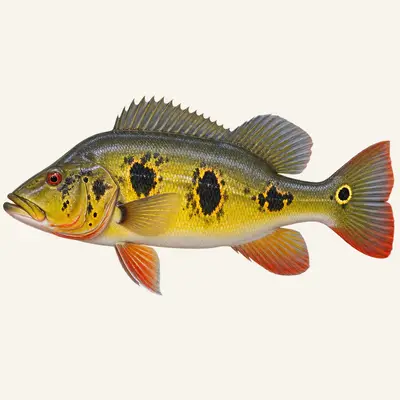
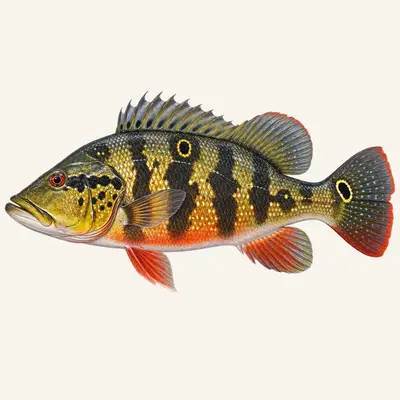
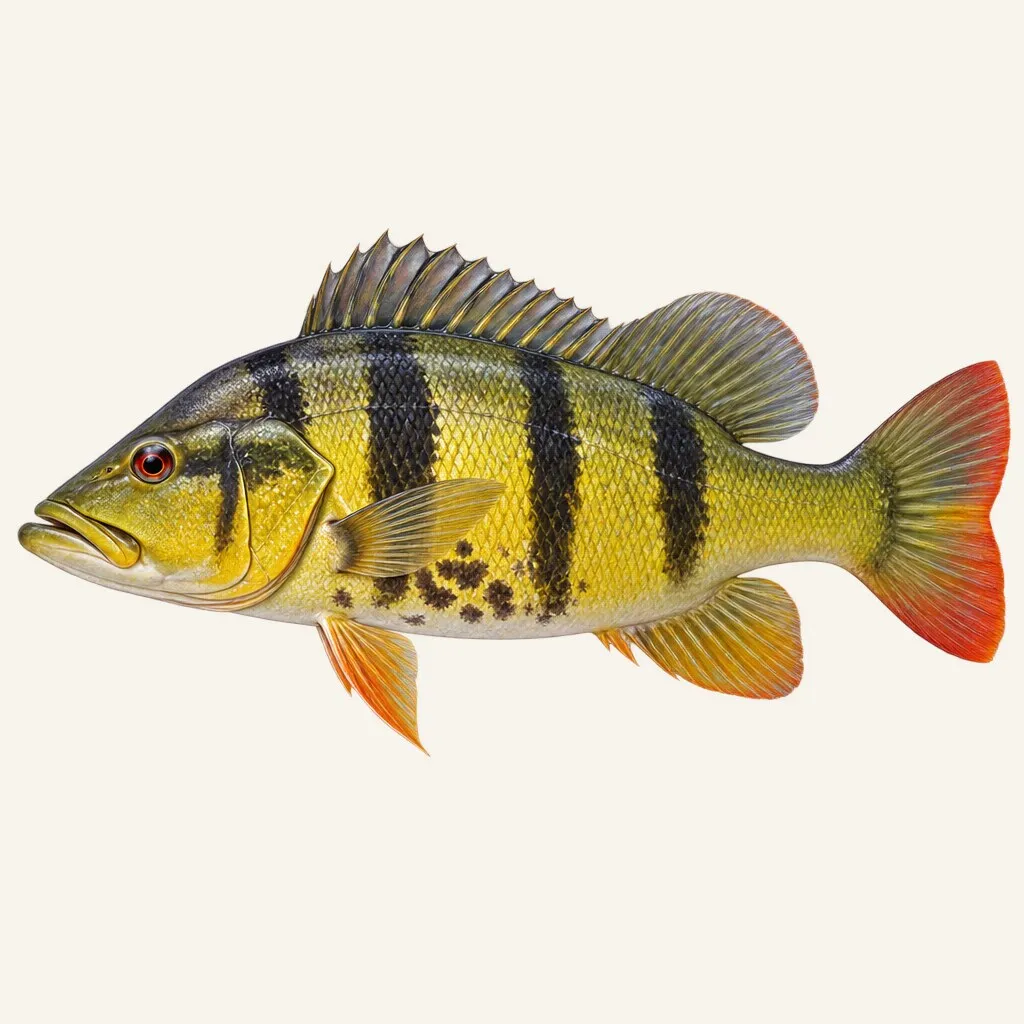
The monoculus peacock bass is an Amazonian predatory cichlid identified by a single ocellated spot on its flank, in addition to the one at the tail base. It inhabits the vegetated shallows of lakes and rivers, where it ambushes prey.
Calendar
Its range
The Solimões-Amazonas along the main channel and up the lower courses of its tributaries, in Peru, Colombia and Brazil, plus the Araguari and the lower Oyapock north of the Amazon.
The documentation adds that the species is probably far more widespread across the lowland Amazon than the records show. The map is therefore a map of collecting effort as much as of the fish, and the blank areas inside the lowlands should be read with that in mind.
Identifying it
On a big fish, look at the nape first: a pronounced bar crosses it, and it grows more marked with size. Three dark bars cross the flank, the front of the belly carries irregular dark patches, and the sides of the head stay clean — no black spots there, no ringed marks. Two congeners answer to that same description, point for point, so the description alone is not an identification.
The separation is arithmetic. A lateral row here holds 68 to 87 scales against 84 to 93 in C. pleiozona, which also usually shows a dark bar at the front of the caudal peduncle where this species has none. Against C. kelberi, the character is the fins: no pale spots on the anal or pelvic fins, none on the lower half of the tail.
Breeding
Males are ready to breed at one year, females at two. That one-year offset between the sexes is stated for this species and not for its relatives.
Breeding is not markedly seasonal. During it, large males develop a frontal hump and turn territorial — a seasonal condition of big males rather than a character of the species, and a fish showing it is telling its state, not its name.
Spawning happens three or four times a year, in batches of 50 to 100 eggs, each bout lasting two to three hours.
Those figures are extraordinarily low for a fish of this size. A congener releases 9,000 to 15,000 eggs per kilogram of body weight at each spawning; a batch of fifty is not the same order of quantity at all. Such a clutch only works if it is guarded, and everything else about the breeding behaviour follows from that arithmetic.
The water it needs
The lower pH on record is 7.0, with no upper figure given, and water at 25 to 28 °C. Neutral to alkaline is the point, and it places the fish: the main channel of the Solimões-Amazonas is silt-laden and near-neutral, quite unlike the acid tributaries where other members of the genus live. Species of this genus sort themselves by water chemistry as much as by geography.
Collected specimens came from ground subject to flooding, though the note adds that its Amazonian habitats are more varied than that sample suggests.
It works the shoreline, moving along it where small fish concentrate. That single behavioural line is the most useful thing in the file, because it says where to look: the margin, not the open water.
Areas
- Vegetated lagoon edges
- Creek mouths
- Holes beneath submerged wood
- Shallow areas in dry season
Techniques
- Cast and retrieve with minnow lures
- Vertical jigging
- Live bait fishing
- Surface dead-bait fishing
Baits
- Colored minnow lures
- Weighted jigs
- Local live fish
- Spinner baits
- Soft shad lures
What it eats
Juveniles eat shrimp. Adults eat fish, and almost nothing else.
The switch itself is common in the genus; here it is described as near-total, meaning a grown fish essentially stops taking invertebrates rather than keeping them as a fallback.
How to catch it
The margin, and the patrol. A predator that runs the bank looking for concentrations of small fish is intercepted by covering the edge, not by sounding the middle.
The frontal hump gives away a territorial male in breeding condition. That fish is aggressive and easy to provoke, which is exactly the problem — it is easy to catch because it is defending something.
Sizes are not settled. The longer length that circulates for the species is a claim; the shorter one is what has actually been measured, and the two are not even taken to the same point on the fish.
Conservation
A brood of 50 to 100 eggs, three or four times a year, is a minute reproductive investment for a fish of this bulk. Nothing in the strategy is spread across numbers, so all of it rests on the survival of each brood, and each brood depends on the pair staying with it.
That changes the arithmetic of taking a territorial adult out of the water during the breeding period. The fish removed is not one fish. It is the guard on a clutch small enough that losing it removes a whole year's contribution from that pair.
The species breeds without a marked season, so there is no closed period during which this cannot happen, and no calendar shortcut that avoids it. Recognising the hump and putting the fish straight back is the only usable answer.
Regulations
Check the local regulations in force (legal size limits, closed seasons, bag limits).
For guidance only. Legal sizes, quotas and open seasons vary by location and season: always check the local regulations in force before fishing.
Other names
Peacock bass in English, tucunaré in Brazil, pavón in Spanish-speaking countries.
The epithet means one-eyed, for the ringed spot on the tail. Every member of the genus carries that spot, so the name describes the whole genus and identifies nothing within it — a scientific name that actively invites the confusion it is meant to prevent.
Sources: fishbase.se · api.gbif.org