Mozambique tilapia
Oreochromis mossambicus · Cichlidae
- Freshwater
- Other
- Medium
- Size
35–39 cm
- Weight
0.7–1.1 kg
- Lifespan
11 years
- Water temp.
17–35 °C
- Depth
1–12 m
Where to fish
- Estuary
- River
Habitat icons: Flaticon
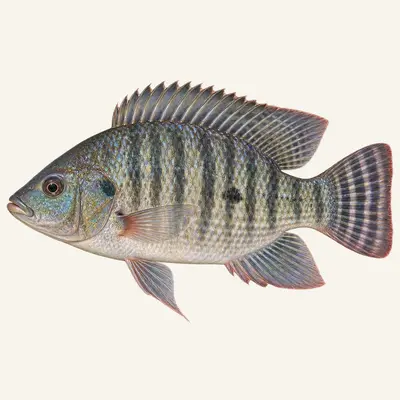
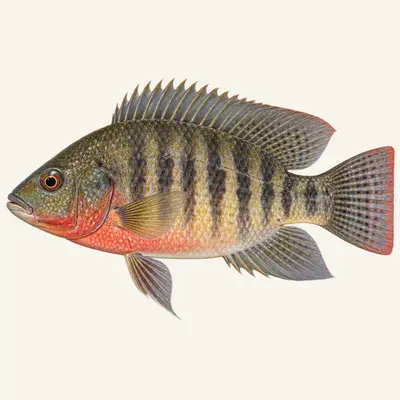
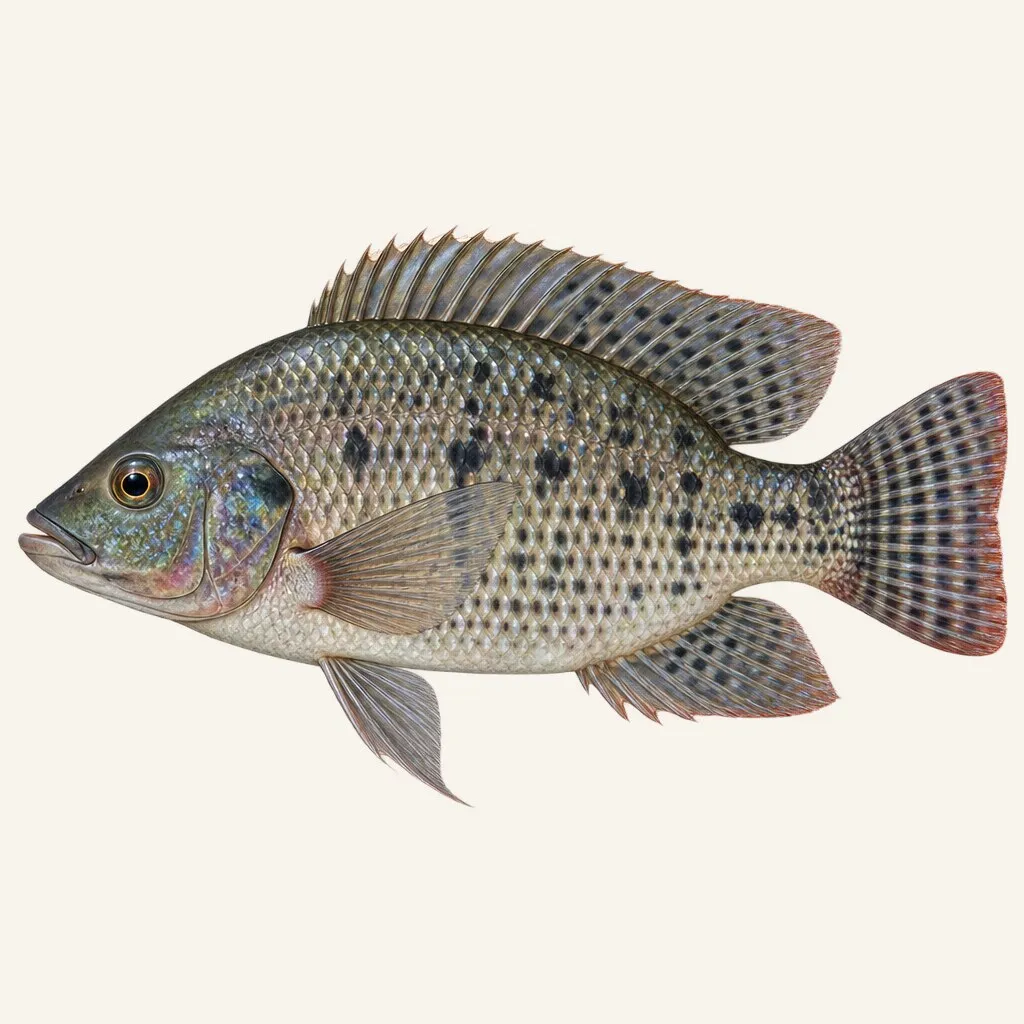
The Mozambique tilapia is a robust cichlid with a laterally compressed body, greyish-green to blackish coloration, and a very dark breeding livery in males. Highly adaptable, it colonises rivers, lakes, irrigation canals, and brackish waters across many tropical and subtropical regions.
Calendar
Recorded in 25 countries
Aruba · Australia · Colombia · Dominican Republic · Eswatini · French Polynesia · Guadeloupe · Hong Kong SAR China · India · Indonesia · Japan · Martinique · Mexico · Mozambique · Puerto Rico · Seychelles · Singapore · South Africa · Spain · Sri Lanka · Taiwan · Thailand · United Arab Emirates · United States · Zimbabwe
GBIF occurrence records — native and introduced populations combined.
Its range
The original range is narrow and coastal: the lower Zambezi, the lower Shire, and the coastal plain from the Zambezi delta to Algoa Bay, with a northward reach to the Brak River in the eastern Cape and into the Limpopo system in the Transvaal. Eleven degrees of latitude at most.
What the map shows now has little to do with that strip. The species was carried for farming to nearly every warm continent, then for angling, for stocking artificial impoundments and for the biological control of plants and animals judged undesirable. It escaped everywhere, and everywhere it established.
The result is documented: several countries record ecological degradation after its arrival, the fish displacing local species. It combines the qualities of a coloniser — very wide tolerance of conditions, early breeding, strong mobility and an aggressive temper towards other species.
Identifying it
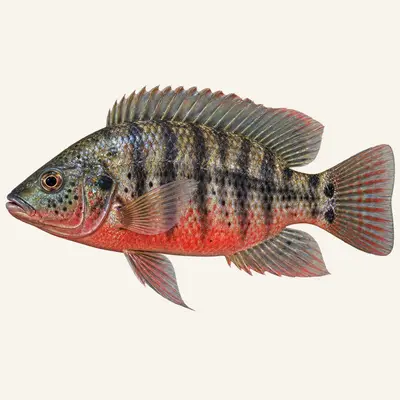
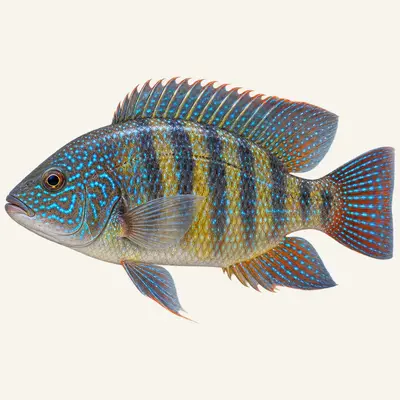
A male in breeding dress no longer resembles what he was a few months earlier. His jaws thicken until the snout draws out into a duckbill and the forehead profile turns concave, where a smaller specimen has it convex. The body goes black, the underside of the head stays white, and the dorsal and caudal take red margins.
Out of season, and in the female, the fish is silvery. Two to five blotches run along the middle of the flank, doubled by a second series set higher. That is the useful mark against the neighbouring southern African tilapias, which carry those spots differently or not at all.
The counts confirm: 15 to 18 dorsal spines followed by 10 to 13 soft rays, three anal spines, seven to 12 anal rays, 28 to 31 vertebrae, 14 to 20 rakers on the lower limb. The forehead carries large scales, two between the eyes then nine up to the dorsal. The caudal is not densely scaled.
The pharyngeal teeth are very fine, and in an adult the blade of the bone is longer than the toothed area. The male's genital papilla stays simple, at most shallowly notched at its tip.
Breeding
Spawning happens on a lek. Territorial males settle along the edge of the littoral terrace, on sand or mud, each digs a pit, darkens, and courts the females passing through. They alone make sound, through every phase of the display and above all in the moments before release.
Subordinate males work the edges of those territories. They slip into a nest at the exact moment of laying, quiver — the usual sign of milt release — and leave. Some go as far as adopting female postures to approach without triggering the owner's aggression. A single clutch can therefore be fathered several times over without the dominant male noticing.
The female drops 100 to 1,700 eggs into the bottom of the pit, then sucks them up along with the milt. Part of the fertilisation happens inside her mouth. She closes on them and stops eating: brooding females school together and live off body reserves. Water is turned over the eggs by chewing movements of the jaws. A male occasionally picks up a few eggs after spawning, and almost always swallows them shortly after.
Hatching comes at three to five days depending on temperature. The fry leave the mouth around the tenth to fourteenth day, stay glued to the mother and go back in at any alarm until about three weeks old. A female raises several broods in a season, with one partner or with several in succession.
Maturity normally arrives near 15 cm. But in crowded or poor water, stunted fish breed at six or seven centimetres and at little more than two months old. That is the mechanism that fills a pond with dwarfs, none of which ever reaches a size worth taking.
The water it needs
Still water is the condition. Impoundments, slow rivers, creeks, drainage ditches, swamps and tidal channels, almost always over mud and among vegetation. It also takes the warm weedy pools of sluggish streams, canals and ponds, between one and 12 m. Fast water does not suit it, and neither does altitude.
Its salinity tolerance has no equal in the genus. It grows and breeds in fresh, brackish and sea water, and culture holds it in hypersaline conditions. Blind estuaries and coastal lakes are where it concentrates; permanently open estuaries and the open sea, oddly, almost never hold it.
Oxygen stops it no more than salt does. It withstands very low dissolved levels and takes oxygen from the air when the water runs down. A temporary pool reduced to a puddle keeps its tilapias where everything else has died.
Temperature follows the same logic: 17 to 35 °C in nature, eight to 42 in extremis, with cold resistance that depends on the salinity it is sitting in.
Areas
- Marginal weed beds
- Shaded banks
- Calm river areas
Techniques
- Feeder fishing
- Match fishing
- Bread fishing
Baits
- Bread
- Corn
- Earthworms
- Vegetable pellets
What it eats
The diet changes with age. Juveniles are carnivorous or omnivorous; adults slide towards plants and detritus. The bulk of the adult ration is algae and phytoplankton, filled out with zooplankton, small insects and their larvae, shrimps, earthworms and aquatic macrophytes.
Large individuals are the exception. They take small fish, and will cannibalise their own young on occasion. That dietary give, as marked as the reproductive give, is the other reason for its success away from home: an animal that eats what it finds does not need the place to resemble where it came from.
How to catch it
The first thing to establish is the size of the fish present, not the technique. A dense population in poor water breeds at seven centimetres and never moves on; the same species in a fertile impoundment reaches 35 cm and lives to 11 years. Before prospecting, the useful question is which of the two situations applies.
Activity is diurnal, which simplifies planning a session. Schools form readily, and the lies are cluttered margins, mud bottoms and the heads of creeks. During spawning the nest arenas are visible in shallow sand and concentrate territorial males, aggressive towards anything entering the circle.
Diet sets the bait. A fish that grazes algae and works through detritus is taken on plant baits or small invertebrates, not on an imitation forage fish — except for the largest individuals, which do hunt fry.
The flesh holds well, with no fine bones in the fillets, a small head and a high dress-out weight. That is what justified half the transfers this species has been subjected to.
Conservation · Vulnerable (IUCN) — This species is threatened with extinction. Always release it (no-kill), handle it with the utmost care and check local rules — fishing for it may be prohibited.
Conservation
A worldwide coloniser can be losing ground at home, and that is exactly the case here. The original range comes down to a fringe of the south-east African coast, exposed to development, to fishing pressure and to the arrival of transferred tilapias that compete with it and cross with it. The thriving populations are elsewhere, and they compensate for nothing: an assessment of this fish is an assessment of the lower Zambezi animal, not of the one in Asian ponds.
Putting a fish back therefore does not mean the same thing in two places. On the Mozambican coast, releasing a breeder supports an original population; in a Central American reservoir, it maintains an establishment the host country lists among its pests.
The plasticity that makes its success is also what makes its future hard to read. A species that can spawn at seven centimetres, hold out in a puddle and move from fresh water to the sea does not disappear easily. But none of that protects a local lineage from crossing with an imported relative.
Regulations
Check the local regulations in force (legal size limits, closed seasons, bag limits).
For guidance only. Legal sizes, quotas and open seasons vary by location and season: always check the local regulations in force before fishing.
Other names
Mozambique tilapia in English, after the coast it came from and not one of the many it now occupies. Southern African anglers usually say kurper, a word covering the tilapias as a group rather than this species, so a catch reported as a kurper needs the flank blotches checked before it becomes a determination.
The animal has a second life as laboratory material, in biology, physiology and behaviour, which makes it one of the best-described cichlids in existence. Much of what is written above about lek spawning and sneaker males comes out of that work, and it is why this species is understood in far more detail than most of its relatives.
Sources: fishbase.se · api.gbif.org