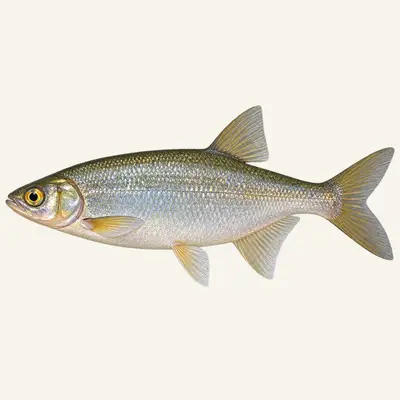
Mooneye
Hiodon tergisus · Hiodontidae
- Freshwater
- Other
- Medium
- Size
28–47 cm
- Weight
0.2–0.9 kg
- Lifespan
10 years
Where to fish
- Estuary
- Lake
- River
Habitat icons: Flaticon
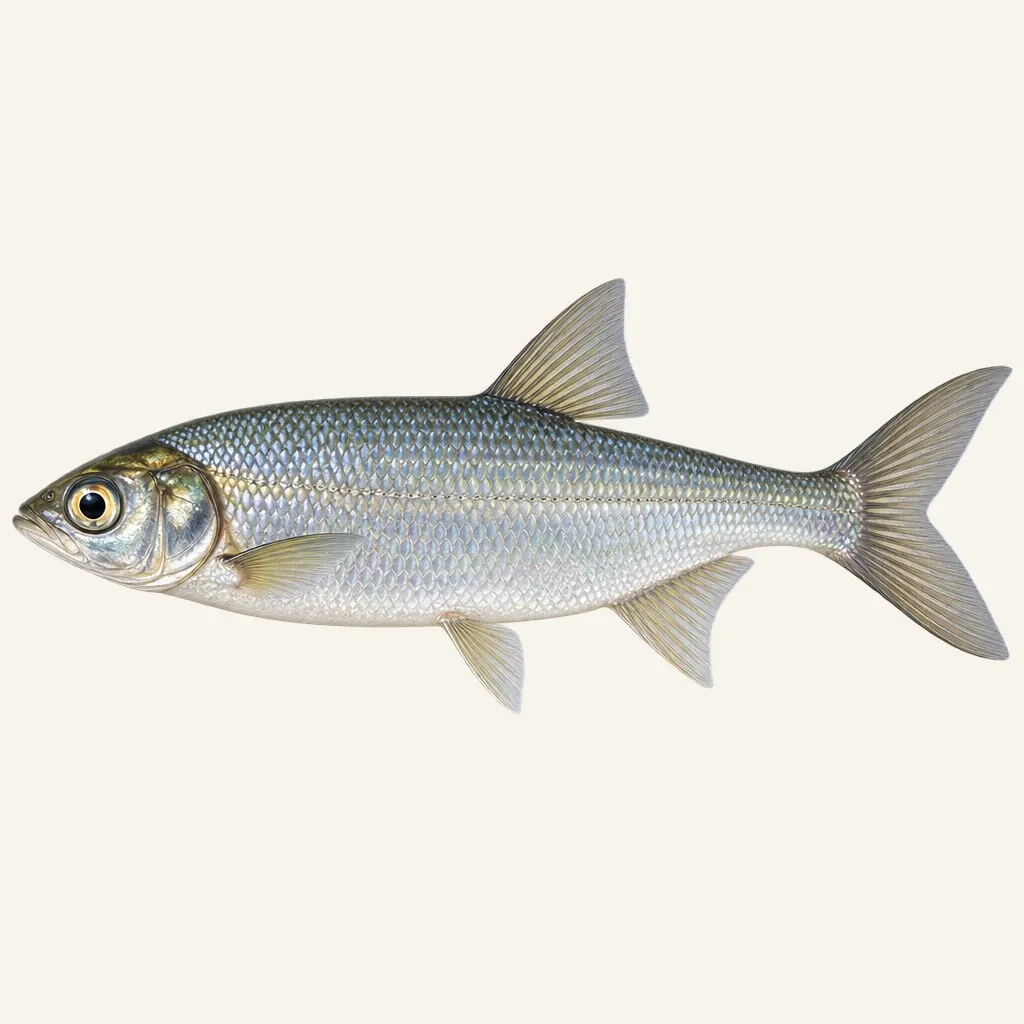
Small silvery fish with a laterally compressed body, recognizable by its large eyes and slender profile characteristic of the Hiodontidae family.
Calendar
Recorded in 2 countries
GBIF occurrence records — native and introduced populations combined.
Its range
Two pieces of this range belong to no other member of the family: the St Lawrence in the north-east, and the Gulf Slope in the south, where the species occupies the coastal drainages from Mobile Bay in Alabama to Lake Pontchartrain in Louisiana. Between the two it takes the Great Lakes, the Mississippi and the Hudson Bay basins from Quebec west to Alberta.
One absence in that list is worth more than the presences. Lake Superior is the only one of the five Great Lakes missing — the coldest, the deepest and the clearest, the one whose water resembles a lowland river least. The line between the two mooneyes is therefore drawn inside the Great Lakes themselves, and it is drawn on the character of the water rather than on geography.
The southern extension towards the Gulf puts the fish in warm water its northern relative never reaches.
The water it needs
Deep pools and backwaters of medium to large rivers, plus lakes and impoundments. Nothing in that requires current: these are slow or standing waters, and the species keeps away from the fast lines.
It is also the only ecological statement published about the animal, and it is enough to separate the two mooneyes. Where one occupies the open channel of turbid rivers, this one settles into what the river sets aside.
Areas
- Moderate current areas
- River mouths
- Shallow shorelines
- Calm surfaces at daybreak
Techniques
- Surface lure fishing
- Dry fly fishing
- Light spinners
- Live bait surface retrieval
Baits
- Small soft lures
- Artificial flies
- Bloodworms
- Small artificial insects
How to catch it
What is missing has to be said outright: nothing is published on its prey, nothing on its spawning season, nothing on when it is active. What remains is a water type, a size and an age.
The water type names the lies without ambiguity — pools, backwaters, quiet margins, river mouths — and the absence of current simplifies presentation as much as it removes reference points. On flat water nothing indicates where inside a lie the fish is holding.
Size dictates the tackle. A common length near 28 cm and a life of about 10 years describe a fine-tackle fishery, small imitations and small baits.
The temptation is to import what is known about the better-studied relative. That is precisely the error to avoid: the two do not live in the same water, and an approach calibrated on the turbid channel of a big river has no reason to work in a backwater.
Regulations
Check the local regulations in force (legal size limits, closed seasons, bag limits).
For guidance only. Legal sizes, quotas and open seasons vary by location and season: always check the local regulations in force before fishing.
Other names
Mooneye in English, Mondauge in German, ojo de luna in Spanish, occhio di luna in Italian, olho-de-lua in Portuguese — the moon in five of the six, against the gold of its congener; only French keeps the silver, with laquaiche argentée. Both species were named on the same part of the body and told apart by the colour of its reflection.
Tergisus is Latin for polished, for the burnished look of the flank, and it is the only part of the scientific name that describes the animal rather than its family.
That family is the one branch of an otherwise equatorial order to have settled in temperate rivers, alongside the arapaima and the arowanas of the tropics. This species is its eastern half.
Sources: fishbase.se · api.gbif.org