Atlantic white marlin
Kajikia albida · Istiophoridae
- Saltwater
- Big pelagics
- Hard
- Regulated
- Size
210–300 cm
- Weight
88–83 kg
- Depth
0–150 m
Where to fish
- Offshore
Habitat icons: Flaticon
Inhabits deep (over 100 m) blue water with surface temperatures above 22 degrees C and salinities of 35 to 37 ppt.
Calendar
Recorded in 12 countries
Brazil · Colombia · Côte d’Ivoire · French Southern Territories · Guadeloupe · Martinique · Mayotte · Portugal · Spain · St. Martin · United Kingdom · United States
GBIF occurrence records — native and introduced populations combined.
Its range
The range covers the Atlantic from 45 degrees north to 45 south in the south-west of the basin, but only to 35 south in the south-east. That 10-degree difference between the two southern shores is not an artefact of where anyone has looked: the western margin of the South Atlantic carries warm water towards high latitudes and the eastern margin receives much less of it, and the fish stops where the warm water stops.
Nor do those limits hold all year. The distribution shifts with the season, and the extreme latitudes of each hemisphere are reached only during that hemisphere's warm months. An annual map therefore adds together two ranges that never exist at the same time, which is the single most misleading thing about looking at one.
Two sets of records fall outside the picture altogether — the Mediterranean, and Brittany. Both are read as straying individuals rather than as any sign of expansion.
Identifying it
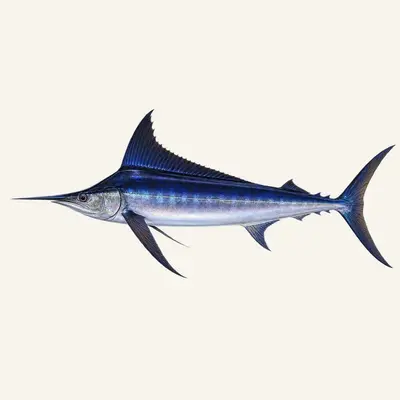
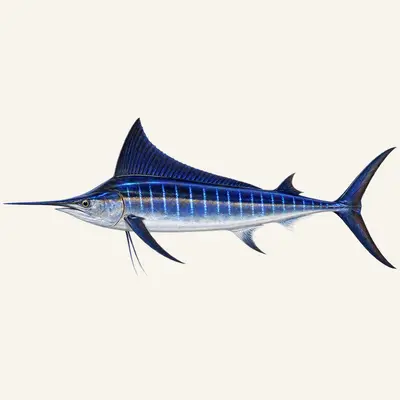
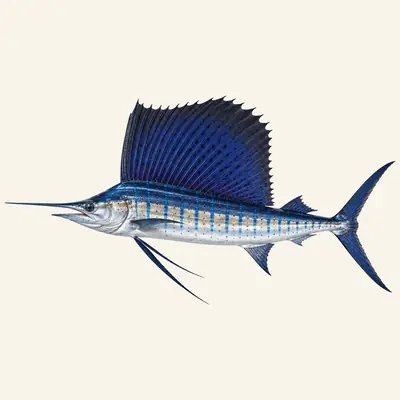
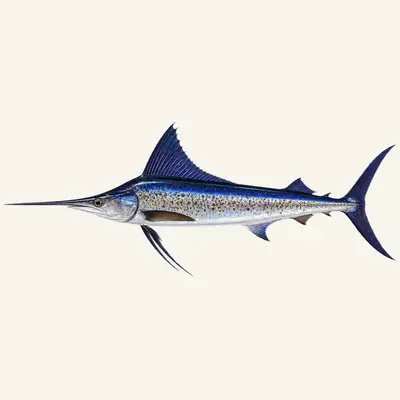
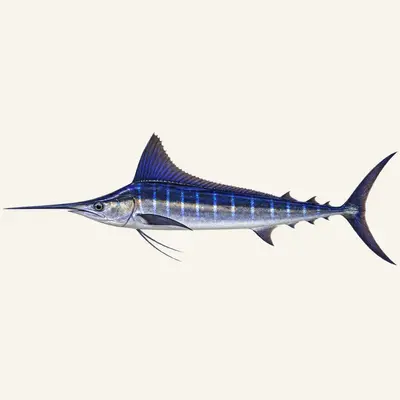
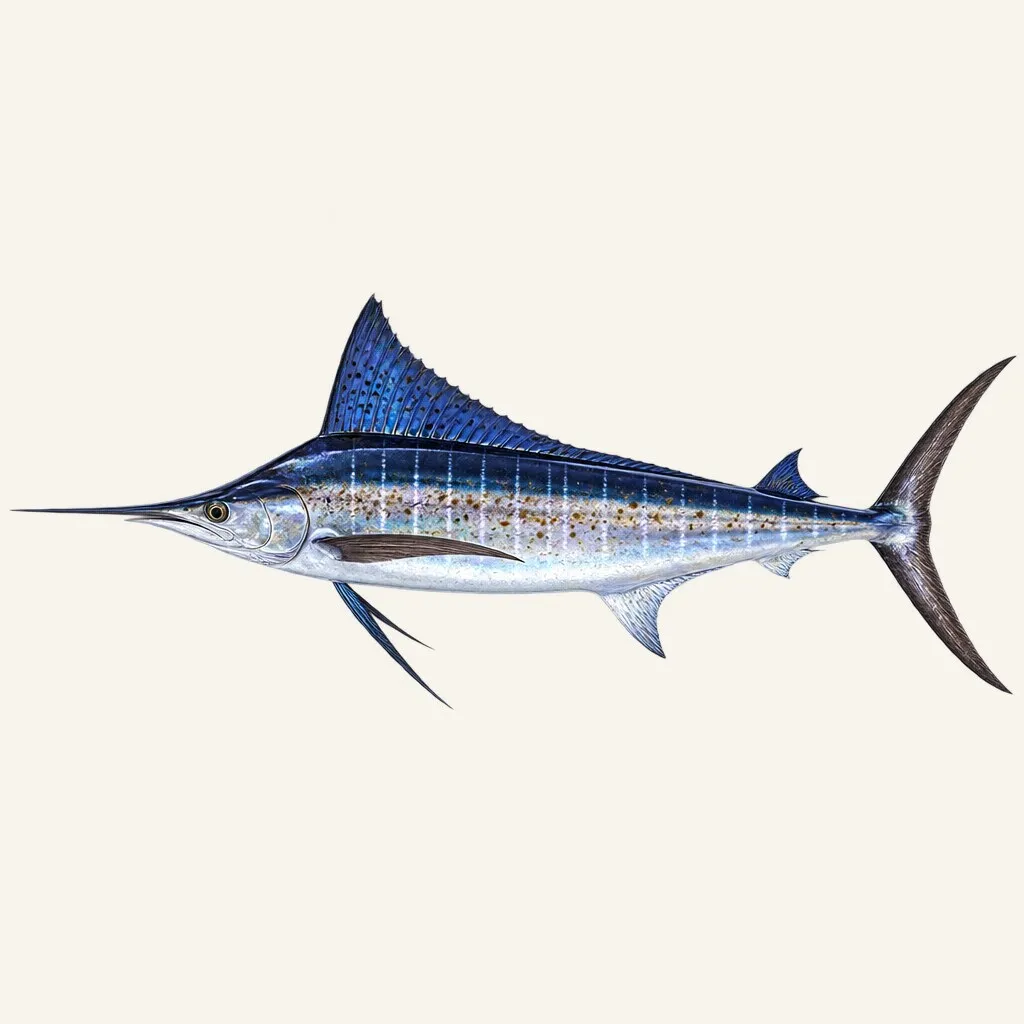
Black dots are scattered over the dark blue membrane of the first dorsal fin. That is the character, and its value is that it holds up alongside the fish in the water as readily as on a fish hung at the scales. Its Pacific counterpart, the striped marlin, carries the same fin in a plain unmarked blue.
The rest of the livery is duller than the reputation of the group suggests. The back is blue-black, the underside silvery white, and between them the flanks are silvery white splattered with brown. Stripes are present — sometimes more than 15 rows of them — but they are whitish and indistinct, nothing like the crisp cobalt banding of the striped marlin. The second dorsal is dark blue and the tail a blackish brown.
Neither fin carries a spine. The first dorsal holds 43 to 52 soft rays, the anal 17 to 23.
What tells most about the animal is the relation between length and mass. A common fish runs a little over two metres, and the weights published for this species against those lengths are a fraction of what the large billfishes carry at the same measurement. The outline shows it: a slighter fish than the word marlin generally conjures. Females grow larger than males, so the heaviest individuals are necessarily among them.
Breeding
The fish leaves the water it lives in to breed. It moves into subtropical latitudes to spawn, with the peak in early summer, and the run is a deliberate journey towards a specific set of conditions rather than a drift.
Those conditions are physical before they are geographic: deep blue oceanic water, high temperatures between 20 and 29 degrees — the southern Atlantic gyrals excepted — and surface salinity above 35 parts per thousand. Water that is cooler or fresher than that does not serve, wherever it happens to lie on the chart.
Maturity averages 164 cm, with ripe individuals recorded from 130.
The water it needs
The fish holds the surface layer above the thermocline, between nought and 150 m and mostly within the first 100.
What the literature describes, though, is not a place but a body of water, defined by four properties that have to be present together. It is blue and deep, with more than 100 m beneath the keel. Its surface temperature exceeds 22 degrees. Its salinity falls between 35 and 37 parts per thousand. And a current of half a knot to two knots runs through much of it.
Not one of those four is attached to a fixed position. The domain of this species is a moving mass of water, and it travels with it.
Areas
- Tropical and subtropical Atlantic
- Gulf Stream current
- Submarine canyons
- Offshore current convergences
Techniques
- Slow natural trolling
- Streamlined surface lures
- Offshore live bait fishing
- Flatfish rigging
Baits
- Natural rigged squid
- Natural flatfish
- Streamlined trolling lures
- Balao and ballyhoo
What it eats
Fishes and squid. The list is short and it is the same list its relatives keep, which means the diet is not what distinguishes this animal — the water it hunts in is.
The current is the part of that water which bears on feeding. Half a knot to two knots is water that carries: forage is transported in it and piles up wherever the flow breaks against something, and a predator living permanently in such a regime does not have to search so much as position itself.
How to catch it
The four properties above amount to a complete search method, and all four can be checked from the boat: the colour of the water, the sounder, the surface thermometer and the drift. A sector that satisfies every one of them is worth working. A sector missing any one of them will not be redeemed by a longer day behind it.
The calendar follows the warm season, and it follows it in whichever hemisphere the boat happens to be. A given latitude holds fish for a few months only, and it is the same population withdrawing towards the equator for the rest of the year. Conversely, a fish taken off Brittany or inside the Mediterranean is an accident and announces no season at all.
Fish and squid are what the animal eats, and rigged natural baits or lures built to that profile are what it comes to at trolling speed.
One point about the table belongs here rather than lower down. The flesh of this species is of excellent quality and is marketed both fresh and frozen, so a capture has a commercial value that will be realised if the fish is landed. Deciding otherwise is a decision, not a default.
Regulated — Often governed by quotas, size limits, seasons, or reporting rules.
Conservation
The protection problem is unusual and it comes straight out of the habitat description. When a species occupies water defined by temperature, salinity, depth and current, and that water changes position from one season and one year to the next, no boundary can be drawn round it. A closed area protects a rectangle of sea; it does not protect a moving mass of water. Whatever is done for this fish has to act on fishing effort, because there is no space to act on.
The record also characterises the Atlantic population as reduced, and that is the part of this page that describes a change rather than a mechanism.
Sitting underneath it is an unresolved question: nobody knows whether the Atlantic holds two separate stocks or a single population. That is not a laboratory nicety. A fleet working at 40 degrees north in August and another at 40 degrees south in February are either drawing on one body of fish or on two, and the two answers point in opposite directions. If one, the two efforts add up in full. If two, either half can collapse without the combined figure registering it. Management has to choose in the absence of the answer.
One element runs in the species' favour. Maturity averages 164 cm and fish are recorded ripe from 130, while an ordinary capture is around 210. Most of the fish encountered have already bred, which is not something that can be said of every large pelagic.
Regulations
Check the local regulations in force (legal size limits, closed seasons, bag limits).
For guidance only. Legal sizes, quotas and open seasons vary by location and season: always check the local regulations in force before fishing.
Other names
White marlin in English, and Atlantic white marlin where the basin needs stating. The basin is not decoration: it is what separates this fish from the striped marlin, with which it shares the outline and very nearly everything else.
Spanish prefers aguja blanca, the white needle, which names two characters at once and is the better name of the two. Italian marlin bianco, German Weißer Marlin, Portuguese agulhão-branco-do-atlântico. Most languages settled on the white, which describes the belly and the flanks and never the back.
The epithet albida means whitish. For a long stretch of the twentieth century the fish was filed as Tetrapturus albidus, and every catch series and stock appraisal written before the genus was split reads under that binomial — which anyone reconciling old figures with new has to know.
Sources: fishbase.se · api.gbif.org