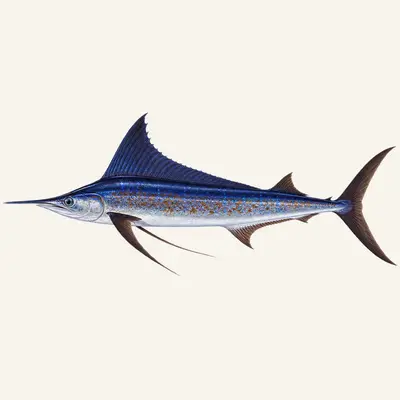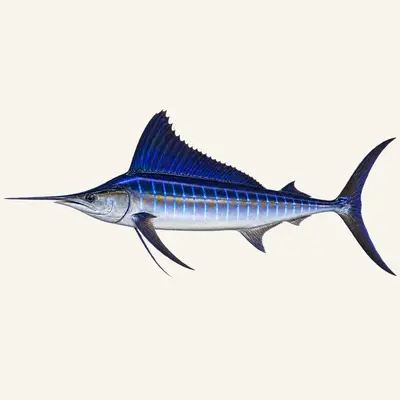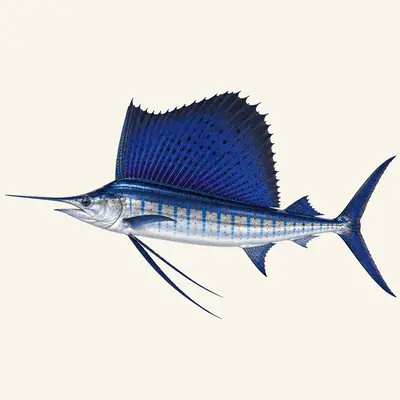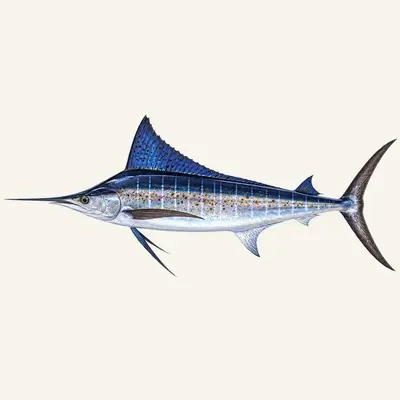
Roundscale spearfish
Tetrapturus georgii · Istiophoridae
- Saltwater
- Big pelagics
- Hard
- Regulated
- Size
184 cm
- Weight
22 kg
- Depth
0–200 m
Where to fish
- Offshore
Habitat icons: Flaticon
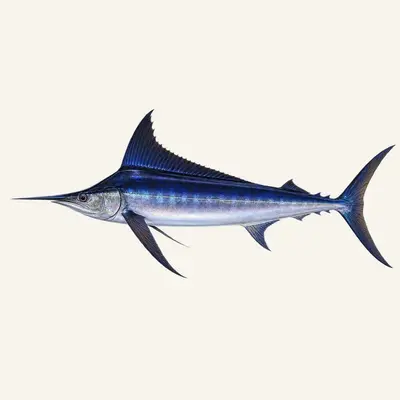
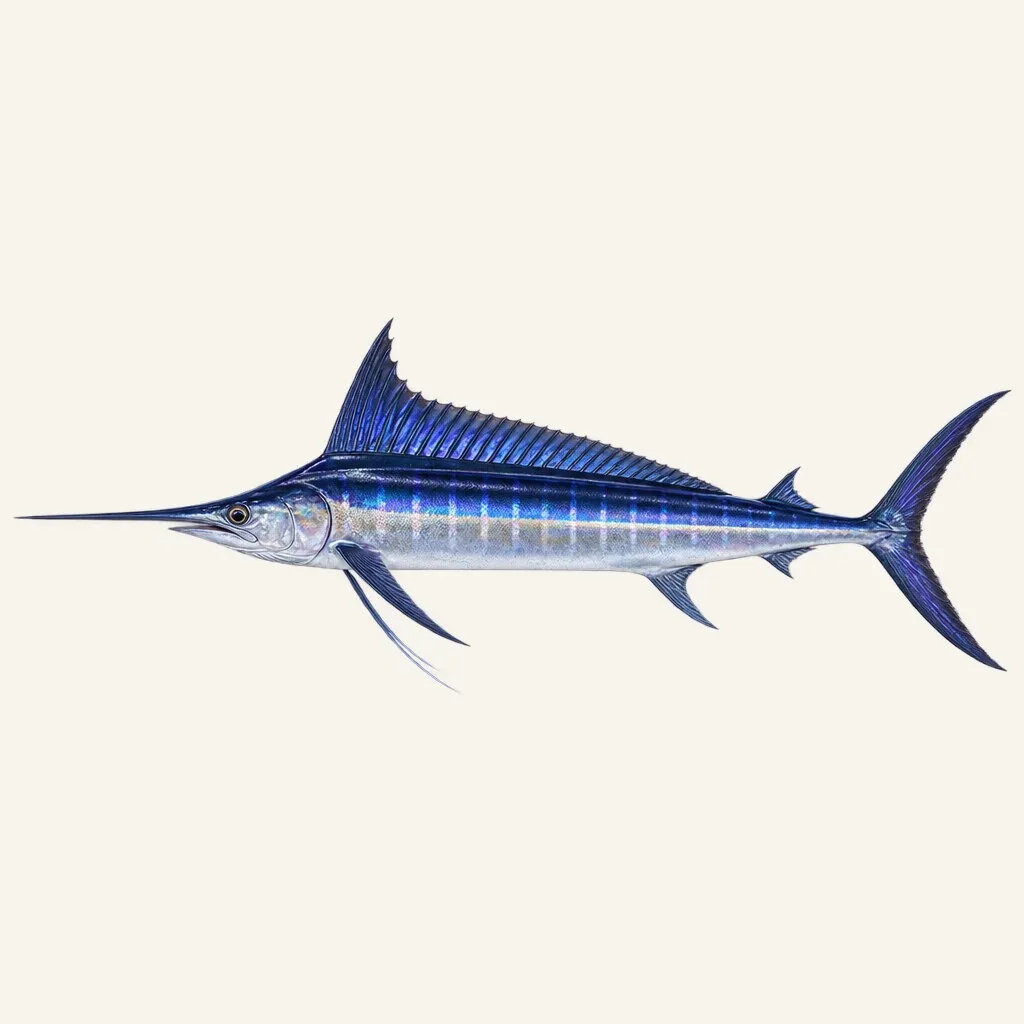
The roundscale spearfish is a rare pelagic Istiophoridae of the Atlantic, recognizable by its rounded non-overlapping scales, a distinctive feature within its family. An infrequent open-ocean species, it inhabits the warm and temperate waters of the Atlantic on both sides of the ocean.
Calendar
Recorded in 4 countries
Bahamas · Brazil · Japan · United States
GBIF occurrence records — native and introduced populations combined.
Its range
Four localities, not a range. The species is known with certainty only from Madeira, from Sicily, from the Strait of Gibraltar and from the adjacent Atlantic off southern Portugal. Everything else on its chart is extrapolation: the record expects it to occur widely in the eastern and perhaps the central North Atlantic without being able to establish it.
The data that would fill that space come from the logs of Japanese longliners working the central and eastern Atlantic, and those logs themselves call for clarification — nothing guarantees that the fish counted under this name belong to it. The chart of this species is made of four certainties and an expectation.
No confirmed report exists for the Black Sea, and the Mediterranean presence rests on Sicily alone.
The water it needs
The animal is described as probably oceanic, in the first 200 metres of water. The word "probably" belongs to the source and should be kept there: nothing this species does in the water column has been observed directly.
Its format is the most modest in the genus, where its congeners pass 50 kg and in one case 70.
Areas
- Offshore pelagic waters
- Edges of warm currents
- Thermohaline convergence zones
Techniques
- Trolling with skipping lures
- Live bait fishing
- Surface dead bait
- Deep trolling
Baits
- Rigged ballyhoo
- Small mackerel
- Natural squid
- Surface lures
How to catch it
No fishery targets it, and the record grants it neither commercial interest of its own nor standing as a gamefish. What exists of it in the archives came up on longlines set for other animals.
The practical consequence has less to do with catching one than with what is done with it afterwards. A billfish taken between Gibraltar and Madeira, or off Sicily, may belong to this species, and the only useful response to such a capture is to document it properly — photographs, measurements, a tissue sample where local rules allow. On an animal whose existence as a species is still argued over, a careful report is worth more than the fish.
Regulated — Often governed by quotas, size limits, seasons, or reporting rules.
Conservation
What presses here is not fishing but taxonomic doubt. The record puts it plainly: further study is strongly needed to clarify the validity of this species. Until the question is settled, no stock assessment can carry the name, no management measure can designate it, and every capture logged under the binomial might belong to another fish.
Its size deepens the confusion. A billfish that stays well short of relatives two and three times heavier passes easily for a young individual of one of them, and a sort made in a hold at the end of a trip does not separate them. Atlantic catch series therefore very probably mix several fish under a single heading.
The result is a complete blind spot: nobody knows how many there are, how many are taken, or whether there is one animal here at all.
Regulations
Check the local regulations in force (legal size limits, closed seasons, bag limits).
For guidance only. Legal sizes, quotas and open seasons vary by location and season: always check the local regulations in force before fishing.
Other names
Roundscale spearfish in English, and every other language of the catalogue translates the same thing.
A name built on the shape of a scale states the difficulty by itself. Where the other billfish are named for the length of a bill or the colour of a flank, this one was distinguished only by a character that has to be examined closely, on a fresh animal, by somebody who already knows what to look for. The epithet georgii commemorates a personal name and describes nothing.
Sources: fishbase.se · api.gbif.org