Striped marlin
Kajikia audax · Istiophoridae
- Saltwater
- Coastal
- Hard
- Regulated
- Size
290–420 cm
- Weight
314–440 kg
- Lifespan
9 years
- Water temp.
20–25 °C
- Depth
0–200 m
Where to fish
- Offshore
Habitat icons: Flaticon
Striped marlin - pelagic predator, Pacific.
Calendar
Recorded in 19 countries
Australia · Chile · Denmark · Faroe Islands · France · Germany · Greenland · Iceland · Italy · Mexico · New Zealand · Norfolk Island · Norway · Portugal · Seychelles · Svalbard & Jan Mayen · Sweden · United Kingdom · United States
GBIF occurrence records — native and introduced populations combined.
Its range
The Pacific has given this fish a range shaped like a horseshoe, running from the north-west of the basin round the whole eastern margin and back to the south-west. No other billfish and no tuna occupies that shape, and there is a workable explanation for it: this species lives in cooler water than either the black marlin or the blue. The great warm pool of the tropical western and central Pacific, which is where those two belong, therefore sits in the hollow of the horseshoe, while the temperate margins and the cooler eastern boundary form its arms.
The Indian Ocean answers to a different logic. There the fish is denser in equatorial latitudes, with concentrations off East Africa, in the western Arabian Sea, in the Bay of Bengal and off north-western Australia.
The full span, from 46 degrees north to 49 south, makes this one of the most widely spread members of its family — and the sources go further, calling it the most dominant and most widely distributed of all the billfishes.
Identifying it
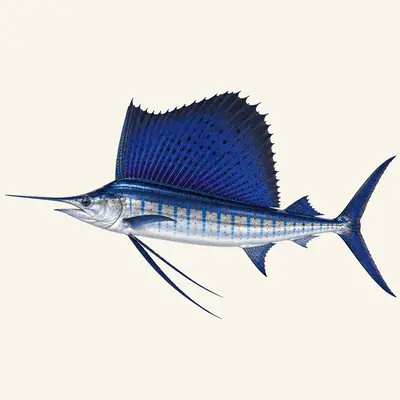
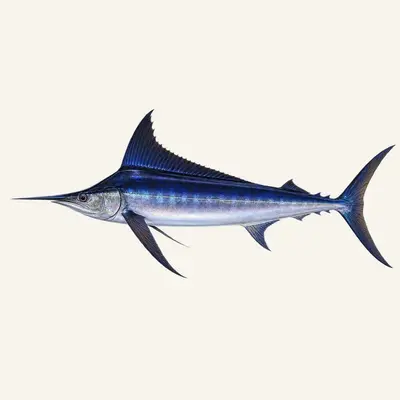
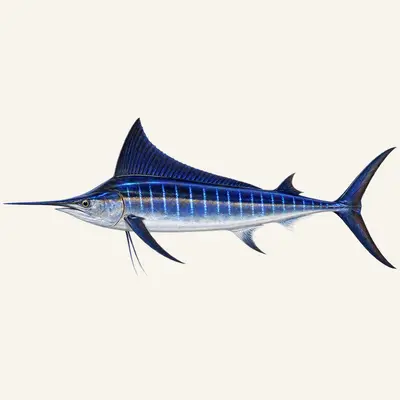
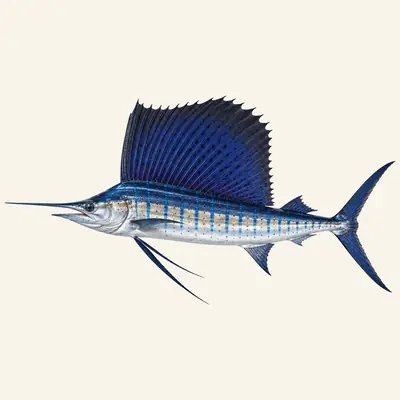
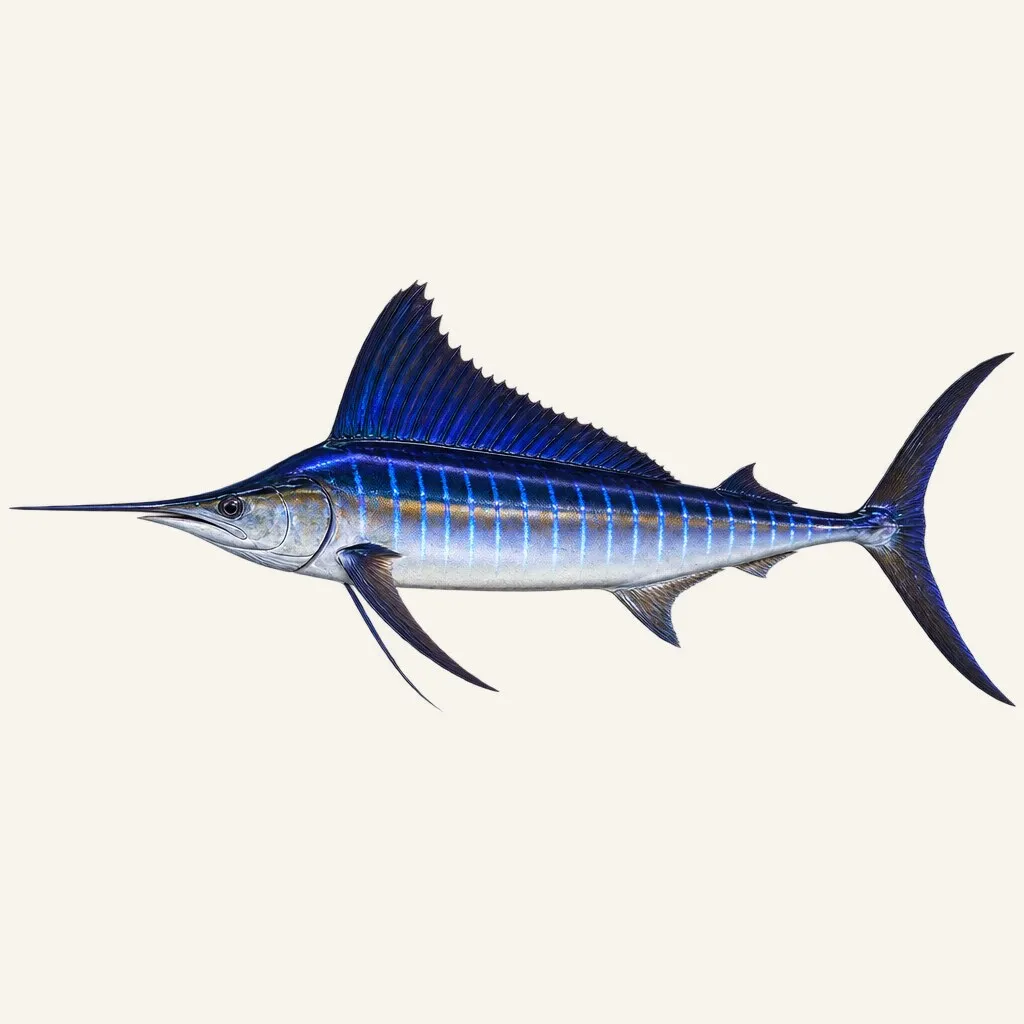
The first dorsal fin stands taller than the body is deep, and its blue-black membrane is bare. The emptiness is the character, and it has a direct counterpart: the description of the Atlantic white marlin gives the same fin as dark blue with black dots. A tall fin with nothing printed on it is therefore the thing to look for.
The fin also has a distinctive profile. It is low where it begins, rises towards the middle, and drops again at the back, instead of reaching its greatest height straight away. It carries 42 to 48 rays; the anal fin has 18 to 24.
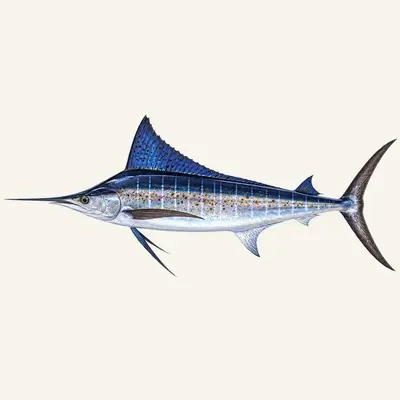
The flanks show about 20 bluish bands over a dark blue back and a silvery belly. Elsewhere the same markings are described as roughly 15 rows of cobalt blue. The count moves with the condition of the fish; the presence of the bands does not.
The pectoral fins are sickle-shaped, flexible, and carry 18 to 22 rays. Flexibility is a field character worth using, because it lets them be folded flat against the flank: the black marlin of the same ocean has rigid pectorals that will not fold, and the difference is settled by hand on a dead fish in a few seconds.
The bill is robust and of middling length — neither the broad blade of the swordfish nor the fine spike of the slenderest spearfishes. The scales are small, sunk into the skin, and end in one or two blunt points.
Breeding
The female does not assemble a stock of eggs in advance. Her oocytes develop out of step with one another and she releases in successive batches, with no seasonal total fixed at the outset. That is what makes her an indeterminate spawner, and the consequence is worth drawing out: a good season yields more than a poor one, because the output adjusts to conditions instead of being committed before they are known.
A single temperature then governs the rest. Larvae are effectively absent below 24 degrees, in the Indian Ocean and in the Pacific alike, and the identical threshold on both sides is what makes it convincing. It maps the spawning grounds more reliably than any chart: between 10 and 30 degrees south in the south-west Pacific, and between 10 and 20 degrees south in the north-eastern Indian Ocean.
The calendar is read off larval abundance, which peaks in the local early summer of each hemisphere, and the presence of ripe females tracks it exactly.
Maturity is reached at about 210 cm, from 190 upwards, and nine years is the greatest recorded age.
The water it needs
It occupies the surface layer above the thermocline, in water of 20 to 25 degrees, down to 200 m.
Abundance increases with distance from the continental shelf. That is the rule that organises any search for it, and it inverts the habit of most sea fishing: here the miles run offshore correlate directly with what is found. The fish comes close to land only where the bottom falls away sharply near the coast, a condition few coastlines meet.
It lives alone, and individuals are dispersed at considerable distances from one another. Only during the spawning season does it gather, in small groups assembled by size.
Areas
- Offshore blue water
- Thermal convergence zones
- Around volcanic islands
- Edges of warm currents
Techniques
- Surface trolling
- Deep trolling
- Live bait fishing
- Surface lures
Baits
- Rigged mackerel
- Natural squid
- Colored vinyl lures
- Small tunas
What it eats
Fishes, crustaceans and squid, as with its close relatives. The list does not set this animal apart; the water in which it collects the list does.
Living cooler than the two large marlins that share its oceans, it works forage shoals of temperate water that they never meet. Occupying a thermal storey the others leave empty is the most plausible reason it is at once the most abundant and the most widespread billfish there is — it is not competing for the same fish.
How to catch it
Three things follow from all of that, and between them they decide how a day is planned.
Distance first. A productive sector is defined by how far it lies from the shelf, or else by a very steep drop close inshore. Working the edge of a broad shelf means working the least populated part of the range.
Dispersion second. Fish separated by long distances have to be searched for over ground, and nothing can be concluded from one capture — the next fish is not nearby simply because this one was here. The exception is the spawning season, when the groups form by size: a fish taken then does predict others of the same dimensions close by.
Method third. This species is also taken with the harpoon, which is a statement about the animal rather than about the gear. A harpoon fishery requires fish visible at the surface, so trolling a spread is not the only way to read blue water.
The flesh is the best in the family for sashimi and sushi. It goes out mostly frozen, sometimes fresh, and also smoked. That value bears directly on the fate of a fish taken incidentally: there is no commercial reason for anyone to put one back.
Regulated — Often governed by quotas, size limits, seasons, or reporting rules.
Conservation
This species keeps its adults and its larvae in different water. The adults occupy cool water, out to the temperate latitudes of both hemispheres; the larvae do not exist below 24 degrees. Two distinct masses of water are therefore required by one life cycle, and a shift in the position of either with respect to the other cannot be made good elsewhere. Most pelagic fish need one set of conditions; this one needs two, and needs them within reach of each other.
Renewal, by contrast, is quick for an animal of this size. Maturity at around 210 cm against nine years of recorded life means the fish breeds at roughly half its greatest length inside a short lifetime. A depleted stock here rebuilds faster than that of a large shark or a grouper would.
What weighs, then, is the geometry of the range. The Pacific horseshoe passes through the economic zones of a very large number of states and across long stretches of high seas, and the Indian Ocean adds four concentrations spread across three continents. One population is fished by fleets answering to no common rule, and its price on the raw-fish market ensures that every individual encountered will be landed.
Regulations
Check the local regulations in force (legal size limits, closed seasons, bag limits).
For guidance only. Legal sizes, quotas and open seasons vary by location and season: always check the local regulations in force before fishing.
Other names
Striped marlin in English, and every other language in the catalogue says the same thing: marlín rayado, marlin striato, gestreifter Marlin, marlim-listrado, makaire rayé. The blue bands on the flanks won unanimous agreement, which is rare in this family.
The genus name comes from the Japanese kajiki, the word for billfish in a country that has caught and eaten them for a very long time. It is one of the few scientific names of a large marine fish built on a language other than Greek or Latin. The epithet audax means bold.
A substantial part of the literature still places the fish in Tetrapturus, and the older catch series are filed there. Anyone tracing this species back through the record needs to follow both genus names.
Sources: fishbase.se · api.gbif.org