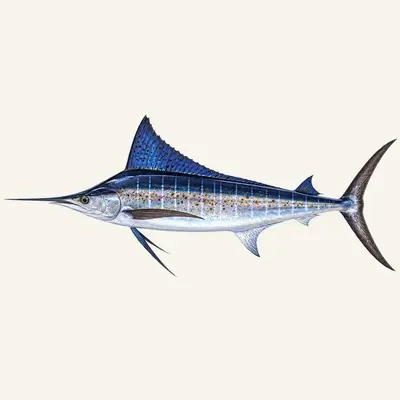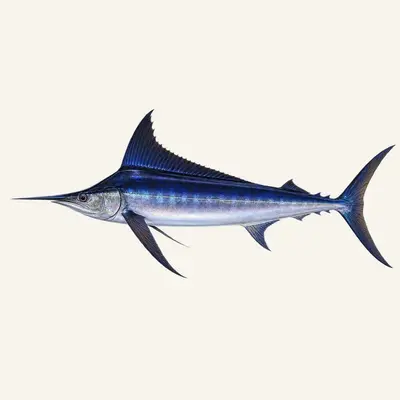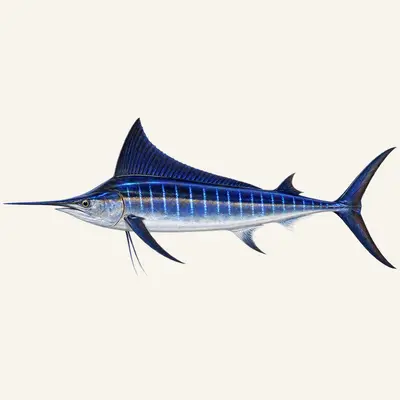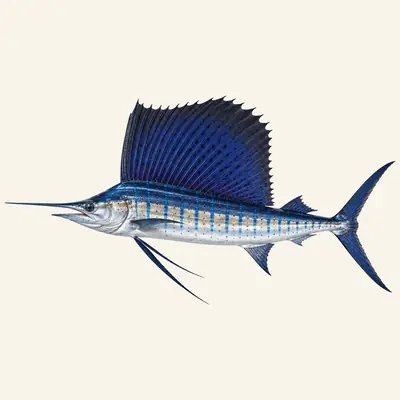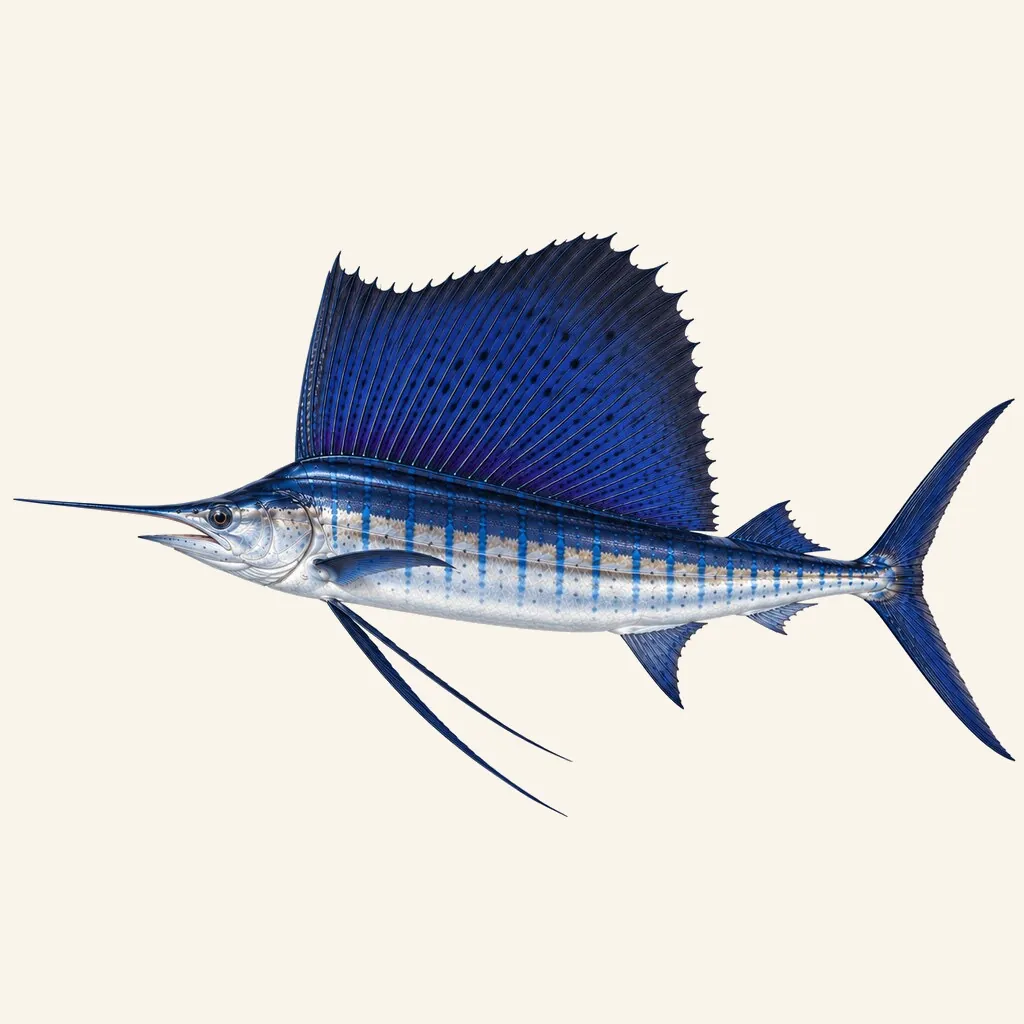
Atlantic sailfish
Istiophorus albicans · Istiophoridae
- Saltwater
- Coastal
- Medium
- Regulated
- Size
240–315 cm
- Weight
133–58 kg
- Lifespan
4 years
- Water temp.
21–28 °C
- Depth
0–200 m
Where to fish
- Offshore
Habitat icons: Flaticon
Lives in the upper layers of warm water above the thermocline, but is also able to descend to fairly deep water. Often migrates into near-shore waters.
Calendar
Recorded in 7 countries
Colombia · Equatorial Guinea · Guinea · Guinea-Bissau · Netherlands · Puerto Rico · United Kingdom
GBIF occurrence records — native and introduced populations combined.
Its range
The Atlantic, tropical and temperate, with limits that differ from one shore to the other. In the north the range reaches about 40 degrees on the western side against 50 on the eastern; in the south, 40 degrees in the west against 32 in the east.
The northern pair is the interesting one, because it runs against the usual arrangement. The drift that carries Gulf Stream water across the basin pushes warm conditions a long way up the European side, and the fish follows that water rather than the parallel — which is why the north-eastern edge of the range lies ten degrees above the north-western one.
Individuals do enter the Mediterranean, and they are almost always juveniles. The Indo-Pacific sailfish also reaches that sea, but from the far end of it, through the Suez Canal. One enclosed basin therefore receives both members of the genus, arriving from opposite directions.
Identifying it
There is no field key for this fish, and pretending otherwise would be dishonest. The world holds two sailfish and they are told apart by ocean: this one belongs to the Atlantic, the other to the Indo-Pacific, and the two ranges barely touch. A sailfish caught off Florida is this species because of where the boat was.
What the record does offer is a handful of counts, and one of them does not overlap. The anal fin here holds 9 to 12 soft rays and no spine; its Indo-Pacific counterpart is described with 12 to 15 and two spines. The dorsal gives 48 to 53 soft rays, and there are 24 vertebrae. The published morphological description stops at about that point, which is itself the fact to take away.
Size carries more information than shape. Females grow larger than males, so a very large Atlantic sailfish is in all likelihood a female. Maturity averages 133.5 cm across a range of 121 to 146, while a common fish in the catch measures around 240 cm — nearly twice the length at which it first bred.
The oldest individual on record is four years old. That figure probably says as much about how hard a billfish is to age as it does about the animal, but it is consistent with a growth curve that reaches breeding length in very few seasons.
Breeding
Off Florida the spawning happens in shallow water, and it is visible. Females move towards the coast, swim slowly at the surface with the dorsal fin raised, each escorted by one or more males, and release near the surface through the warm season. The sail is serving a display function here rather than a feeding one — the same structure, a different job.
Spawning is not confined to the shore. It has also been reported well offshore, beyond the hundred-fathom line, from south of Cuba up to the Carolinas. Both settings are in the record, which means no population depends on a single site.
The quantities set the scale of the investment. A female of 33.4 kg examined off south-eastern Florida was found capable of shedding as much as 4.8 million eggs, in three separate releases within one season. The fractionation is the part that matters more than the total: one female's reproduction is spread over weeks, so a single bad week does not cancel her year.
The water it needs
Warm water between 21 and 28 degrees, from the surface down to 200 m, though the animal is described as able to descend a good deal further than that. It moves into water close to the shore quite regularly.
Dispersion is the practical fact of the species. It forms schools at times, or small groups of 3 to 30 individuals, but most often it occurs in loose aggregations spread across large areas. Meeting a sailfish therefore does not mean having found a concentration. Density stays low even where the fish is genuinely present, and covering water remains the only way to locate it.
Areas
- Tropical Atlantic coastal waters
- Sargasso weed lines
- Offshore thermal fronts
- Around FADs
Techniques
- Surface trolling
- Live bait fishing
- Skipping lures
- Drift fishing
Baits
- Rigged ballyhoo
- Small live sardines
- Natural squid
- Colored surface lures
What it eats
Small pelagic fishes for the most part, with bottom-dwelling organisms alongside them.
That second half of the diet is the more revealing. An animal classed as a surface dweller that takes prey off the bottom is not spending as much of its time in the upper layer as its reputation suggests, and the observation squares with the note that it descends to considerable depths.
How to catch it
Searching dominates everything else. The aggregations are loose, trolling is what covers ground, and a fish located predicts only a small group — 3 to 30, rarely more. The inshore movements are the one situation in which the species comes genuinely close to land.
The spawning period puts females in shallow water, sailing slowly with the fin up. It is the moment at which the animal is easiest to find and easiest to interfere with, and the two facts arrive together.
The species is fished commercially as well as for sport, and sold fresh, canned and frozen. Rod fisheries and commercial fisheries are therefore working the same aggregations rather than different fractions of the stock, which is not the case for every large pelagic.
Regulated — Often governed by quotas, size limits, seasons, or reporting rules.
Conservation · Vulnerable (IUCN) — This species is threatened with extinction. Always release it (no-kill), handle it with the utmost care and check local rules — fishing for it may be prohibited.
Conservation
Sex and size run together in this species, and that changes the cost of a decision. Females outgrow males; keeping the largest fish means keeping females almost exclusively, and it means removing the individuals that carry a season's several million eggs. A fishery that returns everything except its record fish has arranged matters precisely backwards.
The second pressure is administrative, and it is heavier than it sounds. While the Atlantic and Indo-Pacific sailfish are counted as two species, their landings are totalled separately and a decline in one ocean stays visible in the figures. Under one name the catches of both basins would be added together, and a fall on one side would be concealed by stability on the other. Whether there is one sailfish in the world or two is therefore a question with a number attached to it.
Regulations
Check the local regulations in force (legal size limits, closed seasons, bag limits).
For guidance only. Legal sizes, quotas and open seasons vary by location and season: always check the local regulations in force before fishing.
Other names
Atlantic sailfish in English, and the qualifier is not decoration.
The binomial itself has never fully settled. Part of the literature places this animal under the name of its Indo-Pacific counterpart and recognises a single sailfish worldwide; the convention followed here keeps them apart on the strength of the differences recorded between them. Both names have accordingly been applied to the same Atlantic fish across decades of publication, which is what makes older catch series so awkward to read: the name alone does not tell you which animal, or which ocean, was counted.
Albicans means whitening, for the pale silver of the underside. The genus names the sail.
Sources: fishbase.se · api.gbif.org