Rainbow trout
Oncorhynchus mykiss · Salmonidae
- Freshwater
- Salmonids
- Medium
- Size
60–123 cm
- Weight
2.3–25 kg
- Lifespan
11 years
- Water temp.
10–24 °C
- Depth
0–200 m
Where to fish
- Lake
- Pond
- River
Habitat icons: Flaticon
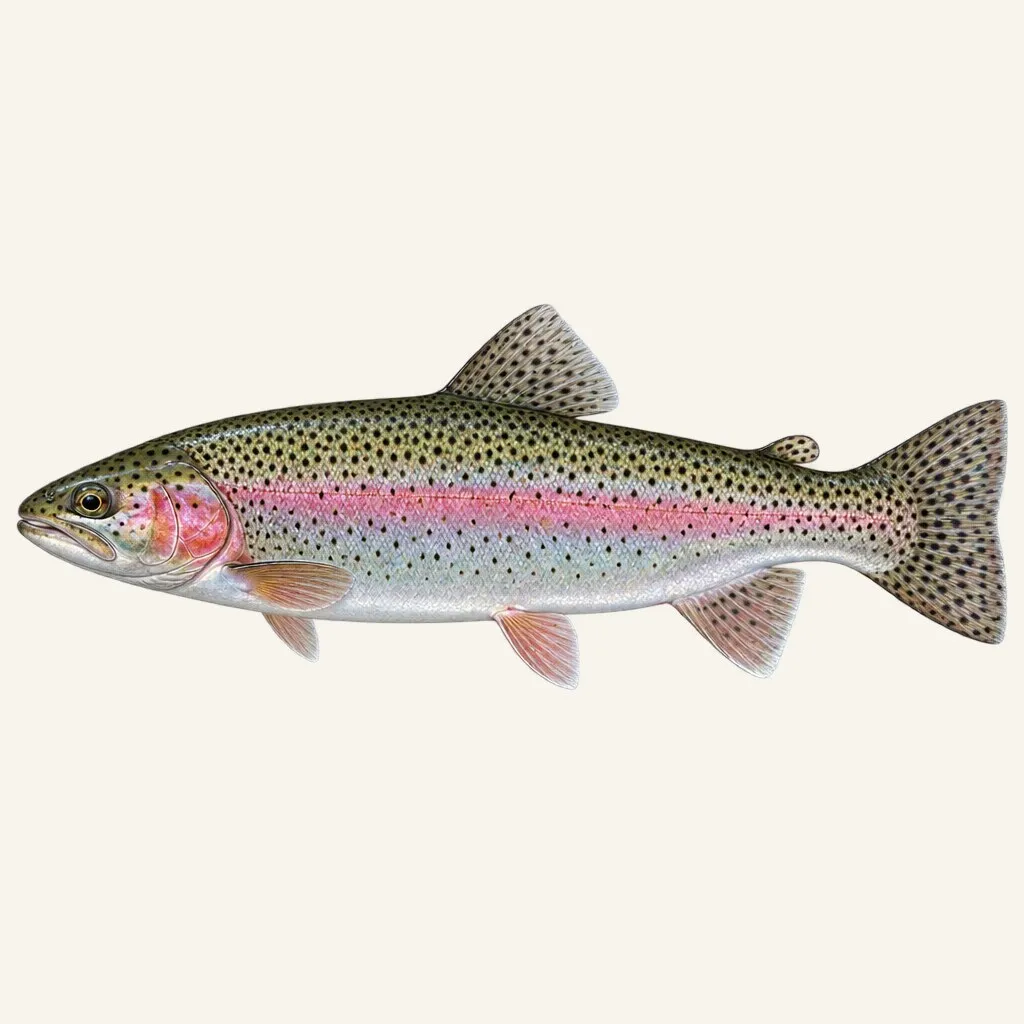
Distinctive iridescent pink band - Native to North America - Mass-farmed
Calendar
Recorded in 56 countries
Albania · Andorra · Argentina · Australia · Austria · Belgium · Bolivia · Bosnia & Herzegovina · Brazil · Canada · Chile · China · Colombia · Costa Rica · Croatia · Cyprus · Czechia · Denmark · Ecuador · Finland · France · French Southern Territories · Germany · Greece · India · Iran · Ireland · Isle of Man · Israel · Italy · Japan · Lesotho · Liechtenstein · Luxembourg · Mexico · Montenegro · Netherlands · New Zealand · Norway · Pakistan · Panama · Peru · Poland · Portugal · Réunion · Russia · Serbia · Slovenia · South Africa · South Korea · Spain · Sweden · Switzerland · Türkiye · United Kingdom · United States
GBIF occurrence records — native and introduced populations combined.
Its range
The natural range is the Pacific slope of North America, from the Kuskokwim drainage in Alaska south to the Otay River in California, with a second native area across the ocean on the Kamchatka Peninsula. Records from the Commander Islands, the Sea of Okhotsk and the mouth of the Amur are more likely to be Kamchatkan fish straying than resident populations.
What happened afterwards is the reason this species is on the catalogue at all. It grows fast, accepts a hatchery, eats manufactured feed and draws anglers — a combination almost no other salmonid offers — so it was shipped everywhere. It is now established across Canada and the United States away from its native slope, in the Arctic, Atlantic, Great Lakes, Mississippi and Rio Grande basins, and on every continent with cool water. Stocking goes into more or less any water that stays under 25 °C in summer and holds enough oxygen.
The bill arrived later. A number of receiving countries now record ecological harm, mostly to native salmonids that held the same niche and had faced no comparable competitor before.
Identifying it
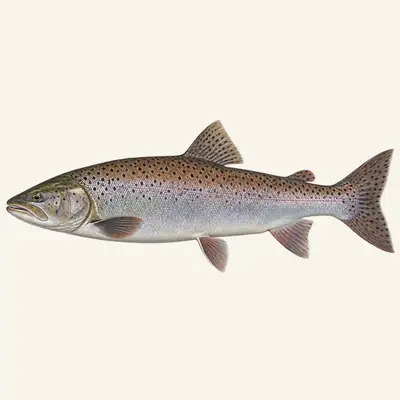
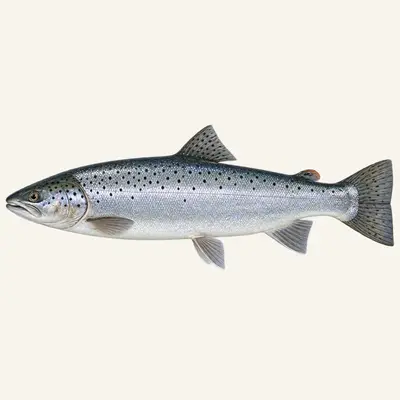
A broad band of pink to red runs from the gill cover to the base of the tail. It names the fish and identifies it. The band is strongest on stream and lake residents, and absent on the sea-run form, which is silver from end to end.
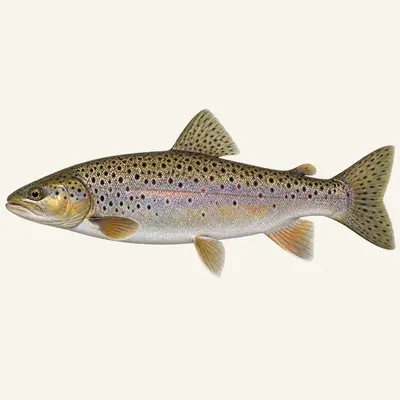
The rest is accumulation. Black spots cover the body and continue across the caudal fin, which a brown trout's do not. The body is elongate and, in bigger fish, noticeably flattened from side to side. The midlateral row carries 115 to 130 scales, the first gill arch 16 or 17 rakers, the anal fin six to nine and a half branched rays with eight and a half the usual count, and the backbone 60 to 66 vertebrae.
Condition alters the appearance more than most anglers expect. Stream residents and fish close to spawning are dark and intensely coloured; lake fish are pale, bright and silvery. Breeding males change slightly about the head and mouth but raise no nuptial tubercles and grow no hump, which separates them at a glance from the Pacific salmons they are now classified alongside.
Juveniles carry 5 to 10 parr marks along the flank, dark ovals that fade with growth.
Breeding
The spawning sequence has an intruder built into it. The female picks a spot and digs a pit; while she works, an attendant male courts her whenever he is not driving off rivals. The moment the pit is finished she drops into it, he follows, the pair lie alongside each other, gape, quiver and release eggs and milt together. A subordinate male then slips into the nest and adds milt of his own. The female moves straight to the upstream lip and starts digging again, and the gravel she lifts falls back over the batch she has just laid.
That repeats for several days until she is spent. Each event yields 700 to 4,000 eggs, 3 to 6 mm across, their size set directly by the size of the female. Fry hatch at 12 to 20 mm, well formed and carrying a large yolk sac, and drop downstream at night soon after emerging.
Males mature at about two years and females at three. In the northern hemisphere spawning runs from November to May; taken to the southern hemisphere, the same fish spawns from August to November.
One set of conditions decides whether an introduced population becomes self-sustaining, and it explains most of the world map. Rainbows fail to establish where peak emergence of fry coincides with the flood season, where summers stay cold, and where the water never falls below 13 °C. A great many rivers hold rainbow trout without having produced a single one.
The water it needs
Clear cold water: headwaters, creeks, rivers of any size, lakes, and the intertidal zone for the migratory form. Rainbows stand warmth better than brown trout do, which is why they turn up lower down catchments and in water where the resident brown has already gone.
They also use the water column more freely, down to 200 m in the marine form, and they are less tightly bound to one place. That difference of temperament has practical weight: a brown trout keeps a station behind an obstruction, a rainbow patrols.
Coastal populations are anadromous. Lake populations do the same thing at the scale of a lake, running well up tributaries to breed, and mature fish in resident populations make short spawning migrations of their own.
Areas
- Rivers
- ponds
- lakes
Techniques
- Lures
- Flies
- Worms
- Waxworms
Baits
- Spoon
- Crankbait
- Flies
What it eats
Aquatic and terrestrial invertebrates and small fish, in whatever proportion the water offers. At sea the diet turns to fish and cephalopods.
That flexibility is half the reason the introductions took. A specialist needs its prey to be present; a rainbow adjusts to a fauna it has never encountered, which is precisely what a fish shipped between continents is being asked to do.
How to catch it
The first question on any rainbow water is where the fish came from, because a stocked fish and a wild one are not fished the same way. Recently released trout stay near the point of release, keep together, and take almost anything offered. Fish that have spent a season or two in the river spread out along current seams and grow progressively harder, converging on the behaviour of a wild trout.
Mobility changes how the water is covered. A brown trout is fished lie by lie; a rainbow is fished by working through water, and in a lake it is found by depth rather than by feature. It follows food up and down the column with the hour and the temperature, so the level at which anything is presented usually matters more than the choice of what to present.
In rivers it takes the strongest oxygenated water — the throat and tail of a riffle, the seam beside fast current — rather than the slack pockets a brown might settle into.
The sea-run form belongs to another discipline entirely. A steelhead entering a river is fished the way a salmon run is fished: by covering holding water within a defined season, on the strength of conditions rather than of imitation.
Conservation
The problem this species raises is not its own survival. It is one of the most numerous fish on earth and is produced industrially; the question is what it does to the fish already in the water it is put into.
Where it has established outside its range it competes with native salmonids, and stocking policy has been reversed in several places on that account, with releases stopped into water holding indigenous fish. FishBase flags it as a potential pest, an unusual label for an animal that also underwrites a large share of the world's trout fishing.
Stocking raises a second question that attracts less attention. A hatchery fish has neither the behaviour nor the genetics of a wild one, and where rainbows do reproduce naturally, repeated releases act on the established population rather than merely beside it.
Regulations
Check the local regulations in force (legal size limits, closed seasons, bag limits).
For guidance only. Legal sizes, quotas and open seasons vary by location and season: always check the local regulations in force before fishing.
Other names
Rainbow trout and steelhead are the same species living two lives, and English treats them as two fish. The freshwater resident is the rainbow; the form that goes to sea and returns is the steelhead, named for the hard grey sheen it comes back with, and the two are routinely managed, licensed and written about separately. Fish that run out into the Great Lakes and back are called steelhead as well, although they never see salt water.
The scientific name records a reclassification. This was Salmo gairdneri through most of the twentieth century before it was moved to Oncorhynchus, which files it with the Pacific salmons rather than with the Atlantic trouts it resembles. German has Regenbogenforelle, Spanish trucha arcoíris.
Sources: fishbase.se · api.gbif.org