Round whitefish
Prosopium cylindraceum · Salmonidae
- Freshwater
- Salmonids
- Medium
- Size
29–59 cm
- Weight
0.3–2.7 kg
- Lifespan
16 years
- Water temp.
2–18 °C
- Depth
4–72 m
Where to fish
- Estuary
- Lake
- River
Habitat icons: Flaticon
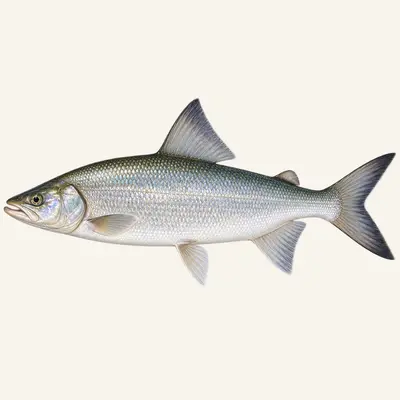
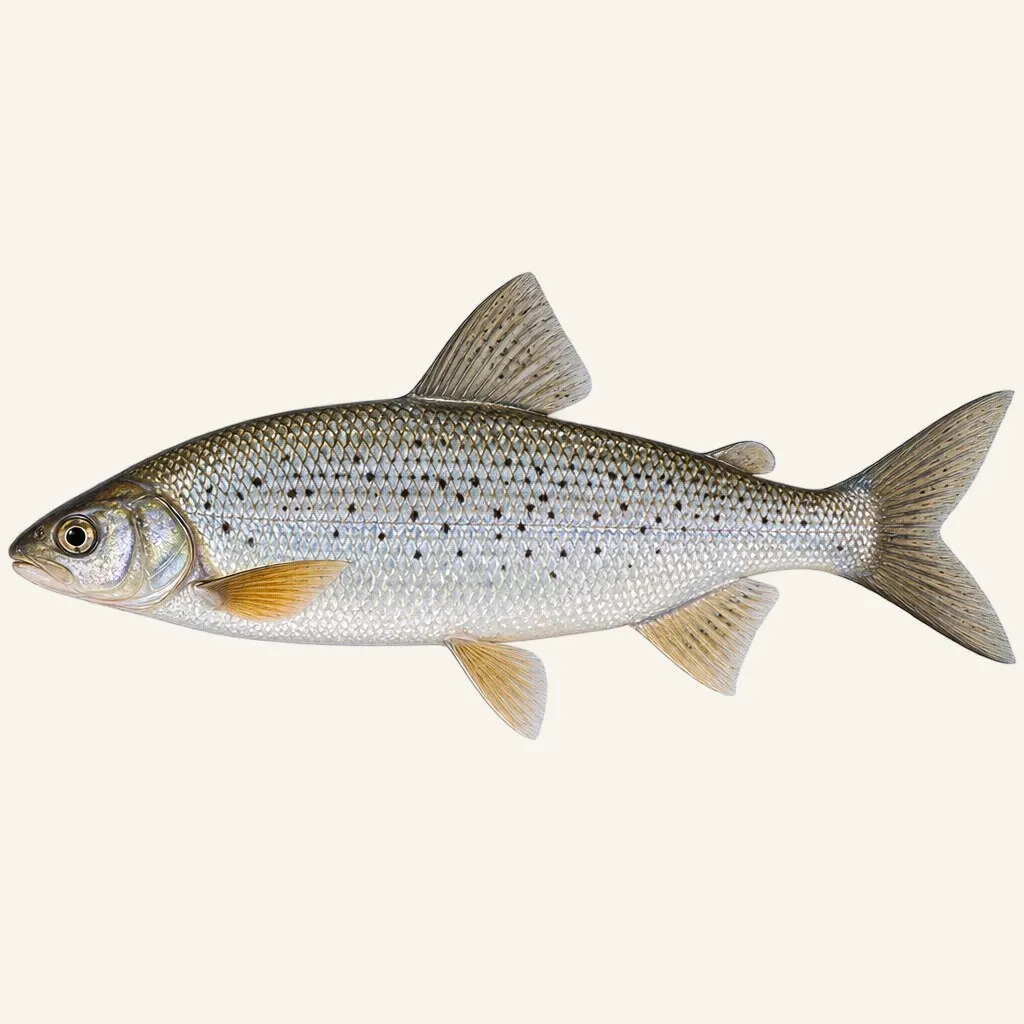
The round whitefish is a North American salmonid with an elongated cylindrical body, olive-brown back and silvery flanks, and a rounded snout with a small slightly subterminal mouth. It inhabits cold lakes and large rivers of Canada and Alaska, feeding mainly on aquatic invertebrates.
Calendar
Recorded in 2 countries
GBIF occurrence records — native and introduced populations combined.
Its range
Arctic and Pacific drainages from the western side of Hudson Bay across to Alaska and northern British Columbia; Arctic and Atlantic drainages from Quebec and Ontario down as far as Connecticut; the St Lawrence and Great Lakes basin, with the exception of Lake Erie. In northern Asia it is widely distributed through the Siberian rivers.
A single species on both sides of the Bering Strait is something few freshwater fish manage, and it puts this animal in Siberia and Connecticut under one name.
The Lake Erie exception deserves attention precisely because the fish holds the rest of that basin. Erie is the warmest and the shallowest of the Great Lakes.
Identifying it
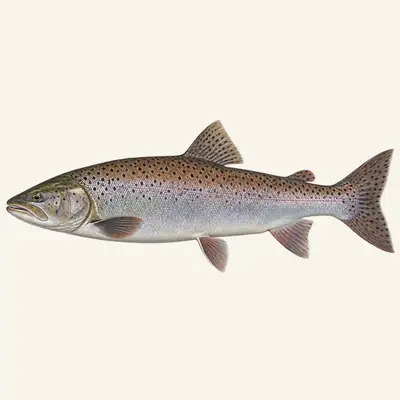
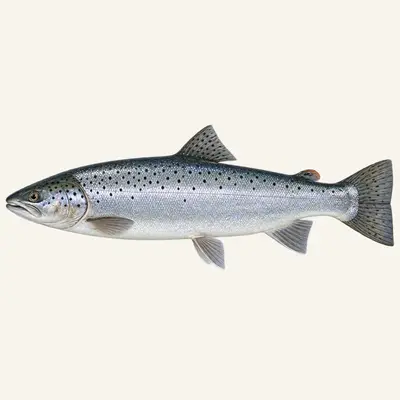
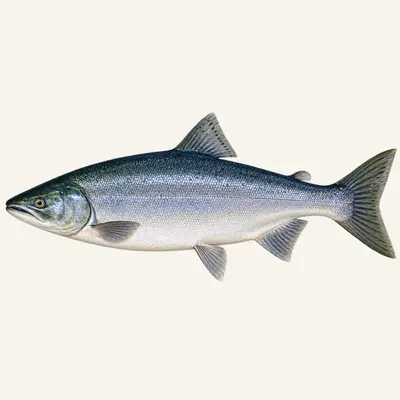
The section is almost circular, which is what the name records, flattening a little towards the rear, with the greatest depth of the body sitting in front of the dorsal fin. Held in the hand it is a tube, not a slab, and that is the quickest separation from the deep-bodied coregonines that share its lakes.
The colour is the surprise. This species carries more of it than most of its family: the scales, over the back especially, have well-defined dark borders that make each one conspicuous, and the pectoral fins are amber, turning orange at spawning with the pelvic and anal fins following to a lesser degree. The adipose fin is usually spotted brown, particularly in fish from central and eastern Canada. Young specimens carry two or more longitudinal rows of black spots along the sides, a marking that goes with age.
The head is relatively short, the snout pointed and pinched, compressed at the sides but rounded seen in profile, with a single flap of skin between the nostrils. The mouth is small and ventral, overhung by the snout. The eye is moderate and measures less across than the snout measures long.
The fin rays repeat the genus: 11 to 15 above, 10 to 13 below, and no spine in either.
Breeding
Inshore and upstream movements are on record and may be connected with spawning; the documentation is careful not to go further than that.
One detail is established, and it is a striking one. The fish swims in pairs while spawning. That is clear-cut pairing behaviour, and it is unusual in a family whose members mostly spawn in numbers over the same ground. A paired spawner needs two fish on the same gravel at the same moment, which is a harder condition to meet in a thin population than a mass spawner's.
First maturity comes at 30 cm — against a common length of 28.6 cm. Most of the fish met are therefore at or just short of first spawning, which is the figure to weigh before one is kept.
The water it needs
Adults inhabit the shallow areas of lakes and clear streams, and they rarely enter brackish water. They also live in rivers of swift current over stony bottoms. The thermal band runs from 2 to 18 degrees.
One specimen was taken at 218.9 m in eastern Lake Superior, and that single record says what the real amplitude is — far outside the shallow ground that is supposed to characterise the species. The ordinary depth range runs 4 to 72 m, usually no deeper than 37.
Movement is limited to what spawning requires. Outside the spawning season this is a sedentary fish, and a shoal located in one autumn is a shoal in much the same place the next.
Areas
- Deep northern lakes
- Large boreal rivers
- Drop-off zones
- River mouths
Techniques
- Wet fly fishing
- Euro nymphing
- Light spoon
- Drift fishing
Baits
- Artificial nymphs
- Small silver spoons
- Bloodworms
- Insect larvae
- Small streamers
What it eats
Adults feed on benthic invertebrates, and occasionally on fish and on fish eggs.
The pinched snout and the modest eye are the equipment of a bottom sifter rather than of a hunter working by sight. That is what divides this species from the open-water coregonines filtering zooplankton in the same lakes: same volume of water, different height in it, no competition worth speaking of.
How to catch it
Shallow stony ground, in a clear lake or in a swift stream. The diet points every presentation at the bed rather than into the water column where its plankton-feeding relatives are found, and that reversal is the single most useful thing to know when moving between the two.
Being sedentary, its marks hold from one season to the next, which is uncommon in this family and worth more than any choice of pattern.
The requirement for clear water is the working difference from the mountain whitefish: where a stream runs silty, the other species is the one to expect. Common length is 28.6 cm and 16 years is the oldest reported age. Commercial interest is minor.
Conservation
The absence from Lake Erie is the most eloquent indicator available. The warmest and shallowest lake of the basin is the only one the species does not occupy, so the thermal constraint is not a laboratory figure but something measurable at the scale of a whole basin — which is rare enough to be worth saying about any fish.
Being sedentary carries the usual consequence. Populations do not rescue one another, a local extinction is not made good from the next drainage, and recovery has to come from inside the water it happened in.
Its own diet places it in direct relation with the spawning of the other species in its lake, since fish eggs are on the menu. The reverse is equally true: eggs laid on the bottom of a shallow lake sit where everything else is feeding.
Regulations
Check the local regulations in force (legal size limits, closed seasons, bag limits).
For guidance only. Legal sizes, quotas and open seasons vary by location and season: always check the local regulations in force before fishing.
Other names
Round whitefish in English, after the section rather than after anything else. Pilot fish and frostfish turn up in regional use, the second of them from fishing through the ice.
Quebec French has ménomini rond, and French corégone rond.
The epithet is the character: cylindraceum, cylinder-like. It is the rare case in this family of a scientific name that identifies the fish faster than the vernacular does — useful, given that the same English name covers a Holarctic animal caught from Siberia to New England.
Sources: fishbase.se · api.gbif.org