Yellowfin tuna
Thunnus albacares · Scombridae
- Saltwater
- Big pelagics
- Medium
- Regulated
- Size
150–239 cm
- Weight
55–200 kg
- Lifespan
18 years
- Water temp.
15–31 °C
- Depth
1–1,602 m
Where to fish
- Offshore
Habitat icons: Flaticon
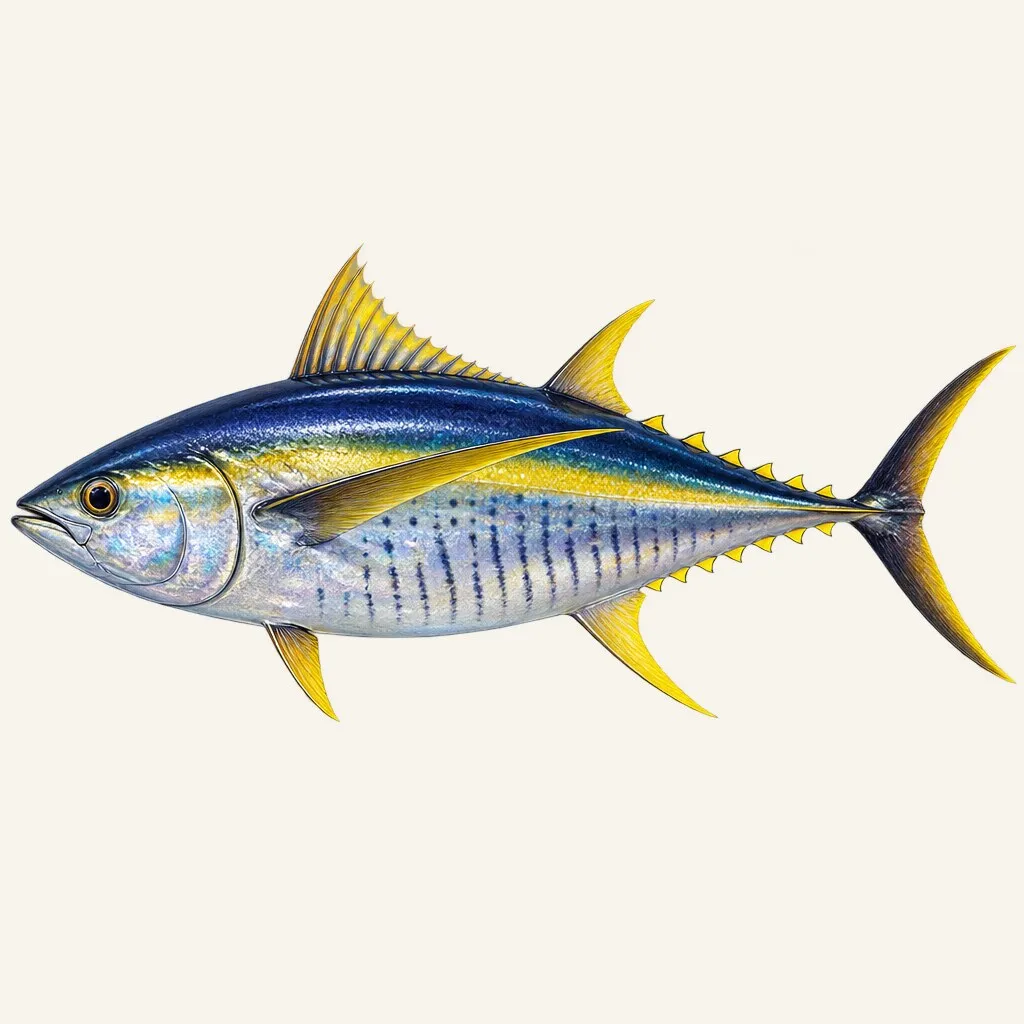
The yellowfin tuna is a pelagic tuna in the Scombridae family, recognisable by its strikingly elongated bright yellow dorsal and anal fins in adults. Found in all tropical and subtropical seas worldwide, it is one of the most abundant and heavily fished tuna species on the planet.
Calendar
Recorded in 85 countries
Angola · Anguilla · Antigua & Barbuda · Aruba · Australia · Austria · Bahamas · Benin · Bermuda · Brazil · British Indian Ocean Territory · British Virgin Islands · Cameroon · Canada · Cape Verde · Caribbean Netherlands · Chile · Christmas Island · Cocos (Keeling) Islands · Colombia · Comoros · Congo - Brazzaville · Costa Rica · Côte d’Ivoire · Cuba · Denmark · Dominica · Dominican Republic · Ecuador · Equatorial Guinea · Faroe Islands · Finland · France · French Guiana · French Southern Territories · Gabon · Germany · Ghana · Greenland · Guadeloupe · Guinea · Guinea-Bissau · Guyana · Haiti · Iceland · India · Indonesia · Ireland · Italy · Japan · Kenya · Liberia · Madagascar · Martinique · Mauritania · Mauritius · Mayotte · Mexico · Mozambique · Netherlands · New Zealand · Nigeria · Norway · Philippines · Portugal · Puerto Rico · São Tomé & Príncipe · Senegal · Seychelles · Sierra Leone · Solomon Islands · Somalia · South Africa · Spain · Suriname · Svalbard & Jan Mayen · Sweden · Tanzania · Togo · U.S. Virgin Islands · United Kingdom · United States · Venezuela · Western Sahara · Yemen
GBIF occurrence records — native and introduced populations combined.
Its range
Yellowfin occupy tropical and subtropical seas worldwide, between roughly 50°N and 50°S, in water from 15 to 31 degrees. The range is a temperature band rather than a geography, and its edges shift with the seasons.
One gap matters for anybody reading a label or a rule book: the species is absent from the Mediterranean. A tuna caught in the Mediterranean is some other tuna. That single exclusion does more work than any amount of range description, because it is the one sea where a yellowfin would plausibly be expected and is not found.
Beyond that, this is a highly migratory species in the formal sense. Individuals cross ocean basins, which is why the stocks are handled as ocean-scale units rather than as national ones.
Identifying it
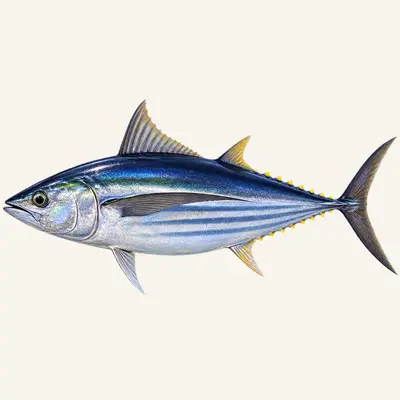
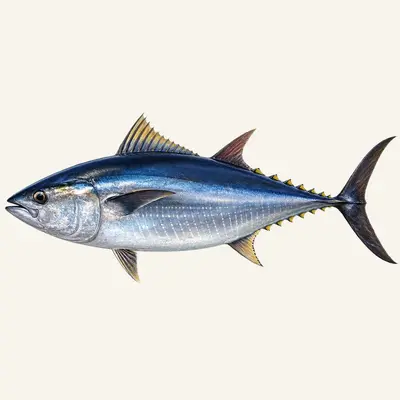
On a big fish the job is done at a glance. The second dorsal and the anal grow out into long scythes, well over a fifth of the fork length, curving back over the body, and they are bright yellow — as are the finlets behind them, each edged in a narrow black line. That colour is where the English name comes from and nothing else in the genus produces those fins.
On a small one none of that has happened yet and the fish has to be counted and measured. Gill rakers on the first arch number 26 to 34. There are eight to ten finlets behind the second dorsal, seven to ten behind the anal, and 39 vertebrae. The pectoral fin is moderately long: it reaches past the origin of the second dorsal but not past the end of its base, and works out at 22 to 31 per cent of fork length. That last figure is what separates this species from a bigeye, whose pectorals run visibly longer.
The rest is standard tuna. A fusiform body slightly flattened at the sides, very small scales, a corselet of larger ones that is present but poorly marked, and a caudal peduncle so slender it looks undersized, carrying a strong keel with a smaller keel above and below it. Metallic dark blue over the back, through yellow, to silver underneath, with about 20 broken vertical lines along the belly.
One character survives butchery: the underside of the liver bears no striations. Once the fins are off and the head has gone, that is what a dockside identification comes down to.
Breeding
Yellowfin spawn across the tropical and equatorial belt of every major ocean, and how often depends on latitude. Towards the edges of the range it is seasonal, peaking in summer. Near the equator it can run right through the year.
They are batch spawners, releasing eggs every few days over the spawning period rather than emptying themselves in a single event. Eggs and milt go into open water, fertilisation is external, and eggs and larvae then drift as plankton with whatever current they land in. There is no nest, no site fidelity, and no parental investment of any kind after release.
The numbers behind that strategy are what make the species what it is. Maturity comes at about 103 cm on average, with a spread from 78 to 158 between stocks, and the greatest recorded age is 18 years. An animal that grows to the full size of the species inside that lifespan is growing extraordinarily fast, and a fast-growing, early-maturing, continuously spawning fish replaces its own losses far quicker than the long-lived tunas can.
The water it needs
The fish is oceanic, lives in open water above and below the thermocline, and is only rarely seen anywhere near a reef. Recorded depths run past 1,600 metres, which on its own is misleading.
Oxygen sets the real limit. Yellowfin are sensitive to low concentrations of it, and in the tropics they are not usually taken below 250 metres because the water beneath that holds too little. The layer they actually use is therefore far thinner than the depth records suggest, and it is closed off from below by chemistry rather than by pressure or cold.
Inside that layer they school, and the schools sort by size rather than by species. A group may be all yellowfin or may mix several tunas of similar dimensions, but the fish in it will be comparable to one another. Large individuals frequently keep company with porpoises, and yellowfin of every size gather beneath floating objects — wreckage, weed rafts, anything adrift.
Areas
- Tropical open ocean
- Around FADs and floating objects
- Equatorial upwelling zones
- Around islands and seamounts
Techniques
- Offshore trolling
- FAD fishing
- Surface popping
- Vertical jigging
Baits
- Natural squid
- Live baitfish (scad, sardinella)
- Trolling lures
- Poppers
What it eats
Fish, crustaceans and squid, taken in the upper water column where the oxygen allows them to hunt.
The association with floating objects is a feeding relationship rather than a taste for company. Drifting structure accumulates small organisms, those draw baitfish, and the tuna arrive at the end of that sequence. The commercial fishery formalised the process a long time ago by deploying floating objects of its own and coming back to them, which works precisely because the chain assembles itself the same way every time.
How to catch it
Finding fish comes before everything else, and the signs are all at the surface: working birds, porpoises, drifting debris, changes in water colour, and the lines where two bodies of water meet. A school located is only useful if it can be approached without being scattered.
The porpoise association is the oldest indicator of the lot — follow the mammals and the tuna are underneath them. It also carries a history: setting nets around dolphin schools to take the tuna below caused serious damage in the industrial fishery before the practice was changed.
The fight is an endurance problem rather than a spectacular one. A yellowfin does not jump. It sounds and circles, deep, for as long as it takes, and it is the tackle and the angler that give out first. Drag set to yield without collapsing, and steady pressure in place of pumping, is what settles it.
The oxygen ceiling has a practical edge as well. In tropical water there is nothing to be gained by fishing below 250 metres, because the fish are not down there. The productive layer is thinner than the depth figures for the species imply.
Regulated — Often governed by quotas, size limits, seasons, or reporting rules.
Conservation
Stock status is the whole question here, and it does not have one answer. Yellowfin are managed as separate stocks by ocean basin, through regional fisheries bodies, and those stocks sit in visibly different conditions. The Indian Ocean has been the longest-running concern, assessed repeatedly as carrying more fishing pressure than it can absorb, while other basins have been judged to be holding up. Any single worldwide verdict averages those together and tells an angler or a buyer nothing about the water actually in front of them.
What keeps the species in a better position than several other tunas is biology rather than restraint. Fast growth, early maturity and repeated spawning through a long season give it a capacity to replace losses that a slow-maturing tuna simply does not have. That capacity is finite, and it is being tested continuously: the fish is taken mainly on longlines and by purse seine, sold fresh, frozen, canned and smoked, and valued highly for raw consumption, which is what sets the price of the largest and best-conditioned individuals.
Recreational fishing is a small share of the total removal. It draws on the same stocks and falls under the same management, which is worth remembering when the two are discussed as though they were separate activities.
Regulations
Check the local regulations in force (legal size limits, closed seasons, bag limits).
For guidance only. Legal sizes, quotas and open seasons vary by location and season: always check the local regulations in force before fishing.
Other names
Yellowfin tuna in English, for the fins. Rabil in Spanish, albacore in French, tonno albacora in Italian.
That French name is a trap running in both directions, because "albacore" in English is not this fish at all: it is Thunnus alalunga, the long-finned tuna sold as white meat. The same word names two different species depending on which language it is read in, and the confusion has survived into labelling and into translated regulations, where it does real damage.
The other name worth knowing is a market term. "Ahi", from Hawaiian usage and the menus derived from it, covers this species and bigeye alike, so it identifies a grade of fish rather than a species.
Sources: fishbase.se · api.gbif.org