Wahoo
Acanthocybium solandri · Scombridae
- Saltwater
- Big pelagics
- Medium
- Size
170–250 cm
- Weight
32–83 kg
- Depth
0–20 m
Where to fish
- Rocky shore
- Offshore
Habitat icons: Flaticon
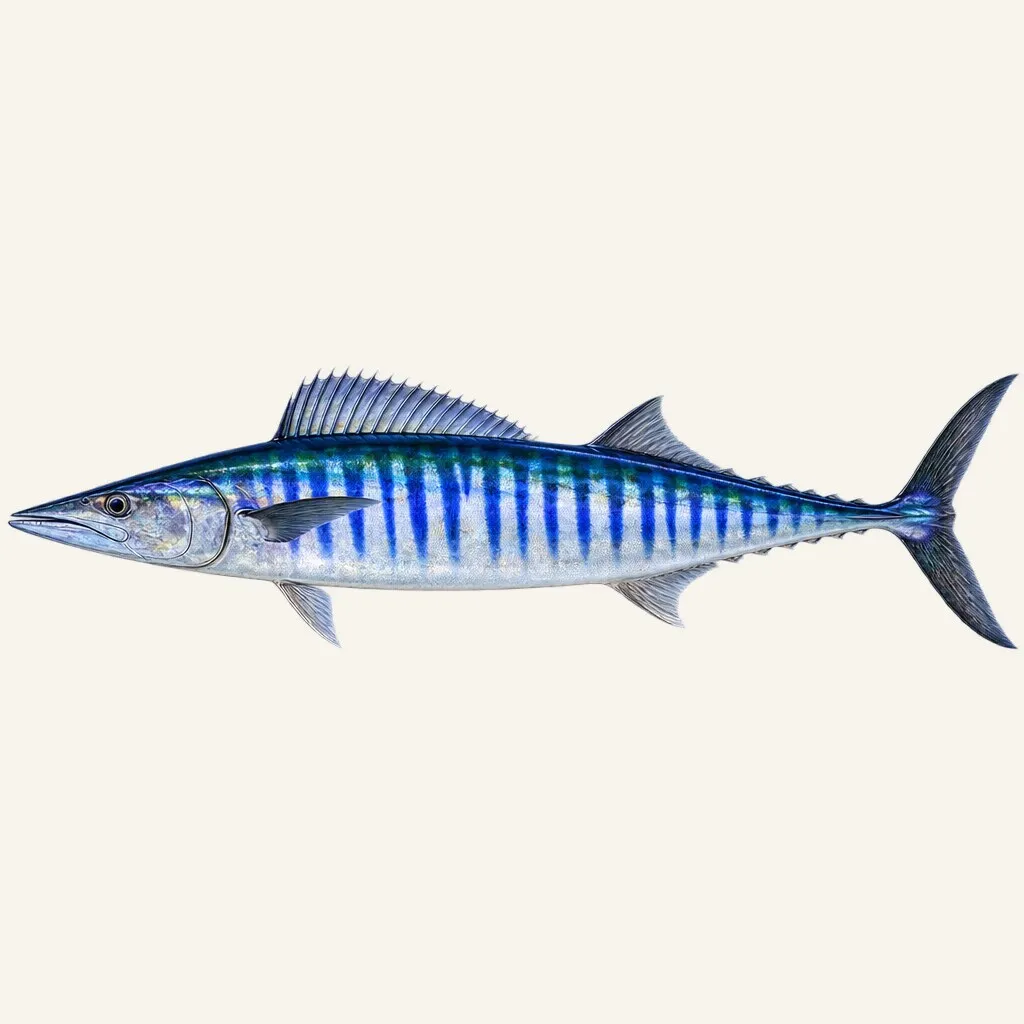
The wahoo is a large scombrid with a streamlined, elongated body covered in small scales, a prominent lower jaw and sharp teeth.
Calendar
Recorded in 34 countries
Australia · Bahamas · Brazil · British Indian Ocean Territory · Cape Verde · Colombia · Côte d’Ivoire · Cuba · Ecuador · Equatorial Guinea · Faroe Islands · French Southern Territories · Ghana · Guinea · Haiti · Ireland · Japan · Liberia · Madagascar · Mauritius · Mayotte · Mexico · Mozambique · Puerto Rico · Seychelles · Sierra Leone · Solomon Islands · Somalia · Spain · Tanzania · U.S. Virgin Islands · United Kingdom · United States · Venezuela
GBIF occurrence records — native and introduced populations combined.
Its range
Tropical and subtropical water in the Atlantic, the Indian Ocean and the Pacific, including the Caribbean and the Mediterranean.
The Mediterranean entry is the one to note, because it is a warm sea reached through a narrow strait and it is not on the list for every warm-water scombrid. For an animal confined to the top twelve metres, an enclosed basin is entered at the surface or not at all, and this one is present there.
Identifying it
The snout takes up half the head. It is described as about as long as the whole rest of it, which gives the animal a profile no other scombrid on this site presents, and it is visible at a distance in the water.
Behind that snout the mouth is large and armed with strong teeth, triangular, flattened from side to side, and finely serrated along their edges. They cut rather than hold. The rear part of the maxilla disappears entirely beneath the preorbital bone, so the jaw hinge is hidden on a closed mouth.
There are no gill rakers at all. The first arch is bare.
Colour is iridescent blue-green over the back, silver on the sides, crossed by 24 to 30 cobalt blue vertical bars that continue below the lateral line rather than stopping at it. Where the bars end is as informative as that they exist.
The counts are extreme at one end and ordinary at the other: 23 to 27 spines in the first dorsal, which is a lot, against 12 to 16 soft rays behind it and 12 to 14 in the anal, with 62 to 64 vertebrae. Small scales cover the body, no corselet develops at the front of it, the interpelvic process is small and forked, and a swim bladder is present.
Breeding
Spawning appears to run over a long stretch of the year, and the evidence for that is a field observation rather than a measurement: fish at different stages of maturity are frequently taken at the same time in the same place.
That single sentence does more work than a date range would. It means there is no moment at which the whole population is doing the same thing, and no window in which a fishery could concentrate on ripe fish or avoid them. Reproduction is smeared out, individual by individual.
First maturity is reached around 99 cm, with reported values from 85 to 105. The common capture runs to about 170 cm, so the ordinary fish in the box is comfortably past the threshold — which is not a common position for a large predator.
The water it needs
The depth figures are the most surprising thing in the file. Recorded range nought to 20 m; usual range nought to 12 m.
An oceanic fish, present in every warm ocean between 59°N and 48°S, spends its life in a layer twelve metres deep. There is no vertical dimension to this animal's world at all. Everything it does, it does within a few body lengths of the surface, over water that may be four kilometres deep beneath it.
The second half of the picture is the company it keeps, which is almost none. The species is frequently solitary, and where it is not, it forms small loose aggregations rather than the compact schools of its relatives. Nothing here travels in thousands.
Put the two together and the result is a very thin animal density spread across an enormous surface. Not a rare fish — a dispersed one.
Areas
- Offshore open sea
- Offshore drop-offs and trenches
- Warm current lines
- Banks and seamounts
Techniques
- High-speed offshore trolling
- High-speed lure fishing
- Drift live bait fishing
- Surface popper fishing
Baits
- High-speed chrome spoons
- Flying fish-style lures
- Whole squid
- Small live tuna
What it eats
Fishes and squids. Nothing else appears on the list.
That agrees exactly with the mouth. With no gill rakers there is no straining of anything small, and with serrated cutting teeth there is no gripping of anything that has to be held whole. This is an apparatus for meeting a large mobile prey at speed and taking a piece out of it, and it offers no fallback: a fish equipped this way has no way to make a living on plankton for a season if the baitfish move.
How to catch it
The search is the fishery. There is no school to intercept and no structure to work, so the boat covers distance and the fish are met one at a time, at high trolling speed, on gear that will survive an unannounced strike.
The teeth decide the terminal tackle and there is no discussion to be had about it. Serrated edges part monofilament cleanly on contact, and a wire trace is not a refinement here.
The swim bladder is worth a paragraph for an unusual reason. This species has one — many of its coastal relatives do not — and yet it is the least likely of the group to suffer for it, because it never goes deep enough for the gas inside it to matter. A fish hooked in the top twelve metres arrives at the surface having changed pressure by barely more than one atmosphere. Whatever else limits a release here, decompression is not it, and that is a genuinely rare position for a marine fish of this size.
Ciguatera poisoning has been reported from the species. As always the burden belongs to the ground the fish fed over rather than to the species in the abstract, and the answer is held locally.
Conservation
Two things in the record work in the fish's favour and one thing is simply missing.
In its favour: the common capture sits well above the length at first maturity, so the routine landing is of a fish that has already bred, and the long, staggered spawning season spreads a year's reproduction across many months instead of concentrating it where a fishery could remove it in one pass.
Also in its favour: the solitary habit. A dispersed animal cannot be surrounded. There is no compact school here for a purse seine to close on, and the removals come from trolling fisheries taking fish singly and from longlines taking it as a secondary catch. The gear that empties a shoaling species in a season has nothing to work with.
What is missing is the lifespan. The file carries no maximum reported age. Length at maturity is known, common length is known, and the number that would join them — how long an individual lives, and therefore how many of those long spawning seasons it actually gets — is absent. Nothing converts a landing figure into a rate without it, and any statement about how fast this fish grows or how quickly a stock rebuilds rests on an estimate rather than on a record.
Regulations
Check the local regulations in force (legal size limits, closed seasons, bag limits).
For guidance only. Legal sizes, quotas and open seasons vary by location and season: always check the local regulations in force before fishing.
Other names
Wahoo, and the name has travelled further than most. German and Italian use it unchanged, so three of the six languages here call the fish by the same English word — which is unusual, because European languages generally build their own name for a fish they land. French has thazard-bâtard and Spanish peto, but in practice the English word is what turns up on a manifest.
Hawaiian gives the other name in common use, ono, which means good to eat, and the record backs the compliment: the flesh is rated of very good quality and is sold fresh, frozen, salted and spice-cured.
The epithet honours Daniel Solander, the naturalist who sailed with Banks. The genus name attaches the fish to Cybium, an old name for the Spanish mackerels, with a prefix for the spines — a reminder that this animal was first understood as an extreme member of that group rather than as something apart from it, which the 23 to 27 dorsal spines still argue.
Sources: fishbase.se · api.gbif.org