Swordfish
Xiphias gladius · Xiphiidae
- Saltwater
- Big pelagics
- Medium
- Regulated
- Dangerous
- Size
300–455 cm
- Weight
228–650 kg
- Water temp.
5–27 °C
- Depth
0–2,878 m
Where to fish
- Offshore
Habitat icons: Flaticon
Swordfish - pelagic predator, worldwide.
Calendar
Recorded in 59 countries
Albania · American Samoa · Anguilla · Antigua & Barbuda · Aruba · Australia · Bahamas · Bermuda · Brazil · British Virgin Islands · Canada · Cape Verde · Caribbean Netherlands · Cayman Islands · Chile · Colombia · Cook Islands · Croatia · Cuba · Denmark · Dominica · Dominican Republic · Ecuador · Faroe Islands · France · French Guiana · French Polynesia · French Southern Territories · Germany · Guadeloupe · Guyana · Haiti · India · Indonesia · Ireland · Italy · Jamaica · Japan · Martinique · Mexico · Netherlands · New Caledonia · New Zealand · Norfolk Island · Norway · Papua New Guinea · Portugal · Puerto Rico · South Africa · Spain · Suriname · Svalbard & Jan Mayen · Sweden · Tonga · Türkiye · U.S. Virgin Islands · United Kingdom · United States · Venezuela
GBIF occurrence records — native and introduced populations combined.
Its range
Tropical, temperate and at times genuinely cold water in all three oceans, plus the Mediterranean, the Sea of Marmara, the Black Sea and the Sea of Azov. Movement is the point rather than residence: the species runs towards temperate or cold water through the summer and returns to warm water in autumn, which puts individual fish across a great many national boundaries in a single year.
One genetic result deserves to be better known than it is. Mitochondrial analysis separates the Mediterranean population from the tropical Atlantic one clearly enough to show that very little exchange occurs between them. A Mediterranean fish is not an Atlantic fish on a visit, and what is taken from one basin is not replaced from the other.
Identifying it
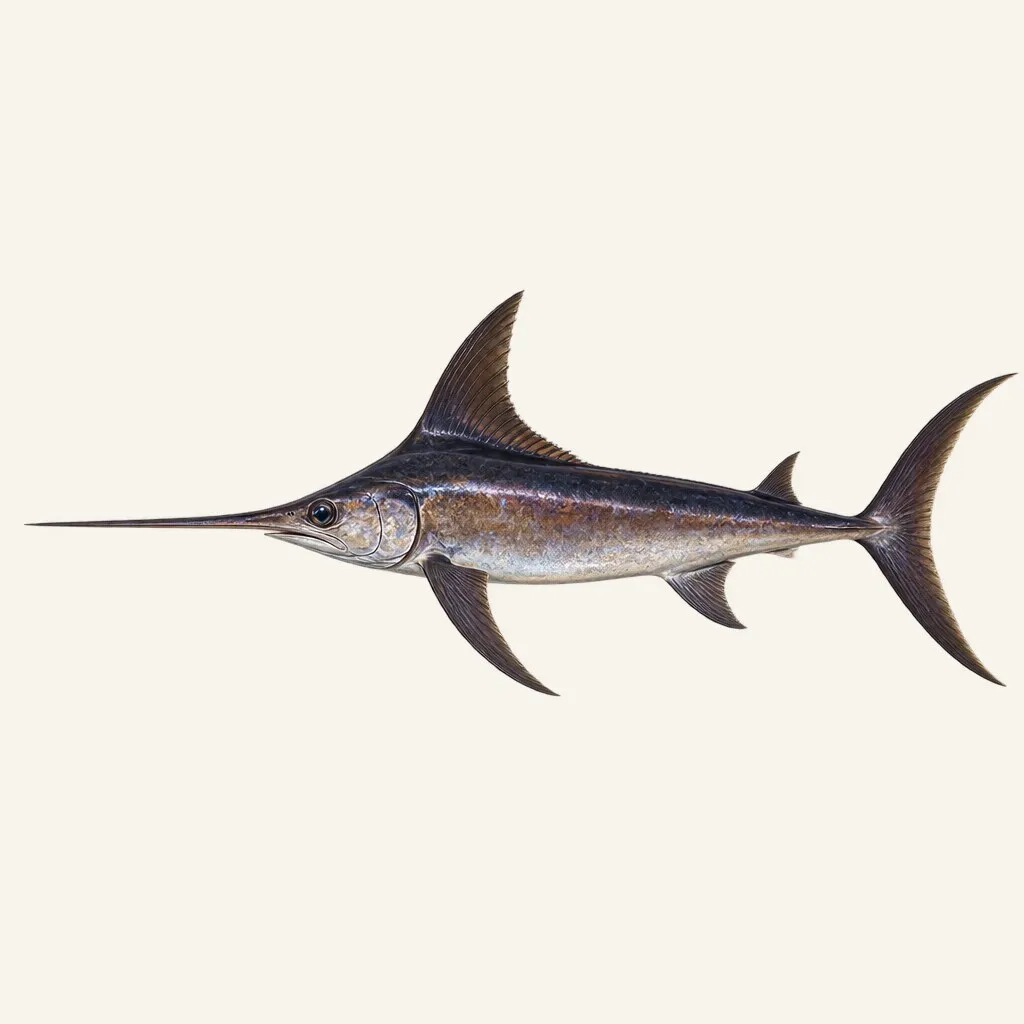
The bill is flat, wide and sharp along both edges. That is a blade, and it is what separates this fish from every marlin, sailfish and spearfish, whose bills are round in section and taper to a point. It can run to something like a third of the animal's total length.
The second character is an absence: adults have no pelvic fins whatsoever. Nothing else of comparable size in open water is built that way, so a look at the underside answers the question on its own. Adults also carry no scales, which is worth knowing because it removes the usual way of ageing a large fish.
The body is elongated, blackish-brown over the back and fading to a lighter brown below. The first dorsal is tall, short-based and stiffened by a dark membrane, quite unlike the long folding sail of the istiophorids. It carries 38 to 56 soft rays and not a single spine, and the anal fin behind it runs to 16 to 18 rays on the same pattern.
Breeding
Eggs go into the top of the water column, from the surface down to no more than 75 m, in water of around 23 degrees and 33.8 to 37.4 parts per thousand of salt. Larval distribution in the Pacific points to the same thing from another angle: spawning there takes place above 24 degrees. Warmth is the constraint, not depth.
Latitude sets the calendar. In equatorial water spawning goes on in every season; further north and further south it contracts into spring and summer. In the Atlantic it concentrates in spring, in the southern part of the Sargasso Sea.
Fertilisation is external and, unusually for a large pelagic, the pairing is reported as a solitary male with a solitary female rather than a group release. Fecundity scales steeply with the size of the female: between 1 and 16 million eggs from a fish of 168 kg, and 29 million from one of 272 kg.
The eggs are pelagic and measure 1.6 to 1.8 mm. Larvae hatch at 4 mm and the sword is already formed by the time they reach 10 mm, at which size they are living in the upper layers and hunting hard. Maturity, by contrast, comes very late: around 212 cm on average, with a range of 156 to 250 cm.
The water it needs
An oceanic animal that occasionally comes within sight of land. It generally holds above the thermocline in water of 18 to 22 degrees, which describes preference rather than limit: the tolerated band runs from 5 to 27 degrees, and the recorded depth range reaches 2,878 m against a usual working range of 0 to 550 m.
That vertical span is the distinguishing feature of the species. It descends far below the layer most large pelagics work, into cold and effectively lightless water, and comes back up. A cranial heat exchanger warming the brain and eyes is what makes that possible, keeping the sensory equipment operating at temperatures that would slow another fish to uselessness.
The result is a day organised vertically rather than horizontally: deep through daylight, up towards the surface after dark, following prey that makes the same journey on the same schedule.
Areas
- Deep offshore pelagic waters
- Nighttime surface upwelling zones
- Central Mediterranean
- Subtropical Atlantic
Techniques
- Night drifting with squid
- Daytime deep trolling
- Sport longlining
- Deep pelagic lures
Baits
- Natural luminous squid
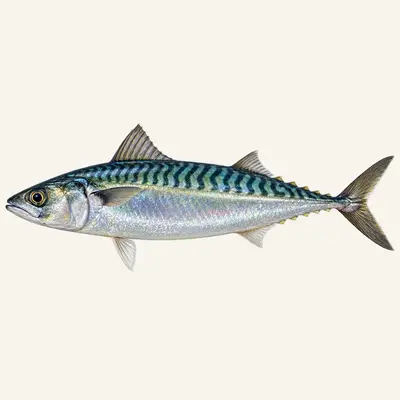
- Whole mackerel
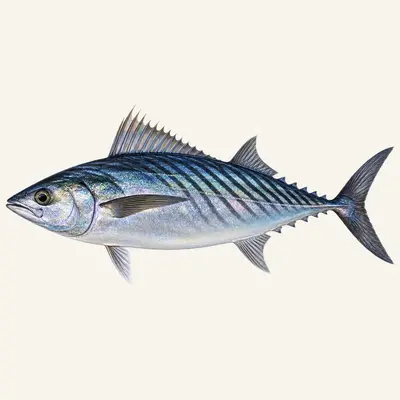
- Rigged bonito
- Deep-water lures
What it eats
An opportunist that forages from the surface to the bottom across an enormous depth range. Fish make up most of it, Atlantic mackerel, barracudinas, silver hake, redfish, herring and lanternfishes among them, filled out with squid and crustaceans.
The lanternfishes are the telling entry on that list. They belong to the deep scattering layer that rises at dusk and sinks at dawn, so the daily vertical cycle is not a preference for depth but the pursuit of a moving food supply.
The sword is used to kill. A pass through a shoal with the blade swinging leaves injured prey behind to be collected at leisure, which is hunting with a weapon rather than by pursuit, and it explains both the shape of the blade and how much punishment it is built to take.
Large individuals accumulate high concentrations of mercury in the flesh. That is the arithmetic of a long-lived animal at the top of an oceanic food chain, and it scales with size.
How to catch it
Recreational fishing for this species happens mostly at night, and the vertical cycle is the reason. The fish spends daylight deep and comes up after sunset to hunt nearer the surface, so a trip is planned backwards from the way most sea fishing is organised.
Beyond that it is a matter of searching. Current lines, colour changes, temperature breaks, working birds: as with every open-water pelagic, the fishing is in finding the water rather than in occupying a spot.
The animal dictates the tackle. Two to three metres of fish that sounds several hundred metres immediately after the hook goes in requires drags set precisely and line that will survive hours of it. Too much pressure breaks something, too little concedes the depth, and there is no third option once it is heading down.
Size also carries a piece of information. Females grow faster than males, so a very large fish is likely to be a female, and given how late maturity arrives it is likely to be one that has spawned or is about to.
The blade is a real hazard once the fish is alongside. It stays dangerous until the very end, and this is one of the few species where handling is a question of crew safety before it is a question of the animal's welfare.
Regulated — Often governed by quotas, size limits, seasons, or reporting rules.
Dangerous — Risky handling: gear, release, and safety practices must be adapted.
Conservation · Near Threatened (IUCN) — This species is in decline. Release your catch quickly and handle it with care — wet hands, as little time out of the water as possible.
Conservation
Populations have been in observed decline, and the biology of the animal explains why they recover slowly. Maturity arrives beyond two metres, which means a great many fish are caught before they have bred once. Ageing is difficult in a way that hampers every stock assessment: the otoliths are minute and adults have no scales, so growth rings have to be read from cross-sections of the fin rays.
Size-selective fishing has a particular edge here. Since females grow faster, pressure aimed at the largest fish falls disproportionately on them, and removing the biggest females removes the ones producing tens of millions of eggs rather than one or two million. Fecundity is not linear with size, and neither is the cost of taking a large fish.
Management can only be international, and this species shows why with unusual clarity. A stock that crosses an entire ocean cannot be judged from any one port, and the genetic separation between the Mediterranean and the tropical Atlantic adds a hard constraint on top: whatever is taken from the smaller, enclosed basin cannot be made good by the larger one.
The mercury load in large individuals belongs to this section as much as to any other. It is a consequence of exactly the traits that make the fish worth catching, longevity and a position at the top of the chain, and it is the one thing about a big one that ought to be considered before deciding what happens to it.
Regulations
Check the local regulations in force (legal size limits, closed seasons, bag limits).
For guidance only. Legal sizes, quotas and open seasons vary by location and season: always check the local regulations in force before fishing.
Other names
Swordfish is the standard English name and broadbill is the working alternative, common enough among anglers and in the scientific literature that the two appear side by side in the same papers. Broadbill is the more useful of the two, because the width of the blade is the single character that distinguishes this fish from the marlins.
Taxonomy backs that up. The species is the only member of its family, while marlins, sailfish and spearfish sit together in another. Billfish is a convenient word covering both groups and corresponds to no taxonomic unit at all, which is worth remembering when reading a catch report that uses it.
The scientific name says the same thing twice over: the genus is the Greek for a straight sword, the species epithet is the Latin for the short sword carried by Roman infantry.
Sources: fishbase.se · api.gbif.org