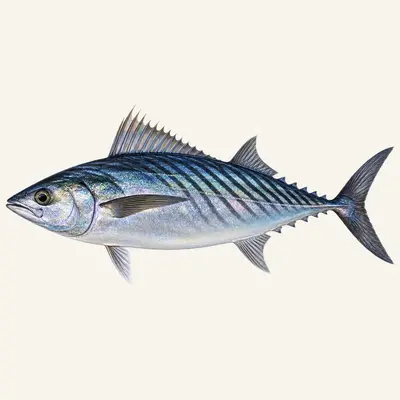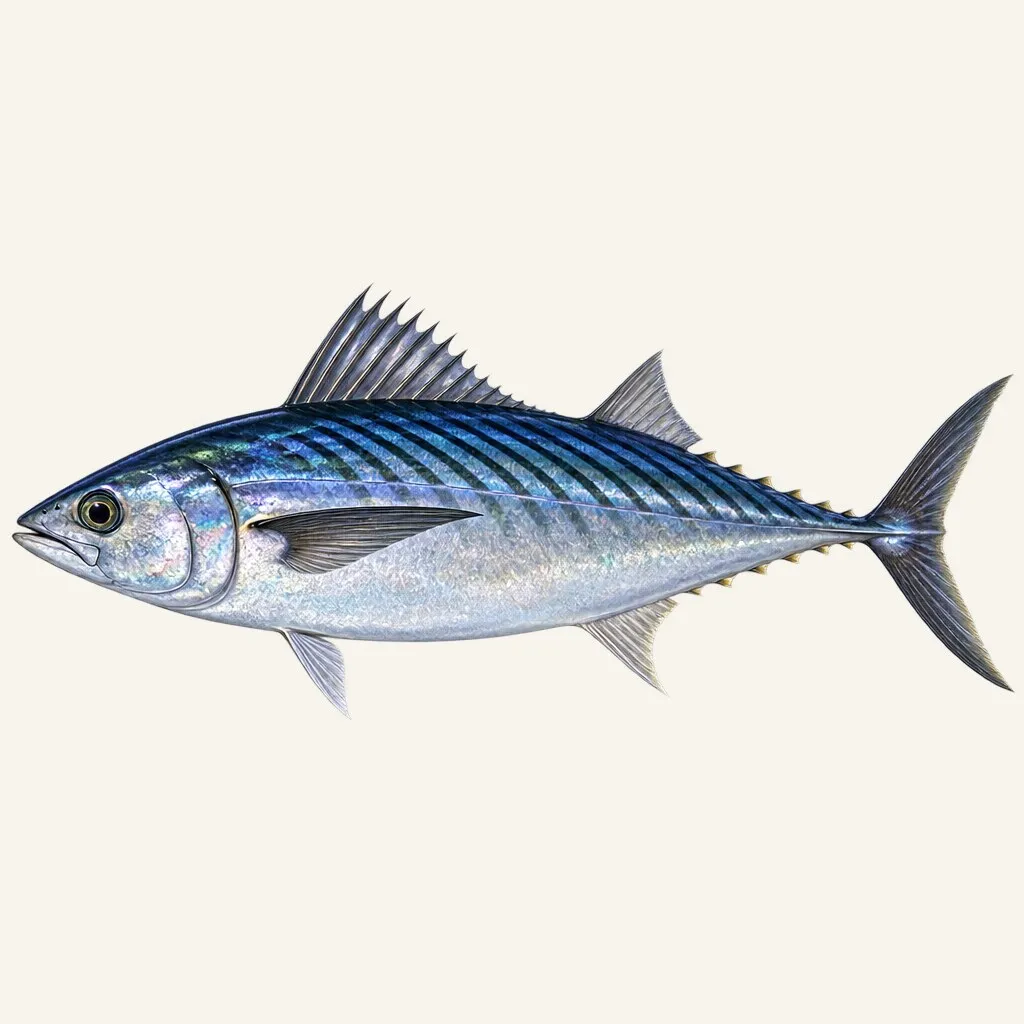
Striped bonito
Sarda orientalis · Scombridae
- Saltwater
- Big pelagics
- Medium
- Size
55–102 cm
- Weight
2.0–11 kg
- Water temp.
14–23 °C
- Depth
1–167 m
Where to fish
- Estuary
- Reef
- Offshore
Habitat icons: Flaticon
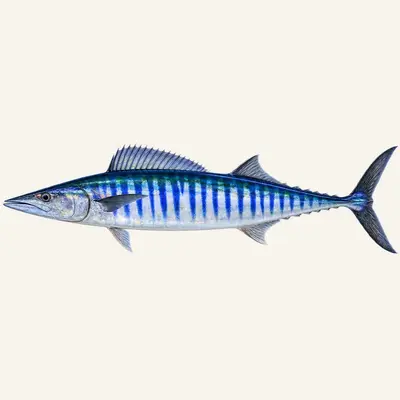
The striped bonito is a pelagic Scombridae of the tropical and subtropical waters of the Indo-Pacific and eastern Atlantic, recognizable by the dark horizontal stripes on its metallic blue back. An active predator, it hunts in schools for clupeids, squids and decapod crustaceans in semi-coastal waters.
Calendar
Recorded in 14 countries
Australia · China · Colombia · Costa Rica · Ecuador · Indonesia · Japan · Mexico · Mozambique · Panama · Réunion · South Africa · Taiwan · United States
GBIF occurrence records — native and introduced populations combined.
Its range
The range is wide and full of holes. The record says so without hedging: the species is widespread across the Indo-Pacific, with many gaps in its known distribution. The chart therefore does not show where this bonito lives, it shows where somebody reported it, and the two do not coincide.
The reason is economic before it is biological. A fish of secondary commercial interest attracts no assessment survey, and its presence gets logged only incidentally, wherever someone took the trouble to separate the scombrids in a single crate.
One exception is well described. On the American side of the Pacific the species runs south to Cabo Blanco in northern Peru, especially during El Niño events. Its southern limit in that ocean therefore depends not on the season but on the interannual state of the water, and it moves by several hundred kilometres from one year to the next.
Identifying it
The pattern on the back is made of narrow oblique stripes, nearer to threads than to bands. It is the first thing to look at, because this fish is rarely identified on its own: it swims mixed in with small tunas, and the examination happens over a heap of scombrids tipped out on the deck.
The vertebral count decides the awkward cases. Forty-four or 45, with no margin: the tightest range in the genus, and it leaves none of the room for interpretation that the other bonitos leave. The first dorsal has 17 to 19 spines and the anal 14 to 16 rays.
The olfactory rosette carries 21 to 39 laminae. This is not something anyone checks on a beach, but it appears in every key to the genus and comes into use as soon as a doubt reaches a laboratory.
The common length of the catch tops out around 55 cm, far below the greatest recorded fish. That spread is the widest in the genus, which means a very large individual of this species is a rarity rather than an ordinary adult.
Breeding
Spawning follows the monsoon. That is not a season in the sense of a month but a wind regime, so the date shifts with longitude: one species spawns at different times in the Indian Ocean, in the western Pacific and off the Pacific coast of the Americas.
Maturity is reached at about 48 cm on average, with the earliest individuals ripening at 45. The threshold sits just below the common size of the catch.
The water it needs
Fourteen to 23 degrees: the thermal window is narrow and cool for a fish of warm seas, and it explains why this one is found around the edges of the tropical oceans rather than in the middle of them.
Depth starts at one metre. That low figure is worth keeping: the species comes into water shallow enough to stand in, and island margins are among its regular ground.
It lives in shoals, and the shoals are not its own alone. The record reports it in company with small tunas, in mixed gatherings where several species work the same forage.
Areas
- Coastal pelagic waters
- Around reefs and shoals
- Thermal fronts
- Passes and river mouths
Techniques
- Metal lure casting
- Surface trolling
- Live bait fishing
- Spoon fishing
Baits
- Small live clupeoids
- Squid
- Silver lures
- Baitfish
What it eats
Clupeoids come first — sardines, anchovies and their relatives — followed by other fishes and by squid.
The surprising entry is decapod crustaceans. A bonito running flat out behind a shoal of anchovies is not the animal anyone pictures picking through shrimps, and yet that share of the diet is consistent. It accounts for the fish taking lures that imitate nothing with fins.
How to catch it
Mixed hunting is the fact to absorb before going out. This bonito holds the same gatherings as the small tunas, so on a feeding school marked by birds there is no choosing what comes to the hook. Rigging for one and refusing the other makes no sense here; the only useful decision concerns the size of the lure, and it is common to both.
Trolling surface lines is among the documented methods, alongside encircling nets and drift nets. The fish answers a fast presentation in open water.
The gaps in the chart have an unusual practical consequence. On this species a local fisherman is a better source than a distribution map: it is present in sectors where no data place it, and absent from areas that ought to suit it.
Conservation
The fish vanishes into other species' statistics. Swimming among small tunas, it is taken by gear aimed at them and landed with them, so its own total exists only at the cost of a sort that nobody has an interest in making. A species not counted separately cannot be followed separately.
Its dependence on the state of the ocean adds a difficulty. A population whose southern limit advances several hundred kilometres in El Niño years changes jurisdiction by changing latitude, and any one country's catch series mixes changes in abundance with changes in presence.
Nothing indicates particular pressure on the species, and maturity that arrives early relative to its maximum size leaves it margin.
Regulations
Check the local regulations in force (legal size limits, closed seasons, bag limits).
For guidance only. Legal sizes, quotas and open seasons vary by location and season: always check the local regulations in force before fishing.
Other names
Striped bonito is the standard English name, and it marks a character that every member of the genus carries — all four have striped backs. What is particular here is the narrowness of the stripes, so the name separates nothing on its own. Spanish says bonito mono, Italian palamita orientale.
There is a trap for anyone reading across languages. French reserves its striped-back name for the Atlantic species, a different fish, so translating that name literally swaps the two animals with nothing to flag the substitution. The binomial is the only safe reference.
The epithet points east, which fits the Indo-Pacific core of the range but sits oddly against the best-documented part of it: Hawaii, the Pacific coast of the Americas, the Galápagos and the Gulf of Guayaquil, all of them as far east as the ocean goes.
Sources: fishbase.se · api.gbif.org