Southern bluefin tuna
Thunnus maccoyii · Scombridae
- Saltwater
- Big pelagics
- Hard
- Size
160–245 cm
- Weight
60–260 kg
- Lifespan
20 years
- Water temp.
5–20 °C
- Depth
0–2,743 m
Where to fish
- Offshore
Habitat icons: Flaticon
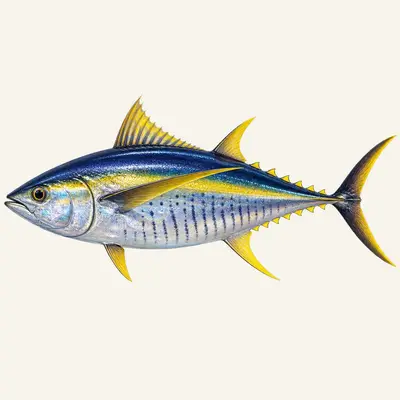
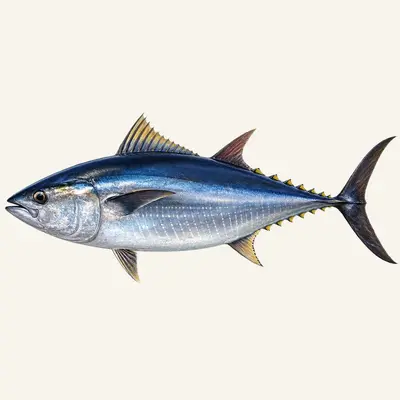
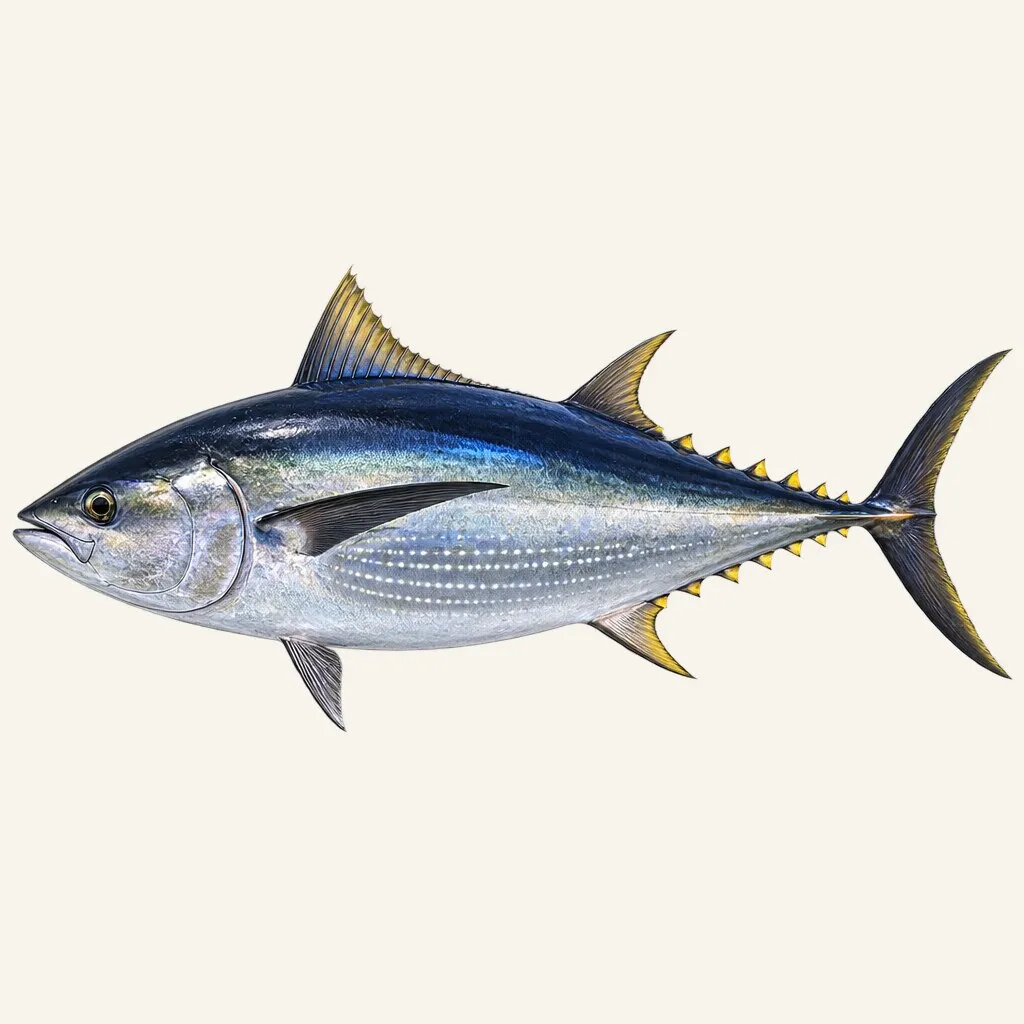
The southern bluefin tuna is a large pelagic tuna in the Scombridae family with a robust, torpedo-shaped body, dark blue back, and silvery flanks. It inhabits the cold temperate waters of the Southern Hemisphere and undertakes long circumpolar migrations around Antarctica.
Calendar
Recorded in 5 countries
Australia · Canada · France · Indonesia · New Zealand
GBIF occurrence records — native and introduced populations combined.
Its range
The water it lives in and the water it breeds in have nothing in common, and that is the species in one line.
The first is a continuous southern belt crossing the Atlantic, the Indian Ocean and the Pacific between 30°S and 50°S, reaching almost to 60°S. Temperate and cold seas, five to twenty degrees.
The second is a wedge of tropical ocean off the west coast of Australia, as far up as 10°S. Large fish run north to it, spawn, and drop back down.
A population spread across three oceans therefore assembles on one ground to reproduce. Everything else follows from that: there is no reserve spawning area, and a failed year has nowhere else to have gone right.
Identifying it
The median caudal keel is yellow in an adult. That is the character, and it exists because everything else about the fish repeats the Atlantic bluefin closely enough to be of no use.
Everything they have in common is useless for telling them apart. Same heavy build with the greatest depth under the first dorsal, same pale ladder of colourless bars and dot rows down the lower flank, same first dorsal tending to yellow or blue, same dull finlets ringed in black. 39 vertebrae and a swim bladder, as in its northern counterpart.
The dimensions sit a little under the Atlantic fish without being modest: 160 cm for an ordinary specimen, and twenty years of life.
In practice, geography decides before anatomy does. A large bluefin taken between 30°S and 50°S can only be this one.
Breeding
The central question has no answer. Nobody knows whether mature fish spawn every year, every few years, or once in a lifetime, and that gap sits underneath a species that has been fished hard for decades.
What is known concerns place and temperature. Spawning fish and larvae are found in surface water of 20 to 30 degrees, far above the band the species occupies for the whole of the rest of its existence. Maturity comes at about 122 cm, within a range of 120 to 130.
The water it needs
Once mature, the animal leads an oceanic, pelagic life. The recorded depth range reaches 2,743 m, which is deep even by the standards of the genus.
It joins schools with other scombrids, albacore among them, in the temperate water of the south.
Areas
- Southern hemisphere open ocean
- Oceanic thermal fronts
- Australian continental shelf edges
- Circumpolar currents
Techniques
- Offshore trolling
- Live bait (sardines, anchovies)
- Deep jigging
- Popping
Baits
- Live sardines
- Anchovies
- Squid
- Large lures
What it eats
An opportunist in the strict sense. Stomach contents put a variety of fishes together with crustaceans, cephalopods, salps and whatever else the water offered.
The salps deserve a line of their own. These gelatinous tunicates return next to nothing in energy, and a two-metre predator eating them is taking what the Southern Ocean has put in front of it rather than choosing. The diet describes the patchy productivity of the water as much as the tastes of the animal.
How to catch it
Two constraints intersect. The first is thermal — five to twenty degrees describes southern seas that few recreational fleets work at all. The second is seasonal: the spawning migration periodically empties the temperate belt of its large fish, which are then off northwestern Australia.
A specialised fishery for sashimi-grade fish has been developed by New Zealand fishermen, alongside the canning trade that absorbs most of the catch.
Conservation · Endangered (IUCN) — This species is threatened with extinction. Always release it (no-kill), handle it with the utmost care and check local rules — fishing for it may be prohibited.
Conservation
This is the tuna whose curve never turned. Where the Atlantic bluefin eventually got a management regime that produced a measurable rebuild, the southern fish is still on the slope that decades of exploitation cut into it: the published projection is that at current rates the adult population falls below 500 mature individuals within a century.
Three traits make recovery slow. One spawning ground, where a bad year cannot be made good anywhere else. An unknown spawning periodicity, which prevents any count of adults from being converted into a production of eggs. And twenty years of life against maturity at 122 cm, which spreads the effect of anything decided now across decades.
Farming offers no way round it. The industry rests on cage-fattening juveniles caught alive offshore, not on breeding in tanks, so the tonnage announced comes out of the wild stock — and it takes precisely the age class that has never spawned.
Demand does not soften. The Japanese sashimi market pays very highly for this flesh, and the unit price of a single fish can justify the effort even as yields fall. That is the mechanism which separates luxury fisheries from the rest, where scarcity eventually stops the boats.
Regulations
Check the local regulations in force (legal size limits, closed seasons, bag limits). Endangered species — strict CCSBT quotas, special permits required.
For guidance only. Legal sizes, quotas and open seasons vary by location and season: always check the local regulations in force before fishing.
Other names
Southern bluefin tuna in English, minami-maguro in Japanese — the tuna of the south — and it is on that market that its value is set.
The epithet honours Frederick McCoy, who directed the museum in Melbourne at the time of the description. The English name places the fish, the scientific one places the naturalist, and only the first is any help in identifying what is on the deck.
Sources: fishbase.se · api.gbif.org