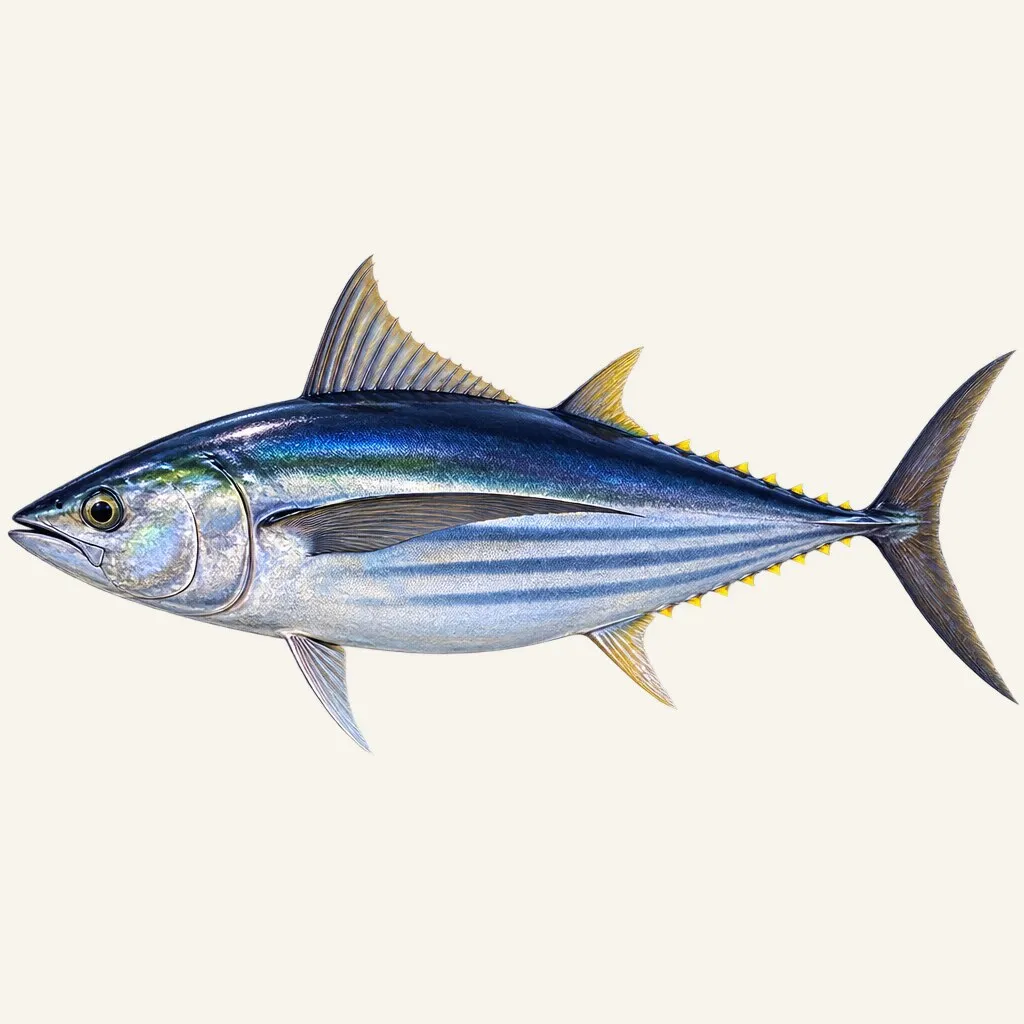
Albacore
Thunnus alalunga · Scombridae
- Saltwater
- Big pelagics
- Medium
- Regulated
- Size
100–140 cm
- Weight
18–60 kg
- Lifespan
9 years
- Water temp.
10–25 °C
- Depth
0–600 m
Where to fish
- Offshore
Habitat icons: Flaticon
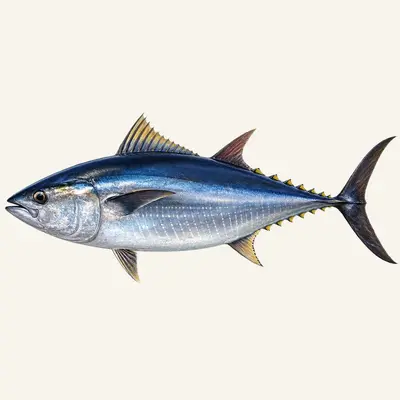
Albacore - a migratory tuna with very long pectoral fins, found in temperate waters of 13.5 to 25 degrees.
Calendar
Recorded in 43 countries
Anguilla · Antigua & Barbuda · Australia · Bahamas · Bermuda · Brazil · Canada · Chile · Christmas Island · Cocos (Keeling) Islands · Colombia · Croatia · Cuba · Dominican Republic · Faroe Islands · France · French Polynesia · Greenland · Haiti · Iceland · Indonesia · Ireland · Italy · Japan · Madagascar · Mauritius · Mayotte · Mexico · Netherlands · New Zealand · Norway · Portugal · Puerto Rico · Réunion · Seychelles · South Africa · Spain · Svalbard & Jan Mayen · Türkiye · U.S. Virgin Islands · United Kingdom · United States · Venezuela
GBIF occurrence records — native and introduced populations combined.
Its range
The species occupies tropical and temperate water in every ocean, the Mediterranean included, but is missing from the surface between 10°N and 10°S. That equatorial gap is the peculiarity of its chart, and it is not an absence.
The explanation is thermal. Albacore are abundant in surface water between 15.6 and 19.4 degrees. The equatorial belt sits above that all year round, so the fish is not excluded from it — it simply drops below the layer that suits. The hole is a surface hole, and it closes as soon as the view goes deeper.
In the western Pacific the range spreads into a broad band between 40°N and 40°S, which is a temperate distribution rather than a tropical one.
Identifying it
The pectoral fins are out of proportion to everything else on the animal. In any individual of 50 cm or more they reach at least 30 per cent of the fork length and frequently exceed it, folding back well beyond the origin of the second dorsal. No other adult tuna carries anything comparable, and the scientific name says precisely that and nothing further.
One trap remains, and only one. Young bigeye also have very long pectorals, but theirs finish in a rounded tip where these taper to a point. On a fish of middling size that is the detail which decides.
The first dorsal shows a strongly concave outline, because its front spines stand much higher than the rear ones. The interpelvic process is small and forked. The scales are very small.
Two internal characters are used on the quay: the underside of the liver is striated, and of its three lobes the central one is the largest.
For the genus, the dimensions are modest: the common length is a metre. The figure that explains more about the species than any measurement is the age, the oldest fish reported being nine years old.
Breeding
The record is thin, and one result in it deserves keeping. Among immature fish the sexes are taken in roughly equal numbers; among mature ones, males predominate. Two explanations sit on the table — mortality that differs between the sexes, or growth that diverges after maturity — and nothing so far separates them.
Maturity itself arrives at 90 cm, which comes late in the growth of the species. A tuna that must spend most of its growth before it can breed at all has a narrow margin, and a nine-year life leaves no room to make up a missed season later.
The water it needs
An oceanic fish of the open sea, epipelagic and mesopelagic, running down to 600 m. The thermal range is 10 to 25 degrees; the larger individuals, which swim deeper, hold between 13.5 and 25.2, and brief excursions into water of 9.5 degrees are tolerated.
The fact to keep is a single word: discontinuities. Albacore concentrate along thermal breaks, where two bodies of water meet. This is a fish of fronts and not of areas, and a chart of surface temperature does more for it than a chart of the bottom.
It forms mixed schools with skipjack, yellowfin and southern bluefin, and those gatherings attach themselves to floating objects, sargassum weed included.
Areas
- Temperate open ocean
- Oceanic thermal fronts
- Coastal upwelling zones
- Cold currents (Gulf Stream, Kuroshio)
Techniques
- Coloured feather trolling
- Live bait fishing
- Fast surface trolling
- Vertical jigging
Baits
- Natural squid
- Sardines
- Trolling feathers (red/white)
- Metal lures
What it eats
Fishes, crustaceans and squid make up the ordinary diet. What matters more than the list is the position in the water: a predator that follows a front eats whatever that front has concentrated, so the composition shifts with latitude and with season rather than with preference.
How to catch it
It is fished well offshore, in mild blue water, and the marker worth all the others is the interface between cooler water and warmer. The fish sits on it. A productive trip therefore begins with the temperature charts rather than with a mark.
The baits that take it are whole fish, alive or dead: mullet, saury, squid, herring, anchovy, sardine. School prey, which is what a front assembles.
The take is hard and is followed by powerful runs. For a tuna of such modest build the effort is disproportionate, and line capacity counts for more than raw drag — the fins that give the species its name also make it a swimmer that can keep going.
Regulated — Often governed by quotas, size limits, seasons, or reporting rules.
Conservation
Albacore carry an intense commercial fishery without the worldwide stock giving way, and the reason lies in the biological clock rather than in any restraint by the fleets. Nine years at the outside, and 90 cm to cover before breeding at all: the species turns its cohorts over quickly and replaces them before the fishing has worked through them. Where the bigeye is caught before it can breed, this one breeds before it is caught.
The skewed adult sex ratio is the blind spot in that reassurance. A fishery meeting mostly mature males reports poorly on the state of the female fraction, and stock assessment depends on exactly that fraction.
Regulations
Check the local regulations in force (legal size limits, closed seasons, bag limits).
For guidance only. Legal sizes, quotas and open seasons vary by location and season: always check the local regulations in force before fishing.
Other names
Albacore is the English name, and it is a false friend of the first order. In French the same word, albacore, means Thunnus albacares, the yellowfin; this fish is germon there, sold as thon blanc for the pale flesh. One word, two species, decided by the language it is read in, and the mistake has done real damage in translated labelling and in translated management texts.
The English trade has a convention of its own on top of that. White, on a North American can, means this species and no other; light covers skipjack and yellowfin. Longfin tuna is the unambiguous alternative when precision is wanted, and it translates the Italian alalunga, long wing, which passed unaltered into the scientific name. Spanish says bonito del norte, German Weißer Thun.
Sources: fishbase.se · api.gbif.org