Arctic char
Salvelinus alpinus · Salmonidae
- Freshwater
- Salmonids
- Hard
- Size
40–107 cm
- Weight
0.5–15 kg
- Lifespan
40 years
- Water temp.
4–16 °C
- Depth
0–70 m
Where to fish
- Estuary
- Lake
- River
Habitat icons: Flaticon
Closely related to the lake char - Lake-dwelling forms are glacial relicts
Calendar
Recorded in 14 countries
Austria · Canada · Denmark · Finland · France · Greenland · Iceland · Italy · Norway · Russia · Svalbard & Jan Mayen · Sweden · United Kingdom · United States
GBIF occurrence records — native and introduced populations combined.
Its range
No freshwater fish lives further north. This one is recorded to 82°N, past the tree line and past most water that stays open in winter, in a circumpolar belt taking in Iceland, Scandinavia, northern Russia, Jan Mayen, Spitsbergen, Kolguyev, Bear Island, Novaya Zemlya, northern Siberia, Alaska, Canada and Greenland.
Cold is not what bounds that belt. Warmth is. The species runs out at about 16 °C, so its southern edge is an isotherm rather than a coastline: down the American Atlantic slope the continuous range stops in Maine, and below that the fish exists only in pockets.
Those pockets are the other half of the map. Landlocked populations survive in Quebec, Maine and New Hampshire, a long way from the arctic block. They are relicts. The fish followed the retreating ice sheet, then found itself shut into deep lakes as the warmth came up behind it, and every one of those populations has been on its own since.
Two absences look wrong until they are explained. Rivers draining to the Baltic and the White Sea hold none, though they are ringed by basins that do. And the Alps hold none either — the char of the alpine lakes is a separate species, or a separate form, depending on the author consulted.
Identifying it
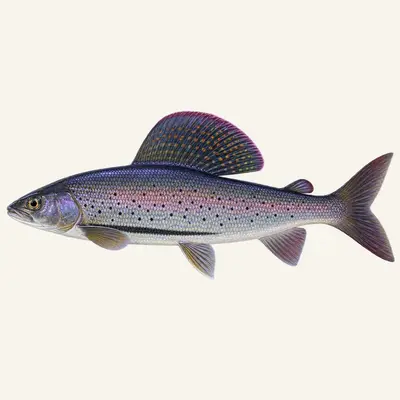
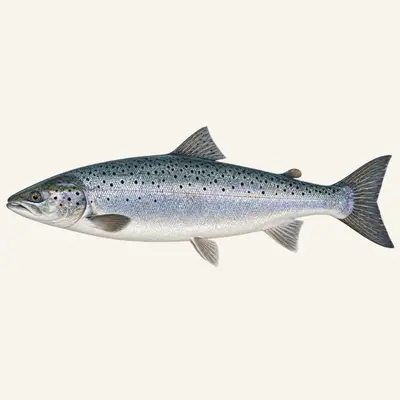
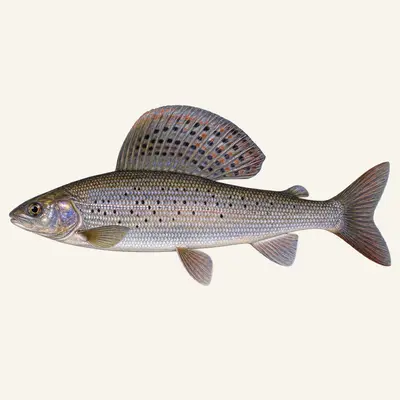
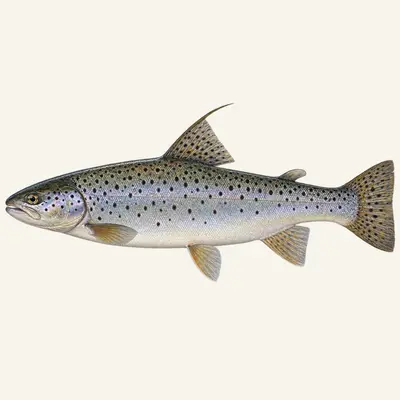
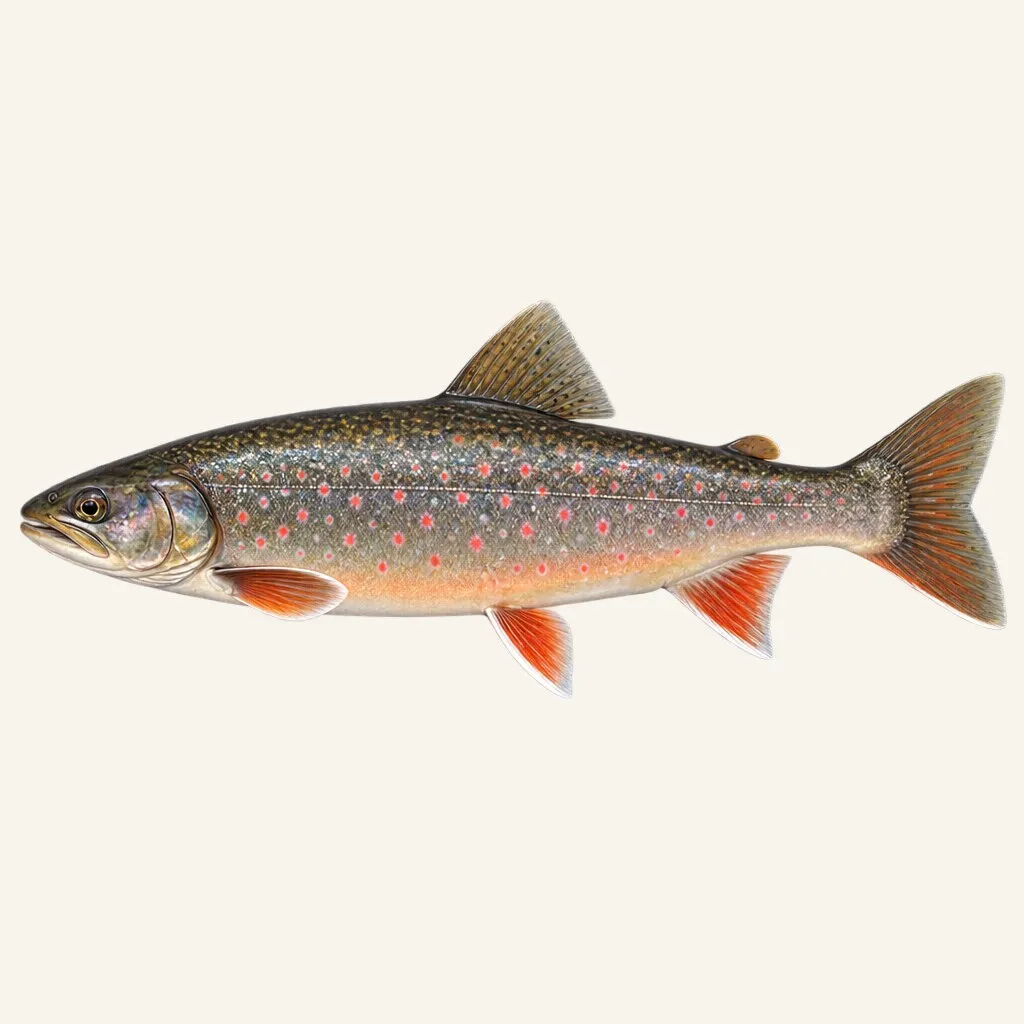
Measure a spot against the eye. The pink to red spots scattered over the back and flanks vary in number and intensity from one water to the next, but the largest of them, the ones ranged along the lateral line, are wider than the pupil. That comparison holds where nothing else does.
Nothing else does, because ground colour here is unreliable to the point of uselessness. It answers to the lake, the season and how far the fish has come towards spawning: usually brown, sometimes cast with green over the back, lighter down the sides, pale beneath. A male close to spawning is unrecognisable beside a summer fish out of the same water — the whole underside and the paired and anal fins turn vivid orange or full red.
Two things do not move. A narrow white margin runs along the leading edge of the pectoral, pelvic and anal fins, and sometimes the caudal. And juveniles carry about eleven dark parr marks a side, which fade with age, while the dorsal and caudal darken to replace them.
When colour settles nothing, counting does. Gill rakers 23 to 32, vertebrae 62 to 68, pyloric caeca 37 to 75. That last figure varies by a factor of two inside one species, which is as compact a summary of this fish as any sentence about it. The tail is emarginate on 19 rays, the lateral line dips gently just behind the head, and there is an axillary process at the base of each pelvic fin.
Breeding
The female makes the approach. Males hold separate territories until females begin to show spawning behaviour, at which point the territory stops mattering to them. A female then enters a male's ground, picks the place she wants and starts to dig.
He courts her while she works — circling, then sliding along her flank and quivering. When the pit is finished both fish release together, and go on releasing as they swim forward out of it. That can happen five times over before she covers anything. She then digs at the rim of the pit, which buries what is already there and opens the next one, and the sequence runs on for several days until she is empty.
Neither sex is faithful to the other. A male takes a second female once the first has no eggs left; a female works through two or more males in succession. Spawning has no hour attached to it and occurs at any point in the day.
The substrate depends on the life the population leads. Lake fish spawn over pebble and stone. River stocks use slow water, between 0.2 and 0.8 metres per second, with the exception of certain Norwegian anadromous stocks that spawn every year in the open current of a riffle. The species is iteroparous: a fish that has spawned will spawn again.
The water it needs
At sea this is not an oceanic animal. It stays neritic, along the coast and in estuaries, and it stays high in the water: the recorded range runs from the surface to 70 m, but the usual depth is the top metre. Sea-run fish are edge fish.
In fresh water it takes clear cold lakes and the deep runs and pools of medium to large rivers. Resident populations complete the whole cycle there. Anadromous ones come back only to overwinter and to breed, running in autumn and winter.
Its sensitivity to anything that alters the water is extreme, and it works through two linked variables, temperature and dissolved oxygen. A lake that warms, or whose bottom water goes short of oxygen at the end of the season, loses this species before it loses anything else.
Areas
- Deep northern lakes
- Arctic rivers
- Under-ice zones
- Cold stream mouths
Techniques
- Spoon
- Jig
- Trolling
Baits
- Lures
- Flies
- Worms
What it eats
In fresh water: planktonic crustaceans, amphipods, molluscs, insects and fish. That breadth is what allows a population to hold in arctic lakes so poor that some years there is nothing on offer but zooplankton.
Anadromous fish run on a different budget. They feed little once back in fresh water and not at all while migrating, so the whole of their growth is done at sea, inside the short season between break-up and freeze-up.
How to catch it
Whether a population can reach salt water decides what kind of fishing it offers, and the two cases have almost nothing in common. A lake stock feeds through the year and can be taken through the year. An anadromous stock shuts down as it enters the river, which puts the useful window ahead of the run — on the coast and in the estuary, while the fish are still eating.
Depth is the second thing worth acting on, and it runs against the instinct that cold water means deep water. Arctic char patrol the surface layer. Fishing the bottom of a deep lake means fishing underneath them.
The third point is arithmetic. The species reaches 40 years, and the length at first maturity on record, 60 cm, sits well above the length commonly met, 40 cm. The gap says that the maturity figure came from one particular population and does not travel. More usefully, it says a big one is a fish with decades behind it in water where growth is slow. What comes out of an arctic lake in one summer is not replaced by the next.
A last point belongs to the kitchen rather than the water. The species commonly carries tapeworm, which is ordinary enough in a salmonid at these latitudes but worth knowing before anything is eaten raw.
Conservation
The unit that matters is not the species, it is the lake. Each landlocked population descends from one glacial episode and has taken nothing in from outside since, so what dies there is not replaced from anywhere: no neighbours exist to recolonise from. The southernmost relicts, in Quebec and New England, are the exposed ones, because they already sit against the 16 °C ceiling.
Aquaculture raises a question that angling does not. A selected farm strain and a lineage isolated for ten thousand years do not share a history, and one stocking mixes them inside a single generation. The point applies as much to escapes from a rearing unit as to deliberate introductions for sport.
Then there is the physics of the water. Spawning happens on the bottom, over stone, and few freshwater fish are as demanding of dissolved oxygen. A lake whose deep layer runs down keeps its adults for a while and produces nothing, so the decline shows in the catches years after the cause appeared.
Regulations
Check the local regulations in force (legal size limits, closed seasons, bag limits).
For guidance only. Legal sizes, quotas and open seasons vary by location and season: always check the local regulations in force before fishing.
Other names
Arctic char in North America, Arctic charr with two r's through much of British writing, the doubled spelling being the older one. Char covers the whole genus in English, and that is a useful word: it holds Salvelinus apart from the trouts in a way the German and Italian names do not.
The species name is the trap. Alpinus says Alpine, and this fish is absent from the Alps — the char of the alpine lakes is Salvelinus umbla. German Seesaibling and Italian salmerino alpino are applied to both, so a Swiss or Italian management document and an Icelandic one may use matching words for different animals.
Sources: fishbase.se · api.gbif.org