European flounder
Platichthys flesus · Pleuronectidae
- Saltwater
- Flatfish
- Medium
- Size
50–60 cm
- Weight
1.2–2.9 kg
- Lifespan
15 years
- Water temp.
5–25 °C
- Depth
1–100 m
Where to fish
- Estuary
- Beach
Habitat icons: Flaticon
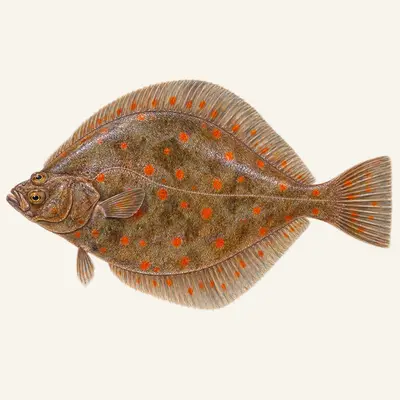
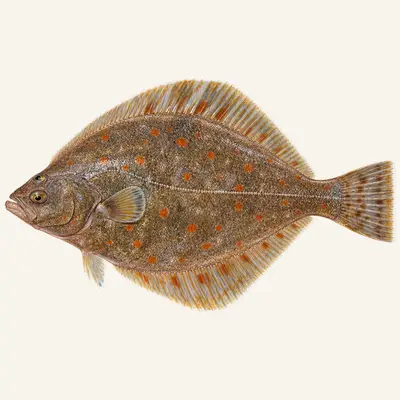
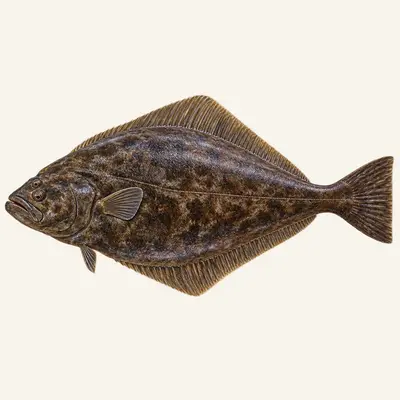
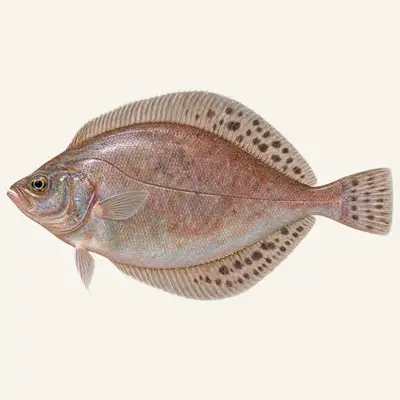
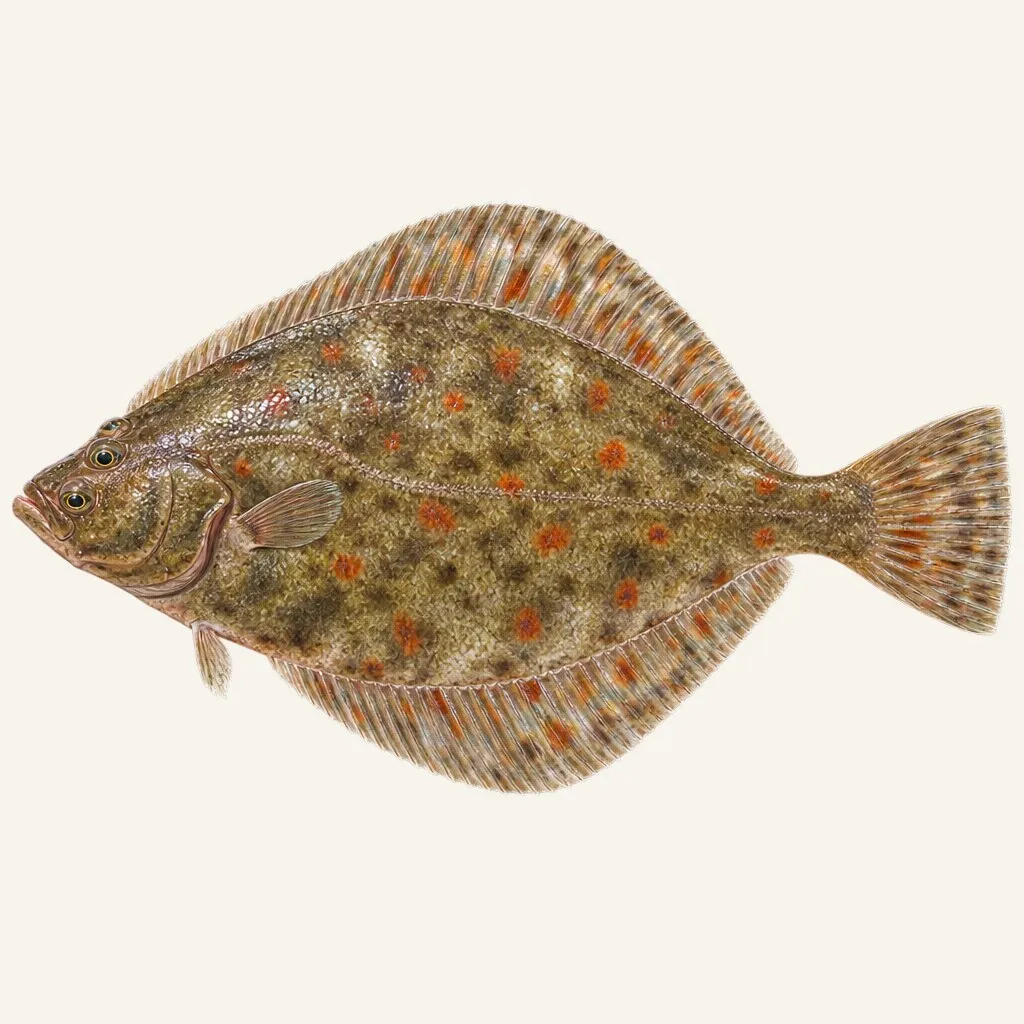
The European flounder is a nearly circular flatfish covered with small rough tubercles along its lateral line. Highly adaptable, it tolerates both saltwater and freshwater, frequently ascending estuaries and coastal rivers across Europe.
Calendar
Recorded in 23 countries
Belgium · Canada · Croatia · Denmark · Estonia · Finland · France · Germany · Ireland · Isle of Man · Italy · Latvia · Lithuania · Netherlands · Norway · Poland · Portugal · Russia · Spain · Sweden · Türkiye · Ukraine · United Kingdom
GBIF occurrence records — native and introduced populations combined.
Its range
Coastal and brackish water of the eastern Atlantic, from the White Sea to the Mediterranean and the Black Sea, with a record from Iran.
The fish also reached North America, and not by swimming. It was introduced accidentally to the United States and Canada in ballast water — a pathway that involves no fishery, no release and no angler, and on which no fishing rule has any purchase whatever.
Identifying it
Rough skin is the finger test, and it is roughest in three places: along the lateral line and at the bases of the dorsal and anal fins, where small hard tubercles sit in rows. Everything else is unremarkable to the hand — a small mouth, a lateral line that straightens after a shallow arc over the pectoral, olive green above, white below, irregular reddish spots on the eyed side. Reach for the tubercles first.
Which side the eyes are on is the character to reach for last, and this fish is the reason the whole family's sidedness has to be explained once.
A flatfish does not begin flat. The larva hatches bilaterally symmetrical, an eye on each side of the head, and swims upright in open water like any other fish larva. At metamorphosis one eye travels across the top of the skull to join the other. The skull deforms to let it pass, the animal tips over onto the flank the eyes have abandoned, and that flank — from then on permanently against the bottom — stays white while the upper surface takes all the pigment. Everything that follows from lying down is downstream of that single crossing: the burial, the ambush, the wide body, the mouth twisted out of line. Where the timing has been measured, in the turbot, the crossing completes on the fortieth to fiftieth day at a length of 25 mm.
Which eye makes the journey is normally settled at the level of the family. The plaices, dabs and soles carry theirs on the right — the 2018 revision of the group calls them the righteye flounders — and the turbot and its relatives on the left.
The flounder is where the rule loosens, and the figures are published. The eyes are on the right in about 70% of individuals; a sample of 1,076 fish returned 79% right-eyed. Somewhere between one fish in four and one in five is reversed. That is not an anomaly worth noting in a logbook, it is a normal outcome of the crossing, and any determination resting on sidedness alone will fail on that share of the catch.
Counts: 53 to 62 soft rays in the dorsal, 37 to 46 in the anal, no spines.
Breeding
Spawning happens in the water column rather than on the bottom, which is worth stopping on in an animal that spends its life lying down. Each female produces 400,000 to 2,000,000 eggs.
The year runs as a loop with deep water at one end and the head of an estuary at the other. Adults withdraw in winter to deeper, warmer water and spawn there in spring. The growing larvae then move towards the coast.
What they do on arrival is the best-documented mechanism in this species' file. Larvae and early juveniles ascend rivers by selective tidal transport: they rise into the flood and drop back to the bottom on the ebb, so every tide carries them a stage further up while they never once swim against the current. The triggers listed are salinity, prey density and water temperature. It is migration by choosing when to let go, and it costs the animal almost nothing.
First maturity averages 22.4 cm, over a range of 14 to 30.
The water it needs
This is the flatfish that goes furthest into fresh water, and the file says so in an oblique way worth pointing out: FishBase publishes a pH range for it, 7.5 to 8.2. A pH is a freshwater parameter. It is not given for the plaice, the dab or the turbot, and its presence in this entry is the clearest single sign of where the animal actually spends its time.
The species is classed as catadromous. Most of the year it is in estuaries. Adults hold mud and sand in shallow water, at sea and in brackish, and often enter fresh water outright. The thermal range is wide, five to 25 degrees, and the salinity range wider still. Depth runs from 1 to 100 m, which for a marine flatfish is a short column.
Juveniles occupy shallow coastal water and estuaries, and those same estuaries are the adults' summer feeding grounds. Two age classes on one ground for one season.
Areas
- Estuaries and river mouths
- Coastal muddy bottoms
- Tidal channels
- Sandy beaches
Techniques
- Estuarine bottom fishing
- Surf casting
- Running ledger
- Shore fishing
Baits
- Lugworm
- Ragworm
- Shrimp
- Cockle
What it eats
The diet splits by age and the first half of it gives the game away. Fish under a year old take plankton and insect larvae. Insect larvae are not a marine item — they are what a fish eats in a river — and the diet confirms in one word what the pH range only implies.
From the second year the menu turns benthic: bottom fauna, including small fishes and invertebrates, taken off and out of the sediment. Feeding is nocturnal, and the animal burrows.
How to catch it
The source is unusually direct about tackle for once, and names it: worms and molluscs are excellent baits for line fishing. Small ones, on account of the small mouth, laid flat on the bottom.
The ground is the estuary, and it stays the estuary for most of the year. That is the working separation from the plaice — this fish is taken where the water is already diluted and sometimes fully fresh, a long way above anything that looks like a sea mark. It is one of the few marine species a freshwater angler meets as a matter of course.
Season is a question of where rather than whether. Winter takes the adults down and out to spawn; spring brings the larvae back inshore on the tide, and the adults follow into the estuaries to feed through the summer.
Night is the window, since the fish is nocturnal and spends the day under the sediment.
Common length is 50 cm against a first maturity near 22, so most of what an estuary gives up has already bred.
Conservation
Selective tidal transport is where this species is exposed, and it is exposed in a way no habitat map shows. A juvenile climbing an estuary on the flood needs the flood to arrive. A tidal barrage, a sluice, a lock, a channel straightened and deepened — each of those removes the transport itself, not merely the habitat at the far end of it. The fish can have kilometres of suitable river above it and no way of reaching them.
Living in estuaries also means living on what estuaries collect. This animal lies in that sediment and takes its food out of it, so whatever settles out of a catchment arrives by both routes at once.
The North American populations belong in this section rather than in the fishing one. An accidental transfer in ballast water put a European flatfish on two further coasts. Whatever comes of that, no fishing measure caused it and none will undo it.
Regulations
Check the local regulations in force (legal size limits, closed seasons, bag limits).
For guidance only. Legal sizes, quotas and open seasons vary by location and season: always check the local regulations in force before fishing.
Other names
European flounder in English, and the bare word flounder is the difficulty. In North America it names a series of unrelated flatfishes — winter flounder, summer flounder, southern flounder — none of them in this genus and none of them this animal. In any text that crosses the Atlantic the binomial is not pedantry, it is the only way to be understood.
German Flunder and Dutch bot keep the old Germanic flatfish words, and bot is the same butt that survives inside halibut. Portuguese solha-das-pedras, the flounder of the stones, names the ground instead of the fish.
Platichthys is simply flat fish, from platys and ichthys — a name that describes the entire order and settles nothing.
Sources: fishbase.se · api.gbif.org