Brill
Scophthalmus rhombus · Scophthalmidae
- Saltwater
- Flatfish
- Medium
- Size
30–75 cm
- Weight
0.3–8.0 kg
- Lifespan
6 years
- Depth
5–50 m
Where to fish
- Estuary
- Beach
Habitat icons: Flaticon
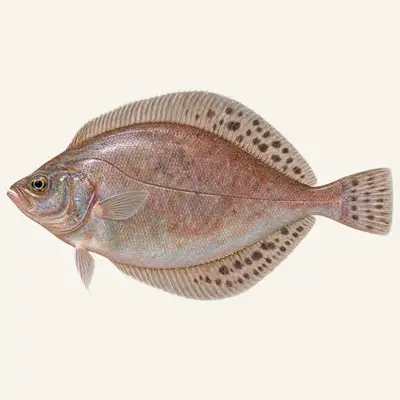
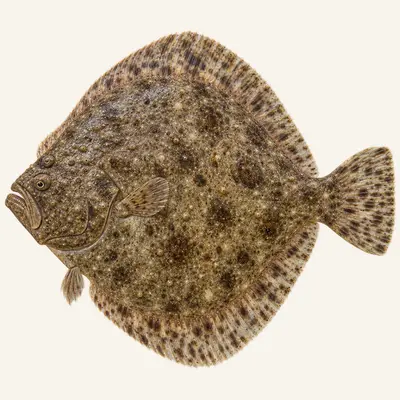
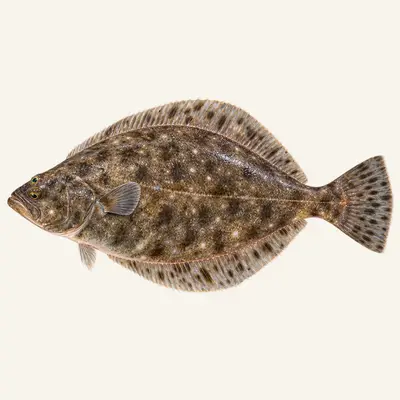
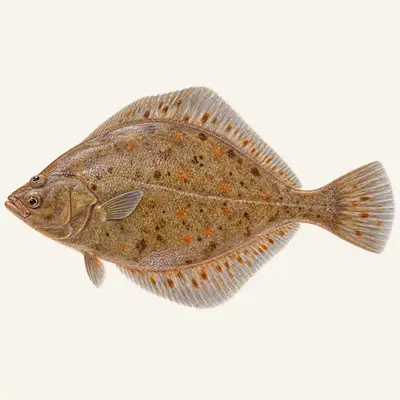
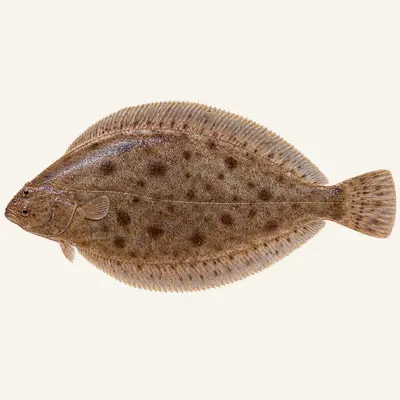
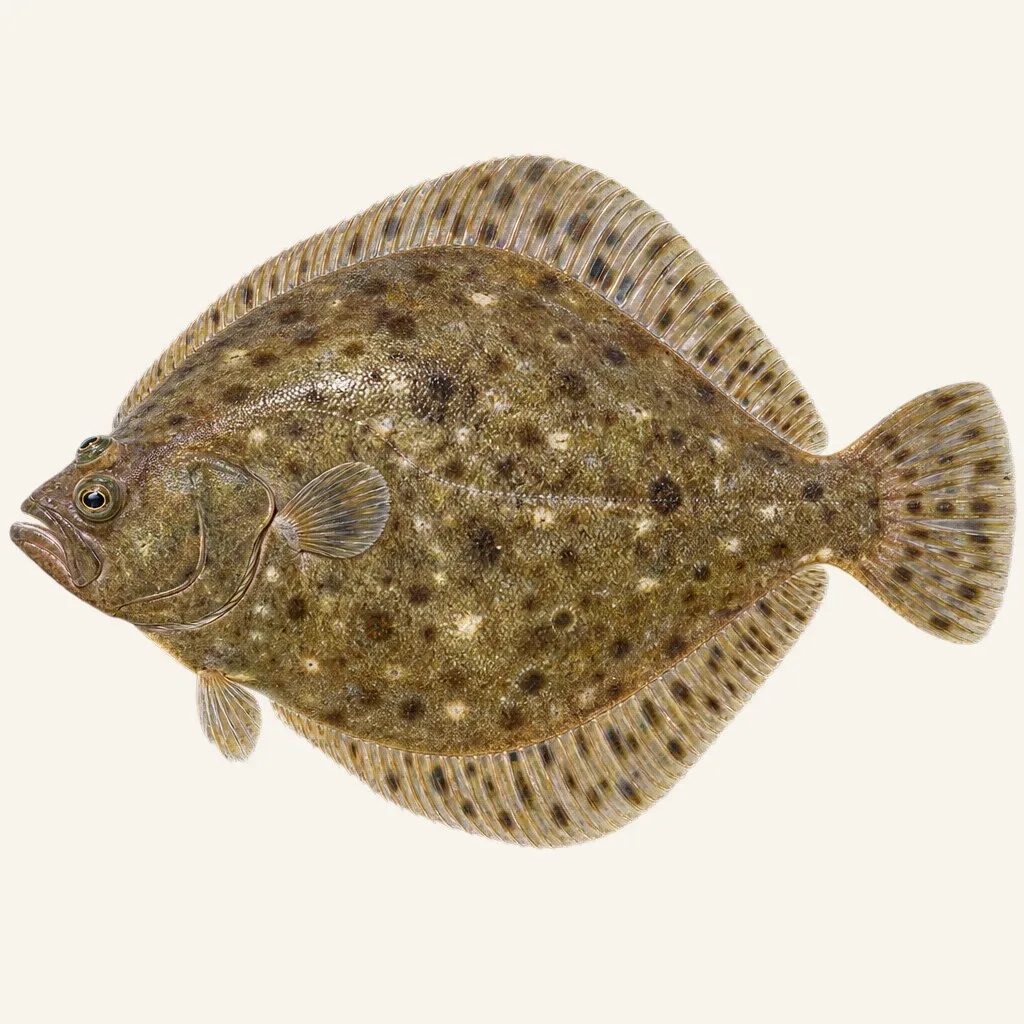
The brill is a flatfish in the Scophthalmidae family with a diamond-shaped body and scaleless skin mottled with brown spots on its eyed side. Smaller than the turbot, it lurks on sandy and muddy bottoms along European coasts to ambush prey.
Calendar
Its range
From 68°N south to Morocco, with reports from Iceland at the margin, plus the whole Mediterranean and the Black Sea.
The span is what stands out. Norway to the Black Sea is a thermal range the cold-water flatfishes do not attempt, and it puts this species in water that has nothing in common from one end of the range to the other. Depth then explains the shape of the map: five to 50 m is a coastal fringe, so the range follows the coastline as a line rather than filling the shelf as an area.
Identifying it
The published diagnosis of this fish is written against the turbot, term for term, and it is worth taking in its own words: a thinner and more slender body, skin with small smooth scales, and no bony tubercle. Where the neighbour is a studded disc, this one is a narrower shape with nothing on it for a hand to catch. Both statements sit in the sources; neither is a deduction from the other.
Field guides across Europe add a mark the diagnosis passes over, and it is the one most people actually use on a boat. The anterior rays of the dorsal fin are branched and partly free of their membrane, so the leading edge of the body appears fringed, as though bordered by a row of short filaments. It shows on a fish lying on the deck without anyone turning it over. The reference consulted here does not record it; the European field literature records it consistently.
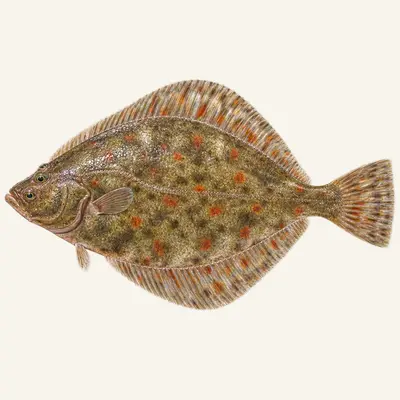
Colour is the character not to use. The species alters the tone of its eyed side to match whatever it is resting on. Olive green with light and dark blotches is frequent and is not diagnostic — a fish lifted off gravel does not wear what yesterday's fish wore off sand.
Breeding
Six years is the maximum reported age. For an animal that comfortably passes half a metre, that single figure organises the whole page: growth has to be very fast, and a population turns itself over in a handful of seasons.
First spawning comes at about 37 cm, in a range of 33 to 41. Common length is 30 cm, which falls below the bottom of that range.
Two things follow. Every year class counts, because there is no reserve of old fish to cover a failed one. And the average fish landed has not yet spawned, which gives the decision to put small ones back a measurable effect on the same stretch of coast within a season or two.
The water it needs
Sand and mixed ground, five to 50 m. The species does not go deep, and that is what keeps it inside the reach of a small boat and, at the top of the band, of the shore.
Active camouflage makes the substrate its own cover. Other bottom ambushers need structure — a rock, a wreck, a weed bed — to break an outline. This one takes the colour of whatever it lies on and sets up in the open without being seen.
Sheltered bays and the approaches to estuaries belong in the search, provided the sand there stays clean or barely silted.
Areas
- Shallow coastal sandy bottoms
- Sheltered bays
- Estuarine zones
- Surf-casting beaches
Techniques
- Boat soft lure drift
- Boat live bait fishing
- Surf casting
- Slow bottom trolling
Baits
- Small live fish
- Sand eel
- Ragworm
- Fish imitation soft lure
What it eats
Bottom-living fishes and larger crustaceans. The word doing the work in that list is larger. These are big, whole, mobile prey, and nothing in the entry points to sediment fauna at all.
Prey of that size is not dug out of anything. It walks or swims past, and a fish lying still in the colour of the ground only has to let it come inside range.
How to catch it
Everything turns on making the bait pass. A buried ambusher does not tour the bottom looking for what is on offer, so a slow drift and a methodical sweep of a sand flat beat a long wait on a fixed spot.
The diet sets the offering: a small live fish, a sand-eel, a strip of fish, a soft lure with a fish profile — all worked slowly and held down on the sediment. Digging baits have no place here.
Shallow water opens beach and bay fishing from the shore, which is unusual for a flatfish of this size.
And since the fish of average length falls under the size of first spawning, the question of what to keep arises at every capture rather than at the end of the session.
Conservation
A stock that lives six years has no memory. There is no old cohort held back to make up a poor recruitment, so two bad springs show immediately in what comes over the side — and a recovery shows just as quickly.
Add that the commonly encountered length falls short of the first-maturity range, and both the commercial and the recreational fishery are working largely on animals that have never bred. That moves the whole weight of the matter to the moment of capture, which is the last point at which selection is still possible.
Regulations
Check the local regulations in force (legal size limits, closed seasons, bag limits).
For guidance only. Legal sizes, quotas and open seasons vary by location and season: always check the local regulations in force before fishing.
Other names
Brill in English, a name of obscure origin that describes nothing about the fish.
The German and Italian names of this species and the turbot form two matched pairs, and both pairs chose the skin over the shape. Glattbutt, the smooth butt, against Steinbutt, the stone butt; rombo liscio, the smooth rhombus, against rombo chiodato, the nailed one. The character that separates the two species in the diagnosis is the character that separated them in the kitchen, twice over and in two languages independently.
French barbue suggests a barbel the animal does not have. The genuine hazard, though, is Iberian: Portuguese calls this fish rodovalho while Spanish calls the turbot rodaballo. Two near-identical words, on two different species, on adjoining coasts.
Sources: fishbase.se · api.gbif.org