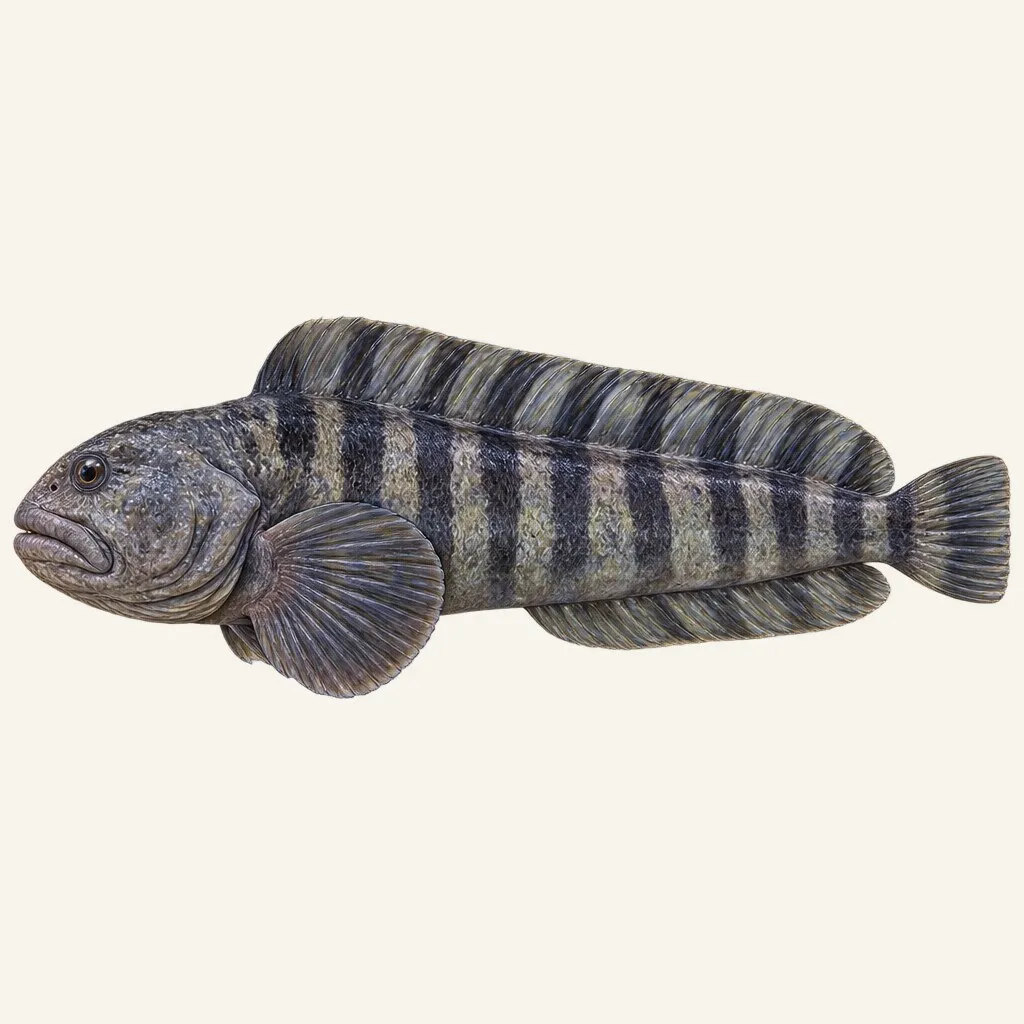
Atlantic wolffish
Anarhichas lupus · Anarhichadidae
- Saltwater
- Bottom fish
- Medium
- Size
60–150 cm
- Weight
2.0–24 kg
- Depth
1–600 m
Where to fish
- Reef
- Rocky shore
Habitat icons: Flaticon
Northern demersal fish with an elongated body and powerful jaws bearing prominent canines used to crush crustaceans and shellfish.
Calendar
Recorded in 10 countries
Canada · Greenland · Iceland · Norway · Russia · St. Pierre & Miquelon · Svalbard & Jan Mayen · Sweden · United Kingdom · United States
GBIF occurrence records — native and introduced populations combined.
Its range
In the north-east Atlantic the range runs from Spitsbergen south to the White Sea, along the Scandinavian coasts, through the North Sea and the British Isles to the northern part of the Bay of Biscay, with Iceland and south-eastern Greenland included. In the north-west it goes from southern Labrador and western Greenland to Cape Cod, rarely as far as New Jersey.
The margins carry a caveat that is easy to lose. The source treats reports from the Baltic and the Mediterranean as questionable — strays at most, pending a check of the original records. The southern edge of any map of this species is therefore softer than the map makes it look.
Identifying it
Ten to 15 dark transverse bars cross the body and run up into the dorsal fin. On a long, almost eel-shaped animal that is the pattern to count, and the German name in this catalogue — Gestreifter Seewolf, the striped sea-wolf — records it as the species character.
Ground colour is usually greyish-green, but it runs to almost black at one end and to reddish brown at the other, so it is the bars that hold across individuals and sectors, not the shade underneath them.
The jaws need care in how they are stated. The published diagnosis for this species keeps to colour, bars and body shape, and does not describe the dentition at all; the catalogue description rendered on this page does, giving powerful jaws with prominent canines used to crush crustaceans and shellfish. The diet settles which of the two is more useful to a reader: a menu of hard-shelled molluscs, crabs, lobsters and sea urchins has to be opened rather than caught, and no fish holds that diet with an ordinary mouth.
Breeding
The male guards the clutch right up to hatching, and through that whole period he hardly feeds.
A prolonged fast in the service of eggs is an expensive strategy and a rare one, and it produces a specific vulnerability. A guarding male is stationary, findable and attached to one spot for weeks. Taking him does not remove one fish, it removes a clutch as well, and disturbing him costs an investment he has no way to recover — he has already spent the feeding season on it.
Length at first maturity is 55 cm, in a range of 50 to 60.
The water it needs
Rocky bottoms, sometimes over sand or mud, from 1 to 500 m, with the usual band given as 18 to 110.
One metre to 500 is an extraordinary span, and it is worth reading literally. The same species can be met in a pool at low tide on a Norwegian shore and in a deep tow off Newfoundland. What it is looking for is rock; the depth at which rock occurs is not its concern, which is why no single depth describes it and why the usual band sits so much shallower than the maximum.
It is benthic and solitary. There is no shoal at any stage of the adult life.
Areas
- Norwegian Sea and Scandinavia
- Iceland
- North Sea
- Northeastern North American coasts
- Rocky reefs and drop-offs
Techniques
- Bottom legering
- Bait fishing from shore or boat
- Slow drift fishing
- Weighted paternoster rig
Baits
- Crabs and crustacean pieces
- Shellfish (mussels, whelks)
- Hermit crabs
- Fish strips
- Sea urchins
What it eats
Fishes, hard-shelled molluscs, crabs, lobsters, sea urchins and other echinoderms.
Everything after the first word on that list is armoured. Thick shells and urchins are abundant almost everywhere on cold rock and largely uncontested, precisely because so few fish can get into them — this species feeds on the part of the reef its neighbours have to walk past. It buys that with a head built for pressure rather than for speed, which is also why nothing about it suggests a pursuit predator.
How to catch it
Structure is the whole search. A solitary fish means prospecting rock rather than waiting for a school to arrive, and a productive mark holds an occupant rather than a population.
The baits are the diet: crab and pieces of crustacean, mussels and whelks, hermit crabs, sea urchins, strips of fish. A fish-first approach underperforms here, which is unusual on ground where everything else caught wants a fish.
Unhooking deserves a tool rather than a hand. Whatever a diagnosis does or does not record about the teeth, an animal that makes its living opening sea urchins is not one to reach into, and the sensible order is pliers first, photograph second.
Conservation
The guarding male is the exposure. He is immobile, locatable, fasting and holding the clutch, which makes the reproductive season the period when removals cost the most and are easiest to achieve.
Dependence on rock adds a second. Bottom gear worked over hard ground takes the habitat and the animal in the same pass, and this species has no alternative substrate to fall back on — sand and mud appear in its description as places it is sometimes found, not as places it lives.
Solitude closes the argument. There is no shoal in reserve: individuals are replaced one at a time, from neighbouring rock, at whatever rate a fish maturing at 55 cm manages. A reef emptied of wolffish does not refill the way a reef emptied of a schooling fish does.
Regulations
Considered vulnerable in several regions, notably off North America; follow local regulations and quotas.
For guidance only. Legal sizes, quotas and open seasons vary by location and season: always check the local regulations in force before fishing.
Other names
Atlantic wolffish in English, and five of the six names this catalogue carries reach for the same image: a wolf in French, German and Portuguese, a dog in Spanish. Only German adds anything, and what it adds is the stripes.
What none of them mentions is what the mouth is actually for. The naming settled on the impression the jaws make and missed the diet they exist to open, which is shellfish. The epithet lupus repeats the wolf a seventh time, so the scientific name is no better informed than the vernaculars.
Sources: fishbase.se · api.gbif.org