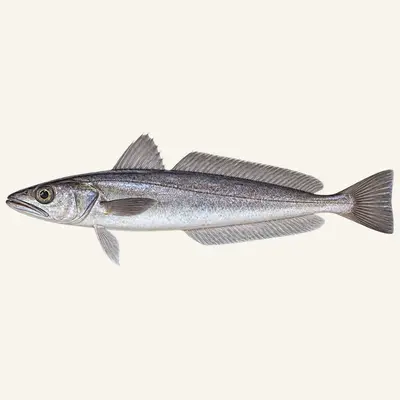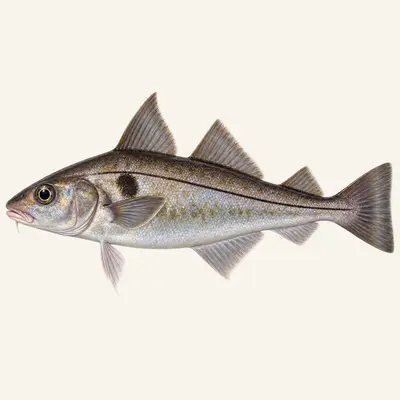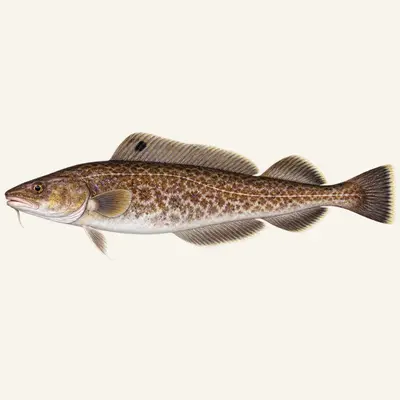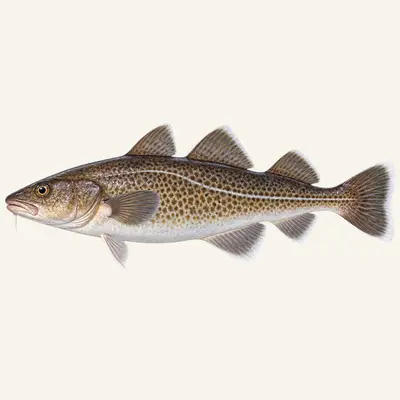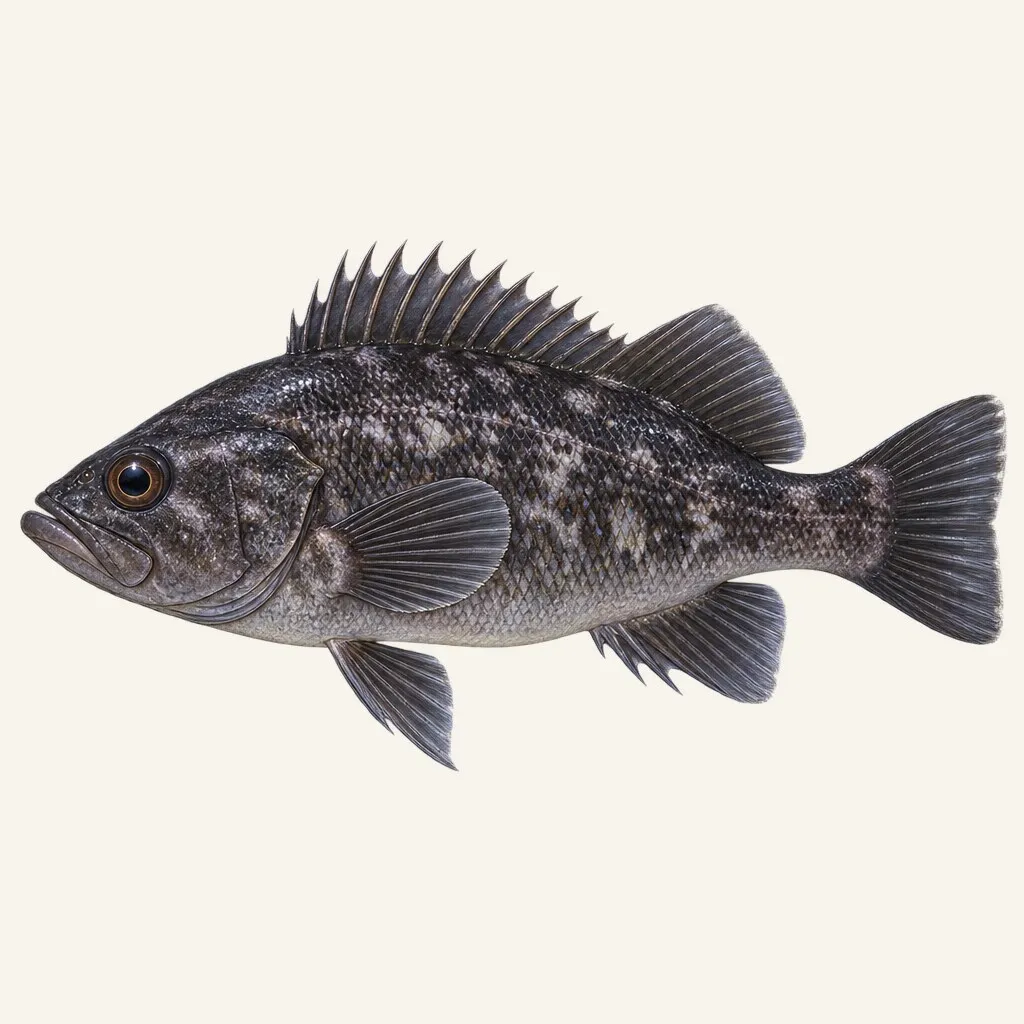
Black rockfish
Sebastes melanops · Sebastidae
- Saltwater
- Bottom fish
- Easy
- Size
35–63 cm
- Weight
0.6–3.6 kg
- Lifespan
50 years
- Water temp.
7–9 °C
- Depth
0–366 m
Where to fish
- Reef
- Rocky shore
Habitat icons: Flaticon
Hardy northeast Pacific rockfish, dark gray-black with mottling, prized for its firm flesh and schooling habits around rocky structure.
Calendar
Recorded in 2 countries
GBIF occurrence records — native and introduced populations combined.
Its range
From Amchitka Island in the Aleutians, along the Alaskan coast and down to Paradise Cove in Baja California: from the 62nd parallel to the 22nd.
The recorded thermal range is narrow — 7 to 9 degrees — and it accounts for the shape of that band better than any coastline does. Cold water reaches a long way south along this shore, carried by the current and renewed by coastal upwelling, and the species travels inside it. The southern end of the range is a temperature boundary that happens to have a beach next to it.
Identifying it
Determination in this genus normally runs through the head, along a series of spines that are named one by one. Here the list is mostly a list of absences. The nasal spines are present. The preocular and postocular spines are usually absent. The supraocular, tympanic, coronal, parietal and nuchal spines are absent altogether, and the knob at the chin is very weak or missing. What is left is a head that gives the hand almost nothing to find.
Identification therefore has to move to the counts, and they are precise enough to carry it: 13 or 14 dorsal spines followed by 13 to 16 soft rays, three anal spines and seven to nine rays, seven branchiostegal rays, 26 vertebrae.
The rest is silhouette and colour. Body fusiform, eye moderately large, the rear margin of the caudal indented, the profile of the anal fin rounded or slanting back. Dark grey to black above with light grey mottling, paler below.
Breeding
The fish gives birth. Fertilisation is internal, the embryos develop inside the female, and what she releases is planktonic larvae rather than eggs left in the current.
That changes what a female represents. An egg-scatterer is finished with the season's effort within the hour and is an ordinary fish again by the afternoon; here the entire reproductive output is carried inside one animal for the whole of its development, and that animal is catchable throughout. The source does not date the period, which is exactly the figure needed to reason about a season — and its absence is worth stating rather than filling.
Maturity settles near 40.3 cm, within a range of 30 to 42.
The water it needs
Two domains, and they have little in common. The first is shallow rocky reef, kelp and wreck — ground fished from the shore, from a kayak, from a small boat. The second is open water over deep banks, where there is no substrate at all.
Adults live both on and off the bottom, and they form schools. Juveniles are pelagic. A fish described as reef-associated that spends part of its time suspended in mid-water is not searched for the way a bottom fish is, and treating it as one is the commonest mistake made with it.
Recorded depth runs from the surface to 366 m, with the usual band given as 183 to 274. The distance between that band and the shallow reefs where the species is routinely caught is the most consequential number on the page, and it comes back below.
Areas
- California coast
- Oregon and Washington
- British Columbia
- Alaskan coast
- Coastal reefs and rocky pinnacles
Techniques
- Metal jigging
- Soft-plastic fishing (drop shot)
- Vertical jigging on the drift
- Bottom bait fishing
- Light kayak fishing
Baits
- Soft-plastic swimbaits
- Metal jigs
- Squid strips
- Herring chunks
- Shrimp
What it eats
It feeds on fishes. No other prey category is attributed to it — no crustacean, no cephalopod.
Two things follow. Lure choice is close to settled, since anything that reads as forage is in the right register. And the schooling life over deep banks makes sense: a fish-eater follows prey that moves, whereas an invertebrate feeder stays with its substrate because its food does.
Its own young sit on the other side of that ledger. They are an important prey species for other fishes, for marine mammals and for seabirds.
How to catch it
The school runs the day. One fish located means a group located, and the group can be holding anywhere between the bottom and the surface, so the search is vertical: change depth rather than mark until the occupied layer answers.
The depth of the capture then decides everything that follows. A rockfish brought up from the deeper part of its band arrives with its swim bladder expanded by the drop in pressure, and released at the surface it cannot get back down — it floats. A descending device carries it to depth, where pressure undoes what the ascent did. On a shallow reef the problem barely arises. It is the depth the fish came from, not the species on the hook, that dictates the handling.
The flesh is well regarded and this coast manages its rockfish closely. What applies varies by state, province and season, and it is checked with the competent authority before leaving the dock rather than worked out afterwards.
Conservation
Fifty years is the maximum reported age, and with maturity around 40 cm that means a black rockfish spends the great majority of its life as a breeding animal.
A school is therefore not a stock of interchangeable fish. It is an accumulation of year classes, and the oldest of them began before most of the boats now over them were built. A population can get its numbers back long before it gets its old fish back, and those are two different recoveries measured on two different clocks.
Release survival is the other point, and it is peculiar to this group. Elsewhere a returned fish is a fish subtracted from the catch; here the subtraction only holds if the animal actually reached the bottom again. A release conducted badly over deep ground returns nothing at all, and the arithmetic that made the decision look conservative was wrong from the start.
The place of the young in the food web is worth knowing too. They feed other fish, birds and marine mammals, so what this species produces was never entirely its own.
Regulations
Strict bag limits, seasons and depth restrictions on the North American west coast; use of a descending device is often required — subject to local regulations.
For guidance only. Legal sizes, quotas and open seasons vary by location and season: always check the local regulations in force before fishing.
Other names
Black rockfish, and all six names in this catalogue agree on the black — as does melanops, built from the Greek for black and for face. The diagnosis is less absolute: dark grey to black, mottled with light grey. The black is what a fish held up against the sky looks like; the mottling needs it laid flat.
Rockfish by itself is a market word covering dozens of Sebastes on this coast, so the qualifier is carrying the entire identification. And the word does not even hold across the country: on the Atlantic side, rockfish means the striped bass.
The genus name goes somewhere else entirely. Sebastes is Greek for venerable or august, which for an animal that reaches fifty years turns out to be better chosen than most fish names.
Sources: fishbase.se · api.gbif.org