Australian bonito
Sarda australis · Scombridae
- Saltwater
- Big pelagics
- Medium
- Size
45–180 cm
- Weight
1.1–9.4 kg
Where to fish
- Rocky shore
- Offshore
Habitat icons: Flaticon
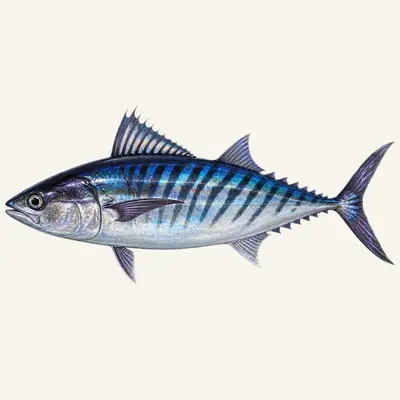
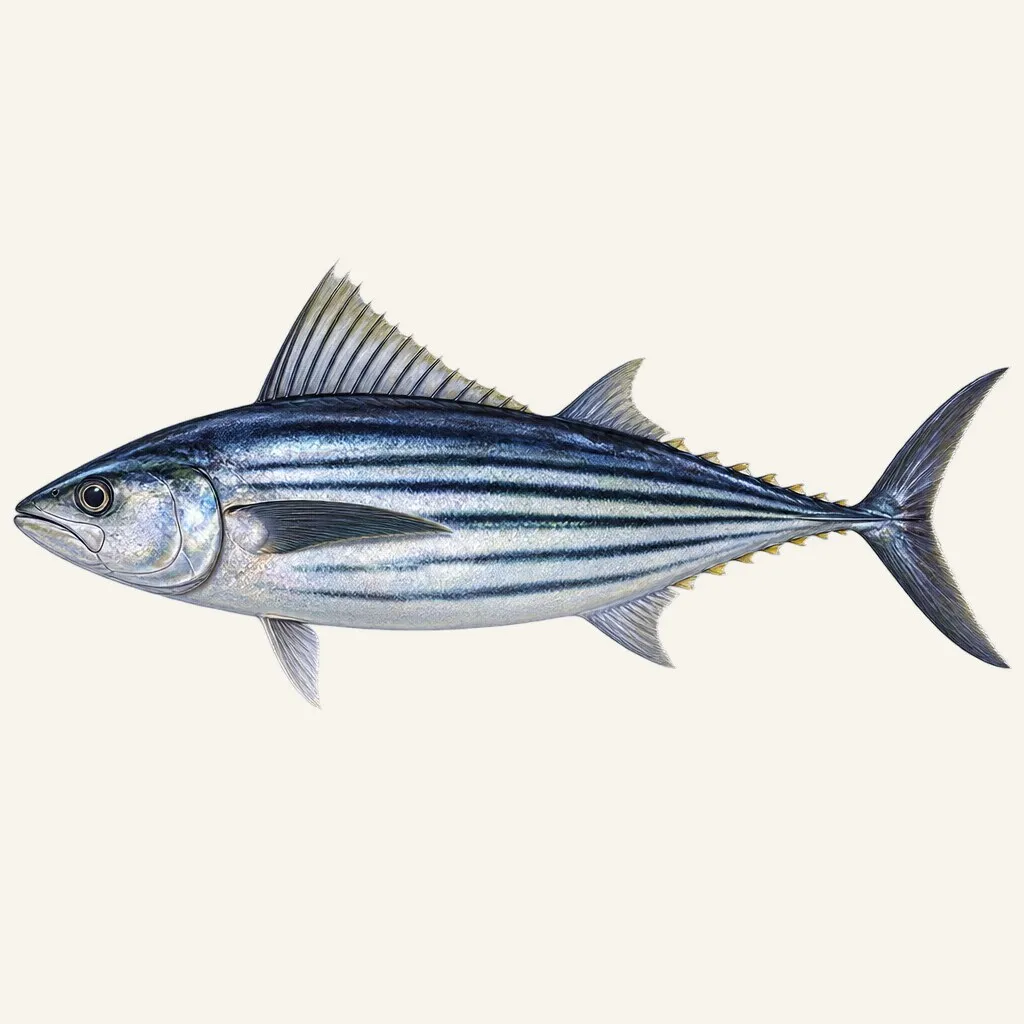
The Australian bonito is a medium-sized pelagic scombrid, easily identified by its dark oblique stripes on the back and its streamlined silver body. It inhabits coastal and epipelagic waters of the southern hemisphere, especially around Australia and New Zealand.
Calendar
Recorded in 3 countries
Australia · New Zealand · Norfolk Island
GBIF occurrence records — native and introduced populations combined.
Its range
No bonito occupies so small a range. South-eastern Australia, Norfolk Island and New Zealand: one continental shelf and two island blocks between 23 and 48 degrees south, and nothing beyond.
The confinement is surprising in an animal that migrates in open water, as the whole genus does, and could cross an ocean. Its congeners spread along entire continental fronts. The constraint is therefore not the capacity to move but the availability of water that suits: this warm-temperate corner of the south-western Pacific is the only place on earth where the species is found, and it is bounded on every side by water masses that do not serve.
Identifying it
This bonito breaks the rule of its genus. Its dorsal stripe lies closer to horizontal than that of any relative, and on some individuals it runs all the way down onto the belly, which none of the others does. A bonito whose pattern is laid flat and spills below the flank is this one and nothing else.
The counts support it: 45 or 46 vertebrae, 17 to 19 spines in the first dorsal, 13 to 18 soft rays in the second, and 14 to 17 in the anal fin.
A dissection detail separates it as well. Its spleen shows in lateral view, whereas in the other bonitos the organ has to be looked for from the belly. As throughout the genus, there is no swim bladder, and the whole body behind the corselet is covered in scales small enough to be missed.
The common length of the catch sits around 45 cm. The maximum length carried in the published summary cannot be reconciled with the heaviest published weight, and is best left out of any account of the fish.
Breeding
Maturation is observed from January through April, which runs from the southern summer into early autumn. It is the only calendar marker documented for the species, and it puts breeding in the warmest months of the Tasman Sea.
The rest of the cycle is undescribed. Neither the number of spawnings, nor fecundity, nor any spawning ground appears in the available record.
Areas
- Australian continental shelf
- Coastal upwelling zones
- Rocky headlands and points
- Neritic pelagic waters
Techniques
- Metal lure casting
- Coastal trolling
- Popper fishing
- Light jigging
Baits
- Silver metal lures
- Surface poppers
- Pilchards
- Squid
How to catch it
Shoals are sorted by size. A gathering holds fish of one calibre, which makes the first capture informative: it says what the rest of the group will give, and changing size means finding another shoal rather than changing method.
One line in the record says a great deal about where this fish stands in local practice: it is usually used as bait. An Australian bonito is most often what gets caught before the fishing starts, rigged whole or in chunks for the large pelagics of the same water. It also counts among recognised gamefish, and the two uses do not exclude one another.
The flesh deserves a mention, because it is not what a bonito is expected to give. It is light-coloured, delicate in flavour and cans well — where the genus has a reputation for dark, strong meat. A fish kept for the table is not a second choice here.
Regulations
Check the local regulations in force (legal size limits, closed seasons, bag limits).
For guidance only. Legal sizes, quotas and open seasons vary by location and season: always check the local regulations in force before fishing.
Other names
Australian bonito in every language of the catalogue, the country standing in for a descriptive character that nobody bothered to take up. That is the odd part, since this species carries the most distinctive marking in the genus and it went unused.
The genus name comes from a long way off. Latin sarda meant a salted fish out of Sardinia, and that western Mediterranean word ended up attached to an animal of the Tasman Sea — one of the more complete geographic displacements in the naming of sea fish. The epithet australis simply means southern.
Sources: fishbase.se · api.gbif.org